Virginia SOL Algebra 1 Free Worksheets: Printable SOL-Aligned Algebra 1 Practice, No Signup Needed
Ask any veteran Virginia math teacher what the hardest part of Algebra I really is, and the answer is almost never a topic. It is the transition. From middle school arithmetic to high school algebra is one of the bigger leaps a student takes in K-12 mathematics, and the leap is mostly cognitive rather than computational. The arithmetic does not get appreciably harder. What changes is what a student is asked to do with it: hold a variable in their head as a stand-in for any number, recognize that two visually different expressions can describe the same relationship, and follow a chain of reasoning across several lines of work. That kind of thinking is genuinely new, and it grows through small, specific reps with honest feedback.
Virginia Algebra I classrooms run across very different places, a Virginia Beach high school in an oceanfront district, a Norfolk school sharing buses with several others, a Richmond classroom near the state capitol, a Chesapeake school threaded through a residential commute. The course is the same, and so is the SOL Algebra I exam that closes it in the spring. What changes between students is how much specific, finished practice they get on each piece of the course before the test arrives.
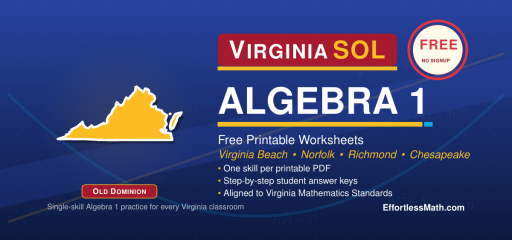
These sixty-seven free PDFs are designed to be that practice, one piece at a time, finished cleanly.
What’s on this page
Sixty-seven single-skill PDFs, each aligned to the Virginia Standards of Learning for Algebra I. The set covers the full SOL Algebra I arc: working with expressions and the properties of operations; solving linear equations and inequalities in one variable; understanding functions, their domains, their ranges, and their representations; graphing and writing the equations of lines, including parallel and perpendicular ones; solving systems by graphing, substitution, and elimination; manipulating exponents and radicals; performing polynomial operations and factoring; solving quadratics with multiple methods; and using statistical reasoning to describe real-world data. Each PDF stays inside a single SOL skill, so a sitting on “Writing the Equation of a Line” does not pull in factoring, and a sitting on “Solving Quadratics by the Quadratic Formula” does not sneak in exponent rules.
Every PDF opens with a one-page Quick Review. The skill is stated in plain English, with one worked example whose reasoning is visible at each step, plus a short note on the slip students most often make. Then twelve practice problems built to climb, gentle at the start, at SOL difficulty by the last few items. The final page is a student-facing answer key written in a friendly, tutoring tone, short enough to read in a minute and complete enough to teach.
Foundations of Algebra
Students meet the language of algebra here: naming unknowns, simplifying expressions, and using the rules that govern how numbers combine. Across Virginia, this is one of the skills that rewards regular reps.
- Variables, Expressions, and Properties
- Order of Operations and Evaluating Expressions
- Simplifying Algebraic Expressions
- Introduction to Equations and Solutions
- Personal Financial Literacy
Solving Linear Equations
The chapter drills the discipline of solving, clear, collect, isolate, across increasingly layered linear equations. It is worth the extra reps for Virginia learners aiming for a strong score on the SOL.
- Solving One-Step Equations
- Solving Two-Step Equations
- Solving Multi-Step Equations
- Equations with Variables on Both Sides
- Literal Equations and Formulas
Inequalities and Absolute Value
Ranges of solutions take over, graphing inequalities, reasoning through compound cases, and working with absolute value. Virginia Beach families can use these pages to lock the skill in before it’s tested.
- Solving One-Step Inequalities
- Solving Multi-Step Inequalities
- Compound Inequalities
- Absolute Value Equations
Relations, Functions, and Sequences
The function arrives, one input, one output, alongside domain, range, function notation, and sequences that behave like functions. In Virginia Beach classrooms it tends to separate confident students from hesitant ones.
- Relations and Functions
- Function Notation and Evaluating Functions
- Domain and Range
- Graphing Functions and Transformations
- Arithmetic Sequences as Linear Functions
- Geometric Sequences
- Comparing Functions
- Piecewise Functions
- Combining Functions
- Inverse Functions
Linear Functions and Their Graphs
The chapter is all about lines, finding slope, writing equations in several forms, and relating parallel and perpendicular slopes. Steady practice now makes the SOL feel far more manageable later.
- Slope-Intercept Form
- Point-Slope Form
- Standard Form of a Linear Equation
- Writing Linear Equations from Graphs and Tables
- Parallel and Perpendicular Lines
- Inverse Variation
- Understanding Graphs as Solution Sets
Systems of Equations and Inequalities
The chapter builds methods for solving systems and reasoning about where multiple constraints overlap. Master it early and the rest of the Virginia course leans on it with ease.
- Solving Systems by Graphing
- Solving Systems by Substitution
- Solving Systems by Elimination
- Applications of Systems of Equations
- Systems of Linear Inequalities
- Solving Linear-Quadratic Systems
Exponents, Polynomials, and Real Numbers
Powers, polynomials, and number sense combine, exponent rules, polynomial operations, and rational versus irrational numbers. It’s a frequent early hurdle for learners in Virginia Beach and across the state.
- Properties of Exponents
- Adding and Subtracting Polynomials
- Multiplying Polynomials
- Special Products of Polynomials
- Rational and Irrational Numbers
Factoring
Here expressions get taken apart, common factors first, then trinomials and the special products that factor cleanly. These worksheets give Virginia students focused, low-pressure practice.
- Greatest Common Factor and GCF Factoring
- Factoring Trinomials: \(x^2 + bx + c\)
- Factoring Trinomials: \(ax^2 + bx + c\)
- Factoring Special Products
Quadratic Functions and Equations
Curves replace lines: graphing parabolas and solving quadratics by factoring, square roots, completing the square, and the formula. For Virginia students, fluency here shows up directly on the SOL.
- Graphing Quadratic Functions
- Characteristics of Quadratic Functions
- Solving Quadratics by Factoring
- Solving Quadratics by Completing the Square
- Quadratic Applications and Modeling
Statistics and Probability
Students summarize and display data, read two-way tables and scatter plots, and reason about likelihood. Getting comfortable here pays off all the way through the SOL.
- Measures of Center and Spread
- Scatter Plots and Correlation
- Lines of Best Fit and Predictions
- Counting Principles
- Probability
- Two-Way Frequency Tables
Exponential Functions and Modeling
The final unit covers exponential growth and decay and how to tell exponential models from the others. Time spent here is time saved when the SOL rolls around.
More Topics
- Absolute Value Inequalities
- Direct Variation
- Displaying Data with Box Plots
- Displaying Data with Histograms
- Exponential Decay
- Graphing Cube Root Functions
- Graphing Square Root Functions
How to use these worksheets at home
A short list of practical suggestions worth more than a long one.
First, work in pairs. Algebra I is built like a chain, and the simplest productive week is two related sheets across two short evenings. Run “Solving Two-Step Equations” early in the week and “Solving Multi-Step Equations” a day or two later. Sit “Slope and Rate of Change” the night before “Slope-Intercept Form,” so the slope just computed becomes the m in y = mx + b. Pair “Factoring Trinomials” with “Solving Quadratics by Factoring,” and the second worksheet reads as the first one finished.
Second, respect short sittings. Twenty unbothered minutes on a single PDF, with a pencil and nothing else on the table, is enough. A finished worksheet teaches the brain something stable; a half-done pile teaches it that math is overwhelming. A Virginia ninth or tenth grader will do their most honest math when they are allowed to work alone, print the page, hand it over, and step away. The dignity of finishing alone is part of what makes the skill stick.
Third, treat the answer key as the closing move, never the opening one. Hand it over after the work is done. Have your student grade themselves, circle each miss, read the short explanation, and rewrite the corrected version on a clean line. That self-correction loop is the single habit that most reliably separates a student who walks into the SOL window feeling prepared from one who walks in hoping.
A note about the SOL Algebra I exam
Virginia administers the Standards of Learning (SOL) Algebra I assessment at the end of the course, with the spring window being the one most students sit. The test is built directly on the Virginia Standards of Learning for Algebra I, the same framework these worksheets are aligned to, so the items on the test and the items on these PDFs come from the same source. SOL Algebra I asks students to solve linear equations and inequalities, move between functions as tables, graphs, and equations, solve systems by multiple methods, manipulate expressions involving exponents and radicals, factor and solve quadratic expressions, and apply statistical reasoning to real-world data. Virginia uses SOL Algebra I scores as part of a student’s verified-credit record in mathematics, which is why the spring window deserves a calm, months-long run-up.
Because each PDF on this page isolates a single SOL standard, the set functions as a personal pre-SOL checklist. Print a sheet. See how it goes. If it lands cleanly, move on; if it stalls, the next sheet to print is usually the one whose title names the prerequisite skill, a faster route than re-reading a textbook from cover to cover. Run through the list this way in the weeks before May, and the test screen will be full of vocabulary that has been on the kitchen table for months.
A short closing
The SOL Algebra I exam is a real milestone in a Virginia high school career, and the calmest way to meet it is page by page through the months leading up to it. Bookmark this page, print the one PDF whose title names a skill that feels almost-but-not-quite solid, and let your Virginia student start there tonight. By spring, the staircase will have built itself behind you a step at a time, and the test on the screen will look very much like the work that has been on your kitchen table all year.
New to Algebra? Start with the basics


Related to This Article
More math articles
- Rosie the Riveter, Child Care, and Women’s Wartime Work
- Math for Programmers: The Practical Topics Every Coder Should Know in 2026
- How to Prepare for the HiSET Math Test?
- TABE Math Formulas
- Full-Length TSI Math Practice Test-Answers and Explanations
- Congressional oversight
- North Carolina EOG Grade 8 Math Free Worksheets: Printable EOG-Ready Practice, Answers Included
- The Best Grade 5 ELA Practice Tests for Washington Students
- How to Prepare for the CLEP College Algebra Test?
- Distractors, Pacing, and Educated Guessing on Vocabulary Questions











What people say about "Virginia SOL Algebra 1: Free Worksheets"?
No one replied yet.