Common Core Algebra 1 Free Worksheets: 64 Free Printable PDFs Aligned to CCSS Algebra 1
It is easy to forget how much of Algebra 1 is invisible work. The visible part, the equations, the graphs, the answer at the bottom of the page, is what gets graded, so it is what students and parents focus on. But the actual learning underneath is structural. A student is slowly building a mental model of how a variable behaves, how an expression can be rewritten without changing its value, how a function takes an input and gives back exactly one output, and how a graph is a picture of every solution at once. By the end of the year, those ideas have to be solid enough to carry into geometry, Algebra 2, and any data or science course that involves a relationship between quantities. They get solid through practice on small, specific skills.
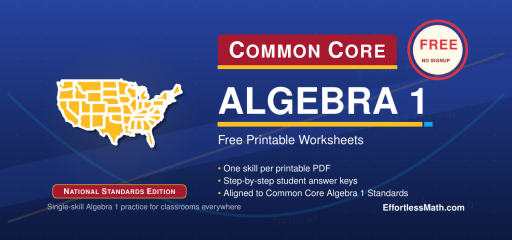
This page is a collection of 64 free PDFs aligned to the Common Core State Standards for Algebra 1. Whether a student is in a Common Core state, in a homeschool that follows the CCSS framework, or in a classroom whose standards are Common Core-aligned under a different name, the topics here are the topics the course is built around. Each worksheet does one job: one skill, one worked example, one short set of practice, one answer key in plain language.
Free, printable, no account, no email. The point is to lower the friction between a student and the next page of practice.
Pre-Algebra for Beginners 2026 The Ultimate Step by Step Guide to Preparing for the Pre-Algebra Test
What’s on this page
Sixty-four single-skill worksheets aligned to the Common Core State Standards for Mathematics, Algebra 1. The set covers the breadth of the framework: writing and simplifying algebraic expressions, the properties of operations, solving linear equations across all the standard forms, one-step, two-step, multi-step, variables on both sides, literal, plus inequalities and absolute-value equations. From there, functions, relations, domain and range, arithmetic and geometric sequences, slope, lines in slope-intercept, point-slope, and standard form, parallel and perpendicular lines, direct and inverse variation, systems of equations and inequalities, and linear-quadratic systems. Then exponent rules, polynomial operations and special products, factoring trinomials, three methods for solving quadratics, statistics, probability, and exponential growth and decay.
Every PDF opens with a Quick Review: the skill stated in plain language, one worked example carried through start to finish, and a short note about where students most often slip. Twelve practice problems follow, building from easy to harder. The last page is a student-facing answer key with friendly tutoring-style explanations, readable by a ninth grader on their own, so a parent doesn’t need a strong math background to support their student through the page.
Foundations of Algebra
This chapter lays the groundwork, moving from numbers to letters and putting properties and order-of-operations to work on real problems. Master it early and the rest of the Common Core course leans on it with ease.
- Variables, Expressions, and Properties
- Order of Operations and Evaluating Expressions
- Simplifying Algebraic Expressions
- Introduction to Equations and Solutions
- Personal Financial Literacy
Solving Linear Equations
Now the central skill of the course: isolating a variable, from one clean step through multi-step solves and rearranging formulas. It’s a frequent early hurdle for learners in classrooms nationwide and across the state.
- Solving One-Step Equations
- Solving Two-Step Equations
- Solving Multi-Step Equations
- Equations with Variables on Both Sides
- Literal Equations and Formulas
Inequalities and Absolute Value
Here a single answer becomes a set: solving and graphing inequalities, handling the sign-flip rule, and unpacking absolute value. These worksheets give Common Core students focused, low-pressure practice.
- Solving One-Step Inequalities
- Solving Multi-Step Inequalities
- Compound Inequalities
- Absolute Value Equations and Inequalities
Relations, Functions, and Sequences
This unit introduces function thinking: notation, inputs and outputs, and the patterns that arithmetic and geometric sequences follow. For Common Core students, fluency here shows up directly on the Common Core.
- Relations and Functions
- Function Notation and Evaluating Functions
- Domain and Range
- Graphing Functions and Transformations
- Arithmetic Sequences as Linear Functions
- Geometric Sequences
- Graphing Square Root, Cube Root, and Piecewise Functions
- Comparing Functions
- Combining Functions
- Inverse Functions
Linear Functions and Their Graphs
Linear graphs take focus: slope, intercepts, point-slope and slope-intercept forms, and special line relationships. Getting comfortable here pays off all the way through the Common Core.
- Slope and Rate of Change
- Slope-Intercept Form
- Point-Slope Form
- Standard Form of a Linear Equation
- Writing Linear Equations from Graphs and Tables
- Parallel and Perpendicular Lines
- Direct and Inverse Variation
- Understanding Graphs as Solution Sets
Systems of Equations and Inequalities
Here several equations are solved together, and systems of inequalities mark out whole regions of valid solutions. Time spent here is time saved when the Common Core rolls around.
- Solving Systems by Graphing
- Solving Systems by Substitution
- Solving Systems by Elimination
- Applications of Systems of Equations
- Systems of Linear Inequalities
- Solving Linear-Quadratic Systems
Exponents, Polynomials, and Real Numbers
The algebra of powers and polynomials: exponent rules, adding and multiplying polynomials, special products, and real numbers. Across Common Core, this is one of the skills that rewards regular reps.
- Properties of Exponents
- Adding and Subtracting Polynomials
- Multiplying Polynomials
- Special Products of Polynomials
- Rational and Irrational Numbers
Factoring
Students learn to rewrite polynomials as products: greatest common factor, trinomial factoring, and recognizable special forms. It is worth the extra reps for Common Core learners aiming for a strong score on the Common Core.
- Greatest Common Factor and GCF Factoring
- Factoring Trinomials: \(x^2 + bx + c\)
- Factoring Trinomials: \(ax^2 + bx + c\)
- Factoring Special Products
Quadratic Functions and Equations
The chapter covers parabolas and three solution paths for quadratics, plus what the discriminant reveals. Classrooms nationwide families can use these pages to lock the skill in before it’s tested.
- Graphing Quadratic Functions
- Characteristics of Quadratic Functions
- Solving Quadratics by Factoring
- Solving Quadratics by Completing the Square
- The Quadratic Formula and the Discriminant
- Solving Quadratics by Square Roots
- Quadratic Applications and Modeling
Statistics and Probability
Data analysis and probability close out the core, from box plots and histograms to counting principles. In classrooms nationwide classrooms it tends to separate confident students from hesitant ones.
- Measures of Center and Spread
- Displaying Data: Histograms and Box Plots
- Scatter Plots and Correlation
- Lines of Best Fit and Predictions
- Probability and Counting Principles
- Two-Way Frequency Tables
Exponential Functions and Modeling
Here change compounds: exponential growth and decay, their graphs, and comparisons among model families. Steady practice now makes the Common Core feel far more manageable later.
- Graphing Exponential Functions
- Exponential Growth and Decay
- Comparing Linear, Quadratic, and Exponential Models
- Interpreting Functions and Parameters
How to use these worksheets at home
A worksheet set is most useful when it tracks what is actually being taught in class right now, so think of these 64 PDFs as a library to pull from rather than a sequence to march through. If your student is in a unit on linear equations this week, print those pages this week. When the class moves to functions, switch to the function pages. The standards are designed to build, and so are the worksheets, but the order they show up in your student’s curriculum will be unique to that classroom.
The other thing that helps is pairing related skills. The Common Core framework is full of clusters that lean on each other. “Solving Two-Step Equations” sits right next to “Solving Multi-Step Equations”, do them on consecutive days, not the same afternoon, so the easier one has time to settle. “Slope and Rate of Change” is the conceptual setup for “Slope-Intercept Form”, practice the rate-of-change idea first and the formula stops feeling like memorization. “Factoring Trinomials” is the prerequisite for “Solving Quadratics by Factoring”, give factoring its own week before adding the equation step. These pairings are how the math actually builds.
The students using these pages are fourteen and fifteen. They are old enough to handle their own homework, and they often do better when nobody is hovering. Print the PDF the night before, leave it on the desk, and walk away. Keep the answer key out of sight until the work is done. After the page is finished, take ten quiet minutes together to read the explanations for any wrong answers. That short review, not a lecture, just reading the reasoning side by side, is where understanding actually consolidates.
A note about Common Core Algebra 1
The Common Core State Standards for Mathematics define what a student is expected to know and do at each level of K, 12 math, including Algebra 1. Adopted by a large majority of states, and used as the underlying framework for many state standards that have since been renamed, the CCSS Algebra 1 standards are built around a small set of big ideas: seeing structure in expressions, creating and reasoning with equations, working with functions as objects, modeling relationships between quantities, and analyzing data. The standards do not prescribe a specific test. Common Core Algebra 1 is assessed through whatever exam a given state uses, Smarter Balanced, an ACT-based system, a state-specific end-of-course exam, or ongoing classroom assessment, and through the cumulative readiness a student brings into the next math course.
That structure is exactly what makes single-skill practice valuable. Because the standards are organized into clusters of related skills, working through one PDF at a time mirrors the way the framework is built. After a unit, the relevant worksheets work like a checklist: the standards inside that unit either feel solid or they don’t, and the ones that don’t get another short, focused session. Over a year, that habit produces fluency that survives whatever specific test a student happens to face.
A short closing
Algebra 1 yields to patient, specific work more than to long stretches of “studying math.” Bookmark this page, pick one standard that feels almost-but-not-quite there, and print that PDF tonight. Tomorrow morning, when the page is on the desk and the next step is clear, a ninth grader can take a real step forward, and over a year, those small steps add up to a course that actually makes sense.
New to Algebra? Start with the basics


Related to This Article
More math articles
- Top 10 Tips to Create an ASVAB Math Study Plan
- 6th Grade North Carolina End-of-Grade Math Worksheets: FREE & Printable
- How to Factor and Simplify Trigonometric Expressions
- The Ultimate ACT Math Course (+FREE Worksheets & Tests)
- The Best Grade 5 ELA Practice Tests for Washington Students
- Electromagnetic Waves and Communication
- The income effect follows real purchasing power
- How Math Can Help You Win At Poker?
- Prospective voting
- Free Grade 4 English Worksheets for Kansas Students











What people say about "Common Core Algebra 1: Free Worksheets"?
No one replied yet.