YOUR GED STUDY COMPANION
How to Pass the GED Math Test in 30 Days (A Realistic Plan, Not a Cram Session)
Give your GED Math preparation a clear next step. Use the guide below to build a routine you can follow.
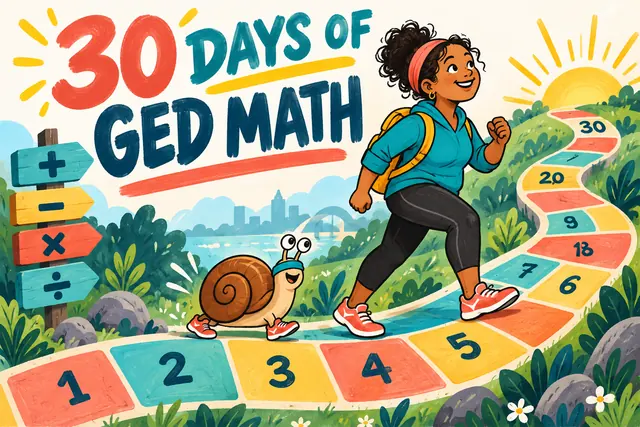
A 30-day GED math plan can organize your review, but it cannot guarantee a passing score. Your starting skills, study time, and practice results determine whether one month is realistic. If the basics still feel unfamiliar, allow more time before booking the test.
Begin by checking your number skills and basic algebra. Use missed problems to choose a focused lesson, then practice that skill again before moving on. The weekly plan below is a starting schedule, not a deadline that every learner must meet.
Let me lay it out for you the way I’d lay it out for a student sitting at my kitchen table.
What “Passing” the GED Math Test Actually Means
Here’s the system in plain language:
- The GED math test (officially called the Mathematical Reasoning test) is scored from 100 to 200.
- You need a 145 to pass.
- A score of 165 is “College Ready”, useful if you’re heading to college after.
- A score of 175 is “College Ready + Credit”, can earn you college math credit in some places.
For most people, the goal is 145. That’s it. You don’t need to ace this test. You need to get a passing grade.
What does 145 actually require? Roughly, you need to get about 60 to 65% of your points. That means you can miss a fair number of questions and still pass. This is important to internalize, because the worst thing you can do on test day is freeze on a hard question. You’re allowed to miss them. Skip, guess, move on.
What’s on the Test (The Honest Breakdown)
The GED math test is 46 questions in 115 minutes. About 2.5 minutes per question average. There are two sections:
Section 1 (first 5 questions): No calculator. This sounds scary. It isn’t. The no-calculator questions are usually basic arithmetic or estimation. You can absolutely do them with paper.
Section 2 (remaining 41 questions): Calculator allowed. You can use an on-screen Texas Instruments TI-30XS, which is provided. You can also bring your own physical TI-30XS if you have one and the test center allows it.
The content breaks down roughly like this:
- Number sense and operations (about 25%): fractions, decimals, percents, ratios, proportions
- Algebra and functions (about 55%): linear equations, linear inequalities, quadratics, exponents, graphing
- Geometry (about 15%): area, perimeter, volume, surface area, Pythagorean theorem
- Data analysis and probability (about 5%): mean, median, mode, basic probability, reading graphs
That algebra number is the one that surprises people. Over half of the test is algebra. If you focus your prep on anything, focus it there.
The 30-Day Plan
I’m going to give you week by week. Each week assumes about 90 minutes a day, 6 days a week. That’s roughly 9 hours per week, 36 hours over the month. If you can do more, go for 2 hours a day. If you can only do 60 minutes, stretch the plan to 6 weeks.
Week 1: Diagnose and Lock Down Fractions, Decimals, Percents
The single biggest reason adults fail the GED math test isn’t algebra. It’s shaky fundamentals. Specifically: fractions, decimals, and percents. If you can’t comfortably go between these three (1/4 = 0.25 = 25%), nothing else will stick.
Day 1: Diagnostic. Take a free GED math practice test. The GED Testing Service has free ones at GED.com. Score yourself. Don’t worry about the number. You’re not “ready” yet. You’re collecting data on where to focus.
Days 2 to 3: Fractions. Adding, subtracting, multiplying, dividing fractions. Mixed numbers. Improper fractions. If you can’t fluently do 2 1/3 + 1 1/2 with paper, drill until you can.
Days 4 to 5: Decimals. Adding, subtracting, multiplying, dividing decimals. Converting decimals to fractions and vice versa.
Day 6: Percents. Finding a percent of a number. Finding what percent one number is of another. Tip and tax problems. Increase/decrease percents.
By the end of week 1, you should be able to look at any fraction, decimal, or percent problem and not freeze. You won’t be fast yet. That’s fine.
Week 2: Linear Equations and Word Problems
This is the heart of the test. Spend the week here.
Day 1: Solving one-step equations. x + 5 = 12. 3x = 24. X/4 = 7. Make sure you can do these in your sleep.
Day 2: Two-step and multi-step equations. 2x + 5 = 17. 3(x – 4) = 18. Equations with variables on both sides like 4x + 3 = 2x + 11.
Day 3: Word problems → equations. “John is 5 years older than Maria. Together their ages add to 27. How old is each?” Practice translating English into equations. This is the skill the GED tests over and over.
Day 4: Linear inequalities. x + 3 > 7. Solve and interpret. Know that multiplying or dividing by a negative flips the inequality.
Day 5: Slope and y-intercept. Given two points, find the slope. Given a slope and y-intercept, write the equation. Given an equation, identify the slope and y-intercept.
Day 6: Practice section. 20 questions from the algebra section of a GED prep book. Time yourself. Review every miss.
Week 3: Geometry, Data, and Quadratics
Wider range this week, less depth on each topic.
Day 1: Area and perimeter. Rectangles, triangles, circles. Memorize the formulas.
Day 2: Volume and surface area. Rectangular prisms, cylinders. The formula sheet on the test gives you the formulas, your job is to know what to plug in.
Day 3: Pythagorean theorem. a² + b² = c². Practice in word problems (ladder against a wall, diagonal of a rectangle, distance between two points).
Day 4: Mean, median, mode, basic probability. Easy points. Don’t skip them.
Day 5: Quadratic equations and the quadratic formula. Factoring simple quadratics (x² + 5x + 6 = 0). Using the quadratic formula for the harder ones. You don’t need to be an expert, just be able to recognize quadratics and have a tool to solve them.
Day 6: Practice section. 20 questions across the topics from this week. Review every miss carefully.
Week 4: Full-Length Practice, Pacing, and Targeted Review
The last week is where most students panic-cram. Don’t. The last week is for pacing and targeted gap-filling, not for learning new things.
Day 1: Full-length practice test #1. Time yourself. 115 minutes for 46 questions. Sit somewhere quiet. No phone. Score it.
Day 2: Review every miss from day 1. Don’t move on. Understand what went wrong on each one. Was it a concept you didn’t know? A careless mistake? Did you run out of time?
Day 3: Targeted drill. Pick the single weakest concept area from your practice test. Spend the day there.
Day 4: Full-length practice test #2. Time it. Don’t peek at the score until you’re done.
Day 5: Review. Same drill as day 2. Look for patterns, are you missing the same kinds of problems?
Day 6: Rest day, or light review. No new material. Don’t take another practice test. Reread your notes. Eat well. Sleep.
Day 7: Test day.
Test-Day Tips That Actually Matter
I’ve watched a lot of students get tripped up by things that have nothing to do with math. Here’s the test-day playbook.
Eat a real breakfast. Not a sugary one. Eggs, toast, fruit. Something that doesn’t crash you 90 minutes in.
Get there 30 minutes early. Testing centers are stressful when you’re rushing.
Read the question twice before looking at the answer choices. This is the single most important tactical move on the GED math test. People miss easy questions because they answered what they thought the question said, not what it actually said.
Use the calculator strategically. The TI-30XS is powerful, but for simple arithmetic, your head is faster. Save the calculator for messy decimals, multi-step computations, and anything with parentheses.
Skip the hard ones and come back. You have 115 minutes. If a question is taking more than 3 minutes, flag it, guess if you have to, and move on. The hardest questions are worth the same as the easiest ones.
Use the formula sheet. It’s right there. Don’t try to memorize formulas you can look up in 5 seconds.
Watch for “select all that apply” questions. A few questions have multiple correct answers. The instructions tell you when. Read the instructions.
A Realistic Talk About What 30 Days Is and Isn’t Enough For
I told you up front I’d be straight with you, so let me be straight with you here.
30 days IS enough time if:
- You finished high school math at some point (even if it was 20 years ago)
- You can comfortably do fractions, decimals, and percents with paper and effort
- You can commit 90 minutes a day, 6 days a week
- You’re willing to take 2 full-length practice tests in the last week
30 days is NOT enough time if:
- You can’t fluently do basic arithmetic (multiplication tables, subtraction with borrowing)
- You have severe math anxiety that makes you freeze on problems
- You can only commit a few hours a week, not a few hours a day
- You’re aiming for a 165 or higher (College Ready) rather than just passing
If you’re in the “not enough time” category, don’t despair. Just give it 8 to 12 weeks instead. The plan is the same. You just stretch each week into two.
The Formulas the Test Gives You (And the Ones It Doesn’t)
The GED math test provides a formula sheet. You can refer to it during the test. It includes:
- Area, perimeter, surface area, volume formulas for common shapes
- Pythagorean theorem
- Quadratic formula
- Slope formula
- Simple and compound interest formulas
- Distance, rate, time formula
What’s not on the formula sheet (you have to know these):
- Order of operations (PEMDAS)
- How to manipulate fractions, decimals, percents
- How to solve linear equations
- How to graph a line given an equation
- The slope-intercept form (y = mx + b), though slope formula is provided
So you don’t need to memorize formulas for area or the quadratic formula. You need to know how to use them. Practice the using, not the memorizing.
A Note on Math Anxiety (Because It’s Real)
I work with a lot of adults who are coming back to math after decades away, and almost all of them carry some version of “I’m bad at math” or “math wasn’t my subject.” If that’s you, I want to say two things.
First: math isn’t a subject you’re either good at or bad at. It’s a set of skills you either practiced or didn’t. The adults who struggle with math aren’t broken. They just stopped practicing somewhere around 10th grade, and skills atrophy. The 30 days of focused practice in this plan will rebuild more skill than you’d think possible.
Second: if you’ve decided to take the GED, you’ve already done the hard part. You decided your education matters enough to fight for. The math test is a hurdle, not a verdict. Lots of people on the other side of a GED struggled with the math section. Lots of them passed on their second or third try. There is no shame in needing to retake it. There is a lot of pride in eventually getting it done.
Free vs. Paid Practice Resources
For free practice, the GED Testing Service at GED.com has official practice questions. Use those. They’re the closest thing to the real test that exists.
For paid practice, the best money you’ll spend is on a GED-specific math workbook organized by topic, not a general “GED prep” book that tries to cover all four subject tests. Our GED math prep books at EffortlessMath are organized by content area with worked examples and full-length practice tests. They include topic reviews you can use during week 2 and week 3 of this plan.
Honestly, one good workbook + the free official practice tests is enough. You don’t need to buy six things.
The Bottom Line
The GED math test is passable. It’s not easy, but it’s not impossible, and you don’t need to ace it, you need to pass it. A 145 out of 200 is the bar. You can miss a third of the questions and still pass.
Use your practice results to decide whether to test or extend the review. Adjust this schedule to your available time; consistent study and careful correction matter more than finishing on an exact date.
Most people pass. You can too. Show up, do the work, treat the test like a checkpoint instead of a judge.
You’ve got this.
Looking for GED math prep that matches the actual test? Our GED math collection at EffortlessMath includes topic workbooks and full-length practice tests in the real format, organized for adult learners coming back to math.
Confirm readiness with current GED guidance
Review the official GED subject information and use our GED learning hub to find lessons and subject paths. Effortless Math practice scores do not replace official readiness or testing requirements.

Related to This Article
More math articles
- 5 Tips for Surviving a Statistics Course
- 10 Must-Have Math Teacher Supplies
- Basic Probability in Science
- Incidence, Prevalence, and the Organization of Health Care
- 6th Grade Georgia Milestones Assessment Math Worksheets: FREE & Printable
- FREE OAR Math Practice Test
- How to Use Partial Products to Multiply Two-Digit Numbers By Two-digit Numbers
- Using Diagrams to Model and Solve Equations
- DNA, RNA, and Protein Synthesis
- The Best Algebra 1 Book for Minnesota Students














What people say about "30-Day GED Math Study Plan: Review & Readiness"?
No one replied yet.