How to Pass the CLEP College Math Exam: Skip a Semester in 2026

Most colleges require students to complete a math course in the first or second year, and most students would rather not. The College-Level Examination Program (CLEP) lets you skip that course for about $95, in 90 minutes, with a single test. The CLEP College Mathematics exam is one of the most popular and most “passable” exams in the entire CLEP catalog. This 2026 guide explains exactly what’s on the test, who should take it, and how to prepare in three to six weeks.
What Is the CLEP College Math Exam?
CLEP is administered by College Board (yes, the same organization behind the SAT and AP). Each CLEP exam is designed to certify mastery of one introductory college course. CLEP College Mathematics specifically covers the material in a typical non-STEM “math for liberal arts” or “quantitative reasoning” college course, the kind required of English majors, communications majors, education majors, and so on.
Two things to know up front:
- CLEP College Mathematics is not college algebra. That’s a different CLEP exam (CLEP College Algebra). College Mathematics is gentler and covers more breadth, less depth.
- CLEP exams are accepted at over 2,900 colleges, but each school decides which CLEPs they accept and what minimum score earns credit. Always check your target school’s CLEP policy before testing.
What’s on the Test?
The CLEP College Mathematics exam has 60 multiple-choice questions in 90 minutes and an on-screen calculator. The breakdown:

| Content area | Approx % of exam |
|---|---|
| Algebra and functions | 20% |
| Counting and probability | 10% |
| Data analysis and statistics | 15% |
| Financial mathematics | 20% |
| Geometry | 10% |
| Logic and sets | 15% |
| Numbers | 10% |
What each area looks like:
- Algebra and functions: linear equations, simple inequalities, function notation, evaluating expressions. No heavy quadratics or polynomial factoring.
- Counting and probability: simple probability, combinations and permutations, expected value (basic).
- Data analysis and statistics: mean, median, mode, range, simple probability distributions, reading charts.
- Financial mathematics: compound interest, simple interest, present and future value, loan basics, percent change. This is the surprisingly large slice many students underprepare for.
- Geometry: area, perimeter, volume, Pythagorean theorem, basic angle relationships.
- Logic and sets: truth tables (yes, real ones), conditional statements, set notation, Venn diagrams.
- Numbers: rational vs irrational, scientific notation, prime factorization, divisibility.
Notice what is not there: no calculus, no advanced trigonometry, no advanced algebra (no rational expressions, no logarithms beyond the most basic).
What Score Do You Need to Pass?
CLEP scores range from 20 to 80. The American Council on Education (ACE) recommended passing score is 50. Most colleges that accept CLEP credit honor this 50 cutoff, though some prestigious schools require 60 or 65 for credit. Always verify with your target school’s CLEP policy before testing.
A 50 corresponds roughly to answering about 60% of questions correctly, meaningful breathing room, especially given the calculator and easier algebra content.
Who Should Take CLEP College Math (And Who Shouldn’t)?
Take it if:
– You’re a non-STEM major facing a “math for liberal arts” requirement.
– You’re an adult learner returning to school and want to skip a remedial sequence.
– You’re a high schooler dual-enrolling and want to bank general-education credit.
– You’re comfortable with high-school-level math (Algebra 1, basic Geometry) and just need to brush up.
Take a different exam if:
– Your major requires calculus. You need a different prereq.
– Your school requires College Algebra specifically, take CLEP College Algebra instead. Same length, but algebra-only and harder.
– You haven’t seen math in 15+ years and the topic list above looks foreign, a community-college brush-up course may be cheaper insurance.
A 4-Week CLEP College Math Study Plan
The CLEP is so format-stable and the content so well-defined that a focused four-week plan is enough for most students who already know high-school algebra.
Week 1, Diagnose and refresh. Take a full free practice test. Sort missed items by topic. Watch one short refresher video per weak topic. Don’t time yourself yet.
Week 2, Drill the heavy topics. Algebra/functions and financial math together make up 40% of the test. Spend the bulk of Week 2 on these two:
– Linear equations and inequalities, function notation, evaluating expressions
– Simple interest, compound interest, present value, percent change, loan-payment basics
Week 3, Logic, sets, probability. These three areas combined are another 25 to 30% of the test, and they’re heavily skill-based once you’ve practiced. Focus on truth tables, Venn diagrams, conditional statements, basic probability, and expected value.
Week 4, Timed mocks. Take two full 60-question mocks under real timing (90 minutes). Review every miss. By Friday of Week 4 your score should plateau within striking distance of a 50.
If you’ve already taken the SAT or ACT recently and scored well, your timeline collapses, many students prep in two focused weeks.
Five CLEP Strategies That Move Scores

- Use the on-screen calculator. It’s a basic four-function calculator. Practice with it before test day so it doesn’t slow you down, especially for financial math compound-interest calculations and probability fractions.
- Eliminate ruthlessly. Each question has five answer choices. Eliminating two before guessing gives you a 33% shot, and there’s no wrong-answer penalty.
- Skip and circle back. You can mark questions for review. Use it for any item that takes more than 90 seconds.
- Pre-memorize four financial-math formulas. Compound interest A = P(1+r/n)^(nt), simple interest I = Prt, percent change (new − old)/old, present value PV = FV/(1+r)^t. These four formulas net students 8 to 12 points on average.
- Pre-memorize the basic probability rules. P(A or B) = P(A) + P(B) − P(A and B); P(A and B) = P(A) × P(B|A); expected value = Σ x·P(x). The probability section rewards students who recognize the formula instantly.
Where and How to Take the Test
CLEP exams are delivered at CLEP test centers (mostly on college campuses) and via online proctored at-home administrations. The fee is $95 as of 2026, plus a small testing-center fee at in-person sites. Score reports are typically available immediately after the exam (except for written essay sections, College Math has none).
If you fail, you may retake the exam after a three-month wait.
What Parents (and Adult Learners) Should Know
- Verify CLEP acceptance at your specific college first. Not all schools accept all CLEPs, and minimum passing scores vary.
- Check whether CLEP credit fills a requirement or just fills electives. Schools sometimes accept the credit but won’t use it to satisfy the core math requirement. Read your transfer-credit policy carefully.
- Active-duty military and many veterans get CLEP fee waivers. DANTES funding covers CLEP testing for eligible service members.
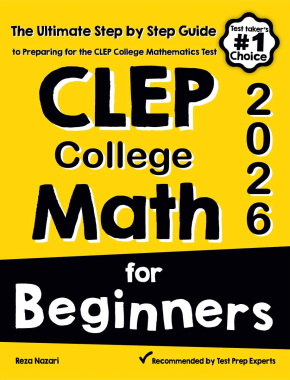
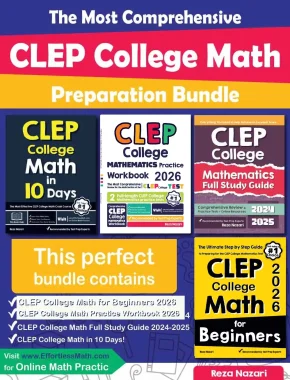
- Budget for one practice book. The official CLEP Official Study Guide from College Board is well calibrated. EffortlessMath and several free YouTube series provide additional drills.
Free CLEP College Math Resources Worth Using
- CLEP College Mathematics Practice Test at clep.collegeboard.org, official sample questions.
- EffortlessMath CLEP Math Practice, full-length practice tests by topic.
- Khan Academy, for foundational fluency in Algebra 1, probability, and statistics.
- Modern States Education Alliance, free CLEP prep courses that, after completion, can earn you a CLEP fee voucher.
Frequently Asked Questions
Is CLEP College Math easier than CLEP College Algebra?
Generally yes. College Math is broader and gentler; College Algebra is narrower and harder. If you’re stronger at algebra, take College Algebra. If you’d rather avoid heavy algebra, take College Math.
Can I use a calculator?
Yes, an on-screen basic four-function calculator is provided. You may not bring your own.
What if I fail?
Wait three months, study the topics you missed, and retake. The retake fee is the same $95.
How long is the score valid?
CLEP scores are valid for 20 years for transferring credit, though many colleges have shorter policies (often 10 years).
Is CLEP recognized for graduate school admissions?
CLEP is for undergraduate credit only. It does not factor into graduate admissions.
The Bottom Line
CLEP College Mathematics is one of the cheapest, fastest, and most reliable ways to skip a required college math course in 2026. Four weeks of focused study, two full timed mocks, a calculator routine, and the four financial-math formulas committed to memory. That’s the recipe. For students who pass, the savings are dramatic: one $95 test replaces a full $1,500, $2,500 course, and you bank a few months of time you can spend on classes that matter to your major.

Related to This Article
More math articles
- The Best Grade 8 ELA Practice Tests for Wyoming Students
- Free Grade 4 English Worksheets for Vermont Students
- How to Convert, Compare, Add, and Subtract Mixed Customary Units?
- Arkansas ATLAS Algebra 1 Free Worksheets: 72 Free PDF Worksheets with Friendly Answer Keys
- ASVAB Math-Test Day Tips
- Divide and Conquer: How to Tackle Word Problems with Division Facts up to Twelve
- Top 10 3rd Grade PSSA Math Practice Questions
- Grade 2 English Practice for Kansas Second Graders
- How Viruses Replicate: Life Cycles and Practice Questions
- Advanced Vocabulary Words: Abate to Ardent











What people say about "How to Pass the CLEP College Math Exam"?
No one replied yet.