Coins, Roulette, and Baccarat: A Field Guide to the Gambler’s Fallacy
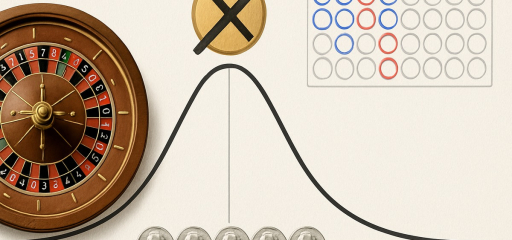
The gambler’s fallacy is everywhere. You’ll see it in casinos, sure and in sports bars after a losing streak, in lottery ticket lines after a number hasn’t hit for months, in group chats debating which red-black casino outcomes are “due.” It’s one of the most common mistakes in probability, and one of the easiest to feel in your bones. If a coin lands heads five times in a row, tails suddenly feels overdue. If a roulette wheel goes black, black, black again, red starts to seem like it’s waiting its turn. Watch a baccarat scoreboard fill with Banker wins, and pretty soon players begin to feel that Player must be next.
The problem? “Feels overdue” and “mathematically more likely” aren’t the same thing. Not even close. In most gambling situations, each outcome follows the same rules as the last one. A streak might be surprising, expensive, or dramatic. But it doesn’t create a correcting force. That’s the core of this field guide.
Coins, roulette, and baccarat teach the same lesson three different ways: randomness can make patterns without making promises. (This is educational, not gambling advice. Real-money gambling should be limited to adults where it’s legal, and if you feel unable to control gambling, reach out to the National Council on Problem Gambling.)
What Is the Gambler’s Fallacy?
The gambler’s fallacy is simple: the belief that a random event becomes more or less likely just because of what happened recently. The classic setup is straightforward. After several heads in a row, a person believes tails is “due.” It feels reasonable, after all, a fair coin should be roughly 50% heads and 50% tails, so a run of heads looks like a debt tails must eventually repay.
Here’s what the math actually says: A fair coin does move toward 50-50 in the long run. True. But that long-run balance doesn’t require the next toss to fix the recent streak. Each toss stands alone. The coin has no memory, no sense of fairness, no obligation to make your recent sequence look neat or balanced.
Probability courses call this independence. If two events are independent, one happening doesn’t change the probability of the other. MIT OpenCourseWare’s probability resources use coin flips to demonstrate: a future toss’s probability doesn’t shift just because a previous one landed a certain way. That independence, and our misunderstanding of it, is where the gambler’s fallacy lives.
If you want to connect this back to basics, check Effortless Math’s guide on finding the probability of an event. Probability’s about favorable outcomes under the actual rules of the game. It’s not about what would feel balanced after a streak.
The Coin Toss Example: Why Tails Isn’t Due
Imagine a fair coin has just landed heads five times in a row.

Heads. Heads. Heads. Heads. Heads.
What’s the probability the next toss is tails? Still 1/2, or 50%, assuming the coin is fair and each toss is independent. Nothing’s changed.
The confusion comes from mixing two totally different questions, and they really do sound similar:
- Before any tosses: What’s the probability of getting six heads in a row?
- After five heads have happened: What’s the probability the next toss is heads?
Before you start? Six heads in a row has probability 1/2 × 1/2 × 1/2 × 1/2 × 1/2 × 1/2 = 1/64. That’s rare.
But here’s the key: once those five heads have already happened, they’re not uncertain anymore. They’re history. The coin’s work is done on those tosses. The only uncertain piece is the next flip. And on a fair coin, that next flip stays 50-50 for heads or tails.
This is where hindsight traps gamblers. A complete streak looks spectacularly unlikely when you view the whole thing as a story. But the next chapter doesn’t know what the previous chapters said.
Roulette: Why Red Isn’t “Due” After Black
Roulette’s the most famous casino example of the gambler’s fallacy. A player watches black hit five, six, even seven times in a row and thinks red must be coming. It feels natural, red and black are the wheel’s most obvious opposites. But here’s the thing: the wheel isn’t trying to alternate colors.

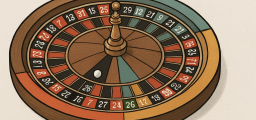
On an American roulette wheel, there are 38 pockets: 18 red, 18 black, a 0, and a 00. According to Britannica, that double-zero wheel gives the house about a 5.26% edge on most bets. The exact probability of red on any single spin is 18/38, roughly 47.37%, not 50%, because 0 and 00 belong to neither color.
If black’s just hit five times, the odds of red on the next spin are still 18/38. The streak might be unusual. But it hasn’t removed any black pockets from the wheel. It hasn’t added red ones. It hasn’t made the ball apologetic.
European roulette works the same way with one zero instead of two. Red comes in at 18/37, about 48.65%, on a single spin. Better than American wheels, sure. But still completely unaffected by a previous streak.
| Situation | What Feels True | What the Math Says |
|---|---|---|
| Black just hit five times | Red is overdue | Red is still 18/38 on an American wheel |
| Red just hit five times | Black is overdue | Black is still 18/38 on an American wheel |
| Zero hasn’t appeared recently | Zero is due | Zero is still 1/38 on an American wheel |
Here’s the house edge’s quiet truth: betting on the color that “feels due” doesn’t make the 0 and 00 disappear. You might win the next spin. But if you do, it’s because of ordinary randomness, not because the universe corrected itself.
Baccarat: Scoreboards Make the Fallacy Look Organized
Baccarat’s where the gambler’s fallacy gets a visual makeover. Most tables display roads, beads, and scorecards tracking previous Banker, Player, and Tie results. These things are mesmerizing to watch. They turn a shoe of cards into narrative: long streaks, tight alternations, clusters, sudden pivots. (Imagine a scoreboard covered in tiny red and blue dots, arranged in patterns that almost seem to predict the next hand. They don’t, but they’re designed to look like they might.)
In punto banco baccarat, you’re typically choosing between Banker, Player, or Tie. After you place your bet, fixed rules determine what gets dealt. According to Wizard of Odds’ eight-deck analysis, the typical house edge sits at about 1.06% on Banker, 1.24% on Player, and 14.36% on Tie (when Tie pays 8 to 1).
Those percentages matter because they give you a real mathematical reason to prefer one bet over another. Banker’s generally your cheapest main bet under standard rules. A scoreboard streak? That’s different. If Banker’s won several hands in a row, that doesn’t automatically mean Player is due. If the shoe’s been alternating, that doesn’t guarantee the alternation continues.
Here’s where I need to correct myself: baccarat’s not exactly like coin tosses because cards come from a finite shoe. Removing cards shifts the remaining shoe’s composition. Theoretically, that could matter. But practically? Most scoreboard reading doesn’t track deck composition with enough precision to beat the house edge built into the game. A visible pattern doesn’t magically convert a losing bet into a winning one.
Bottom line: a baccarat scoreboard is a history book. Not a prophecy book.
Why Streaks Happen Even When Nothing’s Wrong
Here’s why the gambler’s fallacy survives, and this is the sneaky part, people deeply underestimate how lumpy randomness naturally gets. Most people imagine a random sequence should look evenly mixed: heads, tails, heads, tails, red, black, red, black. Alternating. Pretty. Balanced.
But truly random sequences cluster and bunch.
Try writing down what you think 30 fair coin tosses should look like. Most people avoid long runs because long runs “don’t look random.” Then actually flip a coin 30 times. Or simulate it. Runs of three, four, five. They’re not shocks. They’re what randomness actually produces.
This matters in gambling because emotional streaks are loud. Losses feel like pressure building. Wins feel like a signal you’re onto something. Both feelings push people toward bigger bets, faster decisions, and thinking that skips the math.
Effortless Math’s breakdown of theoretical and empirical probability helps here. Theoretical probability is what *should* happen over the long run. Empirical results are what *actually* happened in your sample. A small sample can wander far from the long-run expectation. That wandering isn’t evidence the model’s broken.
The Law of Large Numbers Isn’t a Short-Term Refund Policy
People hear “results even out over time” and misunderstand what that means. The law of large numbers says that (under the right conditions) your average result gets closer to the expected value as you run more trials. It does not say the next event must balance out the previous ones.
Suppose a fair coin lands heads 60 times in the first 100 tosses. Heads is ahead by 20. Over the next 900 tosses, the overall percentage might creep toward 50%. But it doesn’t require tails to dominate immediately. The percentage can drift closer to 50% simply because a big lead becomes smaller relative to a larger total.
Say the next 900 tosses are roughly 450 heads and 450 tails. Now your total is 510 heads out of 1,000. That’s 51% heads. The deficit didn’t disappear because tails was “due.” It got diluted by a bigger sample.
It’s subtle. And it matters: long-run averages don’t create short-run debts.
How the Fallacy Feeds Betting Systems
A lot of betting systems quietly depend on the gambler’s fallacy. The Martingale system tells you to double after losses, banking on the idea that a win must arrive soon enough to recover the whole sequence. Other systems tell you to chase streaks, fade streaks, wait for patterns, or raise after a certain number of losses.
The math problem: changing your bet size doesn’t change the probability of the next independent event. If a roulette red bet has a negative expected value, doubling after black doesn’t flip it positive. It just changes your risk profile. A string of small wins can vanish in one long losing run, especially when table limits and your bankroll hit the ceiling.
Same story in baccarat. Betting bigger because Banker just lost four hands doesn’t improve Banker’s odds on the next hand. It might make the swings bigger, but bigger swings aren’t advantage.
Expected value is your real defense against this kind of wishful thinking. Effortless Math’s guide to expected value breaks it down: multiply each outcome by its probability, add them up. If the expected value is negative, your betting strategy has to overcome the game’s built-in math, not your intuitions about timing.
When Past Results Really Do Matter
Full disclosure: I shouldn’t oversimplify. Past results do matter in specific situations. If cards are removed from a finite deck and not replaced, the remaining deck’s composition changes. That’s why blackjack card counting can work under certain rules. Past cards tell you something about future cards.
Past results also matter if equipment is broken or biased. A damaged wheel. A flawed shuffler. A broken random-number generator. A procedural mistake. These can make outcomes depend on something other than clean chance. But those aren’t ordinary “red is due” scenarios. They require actual evidence about the process, not just a streak that feels weird.
The right question: does the past result change the probability model for the next event? If no, the gambler’s fallacy is probably lurking. If yes, you need to explain exactly how the information shifts the odds.
A Simple Test for Spotting the Gambler’s Fallacy
When someone claims an outcome is “due,” ask three things:
- Did the previous outcome physically change what outcomes are possible next time?
- Did it change how many favorable outcomes exist?
- Did it change the payout or the house edge?
For a fair coin? No to all three. The previous toss doesn’t alter the coin. For roulette under normal conditions? No. The previous spin doesn’t rearrange the pockets. For casual baccarat scoreboard reading? Usually no, not in the practical sense that matters to regular bettors. A visible pattern doesn’t magically turn a negative-EV bet into positive territory.
This test separates actual probability from pattern storytelling. It also keeps things respectful. Humans see patterns because our brains are built to hunt for meaning. The math isn’t calling people foolish. It’s saying that our pattern-finding instincts need checking when money and randomness are both in the game.
The Deeper Lesson: Random Doesn’t Look Fair
The gambler’s fallacy survives because randomness often looks wrong. It produces five heads in a row. It gives a roulette player ten spins without red. It lets a baccarat shoe march in one direction, then flip hard. People want the next event to restore balance.
But probability doesn’t owe you visual order. Fair processes create messy sequences. Casino games spawn winning streaks inside negative expected value. A player can win the next spin for the wrong reason. One hand’s outcome isn’t proof of your theory.
Here’s the cleanest takeaway: streaks are rare before they happen. But once they’re in the past, they don’t trigger a self-correction in the next event. A coin doesn’t know it’s been heads five times. A roulette wheel doesn’t track red’s absence. A baccarat shoe doesn’t care what the scoreboard shows.
That’s not pessimism. It’s useful clarity. Once you understand the gambler’s fallacy, casino claims get easier to evaluate. The question stops being “What feels due?” and becomes “What are the probabilities, payouts, and expected value right now?” That’s a much stronger way to think about any bet.
Sources

Related to This Article
More math articles
- Electioneering
- Free Grade 7 English Worksheets for Idaho Students
- How to Solve Multiplication Rule for Probabilities?
- Best Calculators for Electrical Engineering Students In 2026
- Race, Ethnicity, and Migration
- CLEP U.S. History I 016: Atlantic Trade, Mercantilism, and the Navigation Acts
- Symbolic Interactionism
- How to Use Area Models and the Distributive Property to Multiply?
- Symbolic speech
- District of Columbia DC CAPE Grade 6 Math Free Worksheets: 72 Free Printable Math Practice PDFs









What people say about "Coins, Roulette, and Baccarat: A Field Guide to the Gambler’s Fallacy - Effortless Math"?
No one replied yet.