EZ Baccarat, Punto Banco, Chemin de Fer: A Probability Comparison
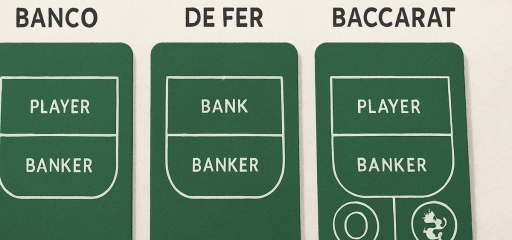
Walk into a Las Vegas pit and the baccarat table almost certainly deals Punto Banco, where the rules are fixed and the dealer does everything. Cross the Atlantic to a private salon in Monaco, and the same game becomes Chemin de Fer, where a rotating banker faces a table of players who get to think for themselves. Stop in Atlantic City or Macau and you might find EZ Baccarat, a commission-free spinoff with a strange side bet attached. Three names, three sets of edges, and three very different feels. This is a probability comparison of all three, focused on what the numbers actually do at the table.
A short history note
Baccarat traces back to 19th-century France, where Chemin de Fer (French for “railway,” a nickname earned because the shoe travels around the table) was the original form. The American casino industry stripped out the player choices in the mid-20th century and rebranded the simplified game as Punto Banco. Then in 2004, John Feola introduced EZ Baccarat, a version that removed the 5% commission while keeping the house edge roughly intact through a single push rule. All three games share the same point count, the same goal of reaching nine, and the same two main bets. What changes is who decides and how the casino takes its cut.
Punto Banco: the modern standard
Punto Banco is the version most people mean when they say “baccarat.” Two hands are dealt, Player and Banker, and a fixed table of third-card rules dictates every decision. Nobody at the table makes a single choice once the bet is placed. The house edge on the Banker bet is 1.06% and on the Player bet is 1.24%, assuming an eight-deck shoe. The Banker wins slightly more often, which is why the casino charges a 5% commission on winning Banker bets. Without that commission the Banker bet would be a small player advantage, which the house obviously will not allow.

The Tie bet, usually paying 8 to 1, carries a much worse edge of around 14.4%. Almost every serious source, including the Wizard of Odds baccarat basics page, tells you to skip it.
EZ Baccarat: commission removed, edge mostly intact
EZ Baccarat solves the annoyance of having to track 5% commissions. The Banker bet pays even money on every win except one specific case: when Banker wins with a three-card total of seven. That hand is called a Dragon 7, and instead of paying, it pushes. That single exception is mathematically equivalent to charging a commission, but it happens roughly 2.3% of the time rather than on every win. The net effect is a Banker edge of about 1.02%, which is actually a touch better for the player than Punto Banco’s 1.06%.
The Player bet in EZ Baccarat is unchanged at 1.24%. The interesting wrinkle is the optional Dragon 7 side bet, which pays 40 to 1 when Banker wins with a three-card seven. That side bet has a house edge of around 7.6%, so it is a worse deal than the main bets, but it does open the door to card counting because the side bet is sensitive to the composition of the remaining shoe. For a flat bettor who only plays the main wager, EZ Baccarat is mathematically the best of the three.
Chemin de Fer: where the player actually decides
Chemin de Fer is the old French version and the only baccarat variant that still has real player choice. One player at a time acts as the banker and puts up the bank. The other players bet against that bank. When a hand reaches the third-card decision, the player representing the punters can choose whether to draw or stand on a five, and the banker can deviate from the fixed Punto Banco chart based on what the punter did. The casino does not bank the game. Instead, it takes 5% of the banker’s net winnings as a fee for hosting.
Because the banker rotates and the casino is not exposed to outcome variance, the bank can be played close to break-even with optimal strategy. The banker edge against the punters is in the same neighborhood as Punto Banco, roughly 1.06% to 1.20% depending on whose strategy is being followed, but the 5% cut on bank winnings is what funds the house. Skilled play on the punter side can shave the edge slightly below 1%, which is the lowest theoretical hold of the three games. The room for skill is small, but it exists, and that is the entire point of the variant.
Rule comparison at a glance
The table below summarizes the key probability stats. Edges are quoted for the main Banker and Player bets in an eight-deck shoe, assuming standard rules.
| Variant | Banker edge | Player edge | Commission | Player choice? | Where you find it |
|---|---|---|---|---|---|
| Punto Banco | 1.06% | 1.24% | 5% on Banker wins | None | Vegas, Macau, almost everywhere |
| EZ Baccarat | 1.02% | 1.24% | None (Dragon 7 pushes) | None | North America, some Asian rooms |
| Chemin de Fer | ~1.06% to 1.20% | n/a (peer-banked) | 5% of net bank winnings | Yes, limited | European private salons, rare |
Why Chemin de Fer is almost extinct
If Chemin de Fer offers the lowest possible edge, why does almost nobody deal it? A few practical reasons stack up:

- The game is slow. Hands per hour are a fraction of Punto Banco because the bank rotates and players debate the third-card call.
- It requires a real table of regulars. You need someone willing to act as banker and put up a meaningful bank, and you need enough punters to cover it.
- Casinos earn less. A 5% cut on bank winnings produces a far smaller hourly hold than a 1% edge on every single decision at a fast Punto Banco table.
- It needs a trained croupier who can run the third-card strategy correctly when the banker is unsure. That is a specialized skill.
- Modern players prefer no decisions. Most baccarat players treat the game as a coin flip with a slight bias, and adding choice is seen as a chore rather than a feature.
The combination of low casino throughput and high operational overhead pushed Chemin de Fer into a few European private rooms and almost nowhere else. The Britannica entry on baccarat notes the same evolution: the player-choice version came first, the casino-friendly version took over the world.
The player-skill component, and why it only lives in CDF
Punto Banco and EZ Baccarat are pure probability exercises. Every third-card decision is dictated by a chart that has been frozen for decades, and that chart is already mathematically optimal for the casino, so there is nothing for the player to optimize. Card counting in baccarat does exist for the main bets, but the gain is tiny (well under a penny per dollar wagered), and the side bets that are countable, like EZ Baccarat’s Dragon 7, carry their own large baseline edge.
Chemin de Fer is different because the player drawing on a five can vary their decision based on what they have seen and what they think the banker is holding. The expected-value gap between “always draw on five” and “always stand on five” is small, perhaps a few tenths of a percent, but it is real. In a game where the baseline edge is already about 1%, shaving 0.2% to 0.3% off through correct play is significant in relative terms. This is why old gambling literature on baccarat is almost entirely about Chemin de Fer strategy and why modern Punto Banco literature is almost entirely about money management. The math has moved.
How the third-card rules differ in practice
The fixed third-card chart in Punto Banco is the single most important piece of math in modern baccarat. The Player hand always draws on a total of zero through five and always stands on six or seven. The Banker hand follows a more complicated rule that depends on whether the Player drew, what card the Player drew, and what the Banker’s two-card total is. Memorizing the chart is unnecessary because nothing you do at the table changes the outcome, but understanding that the chart was tuned to favor the Banker is what explains the commission. EZ Baccarat uses the exact same third-card rules, so the underlying hand probabilities are identical; only the payout structure changes. Chemin de Fer keeps the same skeleton but allows the punter to deviate on a five and allows the banker to deviate based on what the punter did. Those small windows of choice are where the strategy room comes from, and they are the reason serious baccarat literature from the early 20th century reads more like a chess primer than a gambling guide.
Practical takeaways
If you only care about the lowest edge on a flat bet, EZ Baccarat’s Banker wager at 1.02% is the best of the three for casual play. If you want a game with actual decisions and the chance to play near zero edge, Chemin de Fer is the only option, but you will have to find it first. Punto Banco is everywhere, has the cleanest rules, and is a perfectly reasonable game at 1.06% as long as you stay away from the Tie bet. For more general probability tools and worked examples on game math, Effortless Math has accessible writeups you can use as warm-up material.
FAQ
Q: Is EZ Baccarat really better than Punto Banco, or is the difference a gimmick?
A: The 1.02% Banker edge in EZ Baccarat is genuinely a hair better than the 1.06% in Punto Banco, but the gap is about four cents per hundred dollars wagered. It is real, not marketing, but it will not change your night.
Q: Can I count cards in baccarat?
A: Technically yes, but the edge gained on the main bets is so small that it is not worth the effort. The Dragon 7 and Panda 8 side bets in EZ Baccarat are more countable, but they start with a much worse baseline edge.
Q: Does the Banker bet always beat the Player bet?
A: On expected value, yes, across all three variants. Banker wins slightly more often because of the asymmetric third-card rules. The 5% commission in Punto Banco and the Dragon 7 push in EZ Baccarat exist precisely to claw back that advantage.
Q: Why does Chemin de Fer charge 5% of net bank winnings instead of a per-hand edge?
A: Because the casino is not banking the game. Players bank against each other, and the house just provides the table, the cards, and the croupier. Taking a cut of the banker’s profits is the natural way to monetize that.
Q: Is the Tie bet ever a good idea?
A: No. It carries a house edge of roughly 14.4% at the standard 8 to 1 payout, regardless of which variant you are playing. The payout would need to be closer to 9.5 to 1 for the bet to break even with the Banker edge.
Gambling outcomes are uncertain; no strategy guarantees profit.

Related to This Article
More math articles
- Midterm elections
- The Ultimate 7th Grade RISE Math Course (+FREE Worksheets)
- Free Grade 3 English Worksheets for Idaho Students
- Free Grade 3 Math PDFs for Oregon OSAS: 49 Single-Skill Worksheets with Step-by-Step Keys
- Migration, Direction, Selection, and Policy
- Structural Reform and the Sixteenth and Seventeenth Amendments
- Federalists and Democratic-Republicans
- 8th Grade PARCC Math Practice Test Questions
- 8th Grade PACE Math Worksheets: FREE & Printable
- The Art of Math: How to Solve Word Problems with Scale Drawings and Scale Factors









What people say about "EZ Baccarat, Punto Banco, Chemin de Fer: A Probability Comparison - Effortless Math"?
No one replied yet.