Poker and Probability: Is the Game About Luck or Skill?
Poker has long been a mysterious game often featured in action-filled movies, played by tough characters. Virtually everyone knows about poker, but not everyone knows how to play it. Even fewer are familiar with the odds and probabilities associated with the game. This begs the question of whether or not skill and mathematical probability calculations are required for the game, or whether it is simply about luck.
The Basics of Poker
If you’re looking to learn Poker, here is a list of promotions on online casinos that can help you get along with learning, with minimum investment. These platforms give users great perks, exciting bonuses, and several other freebies that make it easy to spend time learning the basics of poker without worrying about financial loss.
In our quick introduction to poker, we’ll be focusing on the rules of Texas Hold ’em, since it’s the most-played variant of poker worldwide. To start a game, each player is dealt 5 cards. Players only know their own hands, and one by one each player gets to decide if they want to:
- Call , Match the amount wagered by another player.
- Fold , Place their two hole cards face-down to be discarded. The player retreats from the round.
- Raise , Place a wager higher than the big blind.
- Check, The player with the big blind can choose to check, which means they do not increase their wager.
After this, there is a show-down where the player’s hands are revealed. The player with the highest hand still in the game wins the pot.
While basic knowledge is important, learning poker specifics and familiarising yourself with all of the rules of Texas Hold ’em poker online, is necessary if you want in-depth knowledge of the game, enough to compete with other players.
The Role That Skill Plays
A good poker player knows the power of their hand. They know the odds; they know how likely it is to be better than their opponents. They then use that information, and cues from opponents, to make educated and smart guesses in the game.
Strategy isn’t going to work every time. If your opponent has the best hand possible, there isn’t much you can do. But even if you get unlucky once, being strategic will pay off in the long run. That’s because luck evens out in the long run, leaving the player who is increasing their odds with the most wins. Putting it simply, the cards you are dealt are 100% luck, but the way that you play them is 100% skill.
How Can Someone Be Good At Poker?
Being good at poker is simply about knowing your odds and making the best choices per them. While you’re not always going to be right, you just need to be right often enough to win against players making random, impulsive, and emotional moves.
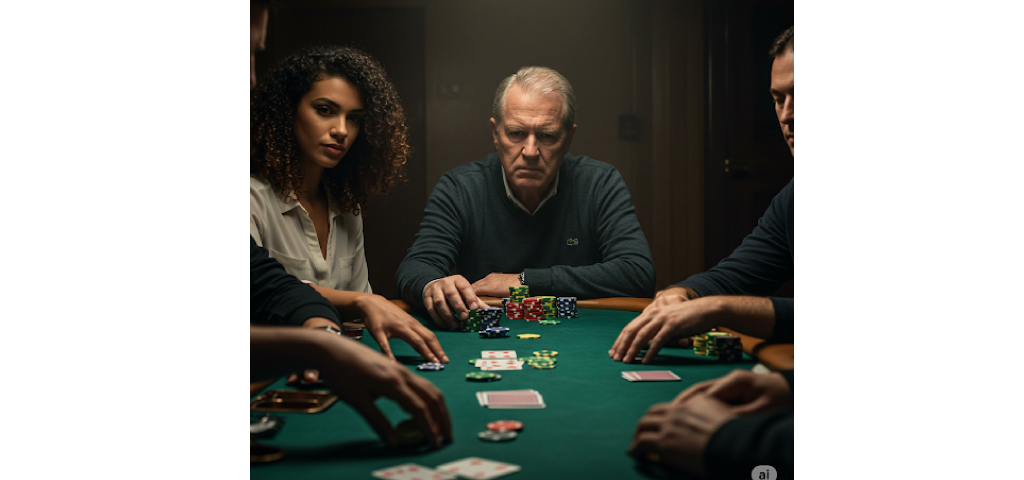
When an exceptional poker player faces off against another, luck and psychology are going to play larger roles. Since both players already know the odds, getting lucky or tricking your opponent are the only strategies left.
How Many Hands Does It Take for Skill to Show?
The luck-versus-skill question has a statistical answer. Imagine a strong player who wins on average 5 big blinds per 100 hands, with a standard deviation of about 90 big blinds per 100 hands, a typical figure for online no-limit hold’em. Treat each block of 100 hands as one trial.
- After 10,000 hands (100 blocks): the expected result is +500 big blinds, but the standard deviation is 90 × √100 = 900. The chance of still being behind is about 29%.
- After 100,000 hands (1,000 blocks): the expected result is +5,000, the standard deviation is 90 × √1,000 ≈ 2,846, and the chance of being behind drops to about 4%.
The average grows with the number of hands, while the noise grows only with its square root. That is why skill dominates in the long run but can be invisible over a weekend. Both numbers come from the normal distribution and the idea of standard deviation.
Conclusion: Skill trumps luck in the long run
In the short run, luck is going to be more important. You’re never guaranteed to win any one game, no matter how expertly you play it. However, maximizing your skills will in the long run increase your odds of winning to the point where you’ll likely come up top.
While a player can get very unlucky, a good poker player will end up winning most of the time as they increase their odds to the maximum. A player who is just lucky, on the other hand, will eventually lose since their good luck is bound to be balanced out.
Frequently Asked Questions
Is poker more about luck or skill?
Over a single session, luck can easily decide the result. Over a large number of hands, a consistent edge shows up because the average result grows faster than the random swings. The worked example above puts numbers on that difference.
What probability skills does a good poker player use?
Counting outs, converting outs into percentages, comparing that percentage with pot odds, and estimating expected value. Our guide to compound events and our expected value entry are good starting points.
Why do professional players talk about variance?
Variance measures how far results swing around the average. A player with a real edge can still lose for thousands of hands, so professionals judge decisions by their expected value rather than by short-term results.
More practice: Worksheets · Top 10 Grade 3 Math Books Inspiring Young Mathematicians To Explore
Sources and Further Reading
- University of Alberta Computer Poker Research Group: research on computer poker and game theory
- MIT OpenCourseWare: Introduction to Probability and Statistics: the law of large numbers and the central limit theorem
- The normal distribution and the 68-95-99.7 rule
- Standard deviation explained
- 1-800-GAMBLER: free, confidential help in the U.S.
If gambling stops feeling like entertainment, free and confidential help is available from the National Council on Problem Gambling or by calling 1-800-GAMBLER.

Related to This Article
More math articles
- Top 10 Tips to Create an ACCUPLACER Math Study Plan
- How to Navigate the Fraction Jungle: A Guide to Adding Fractions with Unlike Denominators
- Linear, Quadratic, and Exponential Models
- How to Solve Non-Right Triangles Problems
- Unions, Unemployment, and Work-Family Boundaries
- Back to School Essentials: Why “Pre-Algebra for Beginners” Should Be on Your List
- Piecewise Function Calculator
- Top 10 8th Grade OST Math Practice Questions
- How to Write a Formula for a Recursive Sequence
- 7th Grade NSCAS Math Worksheets: FREE & Printable







What people say about "Poker and Probability: Is the Game About Luck or Skill? - Effortless Math"?
No one replied yet.