How Math Helps You Make Decisions Under Pressure
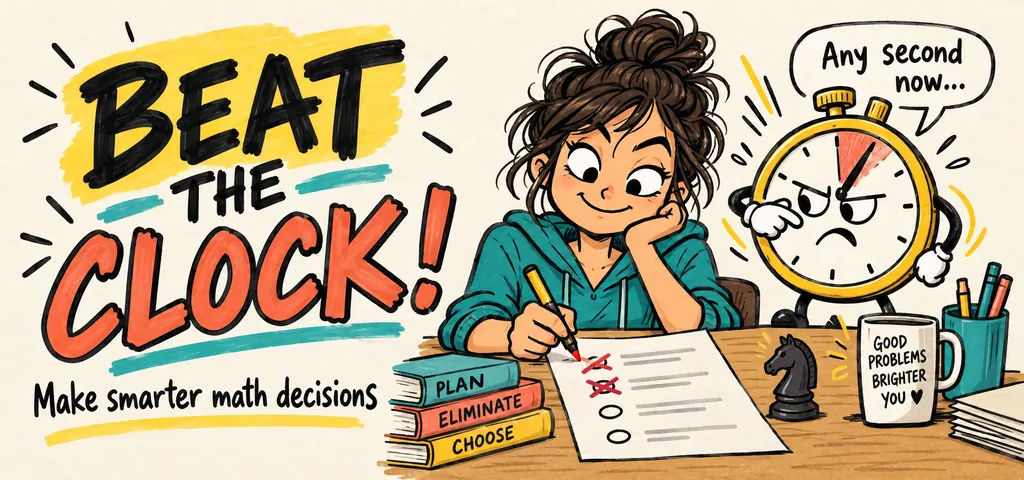
Making decisions under pressure takes more than quick thinking. Math helps you compare outcomes, use your time wisely, and choose when to stop looking. You can practice these skills before a timed exam, a chess game, or an everyday deadline. Start with three useful ideas: expected value, stopping rules, and risk.
Why Decisions Under Pressure Need a Time Limit
A deadline changes the problem. Each second spent on one option leaves less time for the next. At first, extra thought may help you find a better answer. Later, it may cost more than it adds. You need to balance speed with accuracy, whether you face a timed exam or a board game.
Games are a useful laboratory for this idea because their clocks are explicit. A chess clock, a quiz show buzzer and the countdown on Live dealer tables in social gaming all work the same way: a real person runs the round, a short window opens for each choice, and when the timer reaches zero the game moves on without you. That structure forces a question most people never state out loud. Is a good decision made now worth more than a perfect decision made too late? In a timed format, the second option does not exist, so the math has to be about deciding well inside the window rather than deciding perfectly outside it.
Expected Value on a Deadline
Expected value helps you compare uncertain choices. It describes the average result across many repeats of the same situation. Multiply each possible result by its probability, then add those values. A positive expected value does not guarantee success on one try.
Consider a historical scoring system: one point for a correct answer, a quarter-point penalty for a wrong answer, and five choices. A blind guess has expected value (1/5)(1) + (4/5)(−0.25) = 0. If you rule out one wrong choice, it becomes (1/4)(1) + (3/4)(−0.25) = 0.0625. Eliminating an answer improves the average outcome under those rules.
Check today’s exam rules: The example above illustrates a historical penalty system. The current SAT has no penalty for wrong answers, so do not use that old rule to decide whether to leave a question blank. College Board’s current SAT tips explain how to approach guessing.
When to Stop Looking
Sometimes options arrive one at a time. If you reject an option, you cannot return to it. The classic secretary problem asks how to find the best candidate in this setting. It assumes a known number of candidates, random arrival order, and an immediate accept-or-reject choice.
The solution is known as the 37 percent rule. A mathematics blog at Washington University in St. Louis explains the logic neatly: look at the first 37 percent of options without committing, then choose the next one that beats everything you have seen. The number comes from 1/e, where e is roughly 2.718, and for large pools, the best-choice success rate approaches 37 percent. With small pools, the exact cutoff and success rate differ. That may sound low, but it is far better than any other strategy under those strict rules, and it gives a clear answer to the question of when to stop gathering information.
What the Chess Clock Reveals
Chess has become one of the best places to study decisions under pressure, because every move and every second is recorded. A recent study used a machine learning measure of how risky each move was and applied it to FIDE Chess World Cups from 2013 to 2023. The researchers found safer choices dominated when players had less thinking time, and the effect was strongest when a player was already behind.
The result highlights a practical limit. Even skilled players cannot check every line when time runs short. A safer move may reduce the chance of a serious mistake, even if another move offers more upside. For your own decisions under pressure, ask both “What could I gain?” and “How costly would a mistake be?”
Practice Before the Pressure
The common thread is preparation. Expected value, stopping rules and risk management all work best when the thinking happens before the timer starts. A student who already understands how to count favorable outcomes can estimate a probability in seconds, while one who has to work out the method from scratch runs out of time. If the basics feel shaky, it helps to review probability until comparing outcomes becomes automatic.
Practice turns some calculations into habits. A chess player learns opening principles before a game. A test taker practices ruling out wrong answers before an exam. Both save thinking time when a clock is running.
Try a One-Minute Decision
Suppose a classroom quiz gives one point for a correct answer and no penalty for a wrong one. You have one minute left and two questions. You can answer the first with an 80% chance of success. Then you can use the remaining time to make a guess on the second with a 25% chance. In this simplified model, the expected total is 0.80 + 0.25 = 1.05 points. Spending the whole minute on the first question can earn at most one point.
The lesson is to compare the next use of your time, not just the question in front of you. Your estimates may be imperfect, but the comparison gives you a clear reason to move on.
A Simple Plan for Decisions Under Pressure
To make better decisions under pressure, decide what matters before the timer starts. Use expected value to compare uncertain outcomes. Use a stopping rule only when its assumptions fit. Finally, leave enough time to act. A sensible choice you can carry out is more useful than a perfect plan that arrives too late.

Related to This Article
More math articles
- 7th Grade North Carolina End-of-Grade Math Worksheets: FREE & Printable
- Secularization, Religious Change, and Civil Religion
- Ecclesia, Church, Denomination, Sect, and New Religious Movement
- Decoding Discreteness: A Comprehensive Guide to the Probability Mass Function
- 4th Grade English Worksheets for Utah (RISE): 57 Free Printable PDFs
- How to Find Angles as Fractions of a Circle
- The Best Grade 7 ELA Practice Tests for Delaware Students
- The Best Grade 8 ELA Practice Tests for Minnesota Students
- Full-Length TASC Math Practice Test
- How to Multiply Polynomials Using Area Models







What people say about "How Math Helps You Make Decisions Under Pressure"?
No one replied yet.