Metabolic Scaling: How to Compare Animal Energy Needs
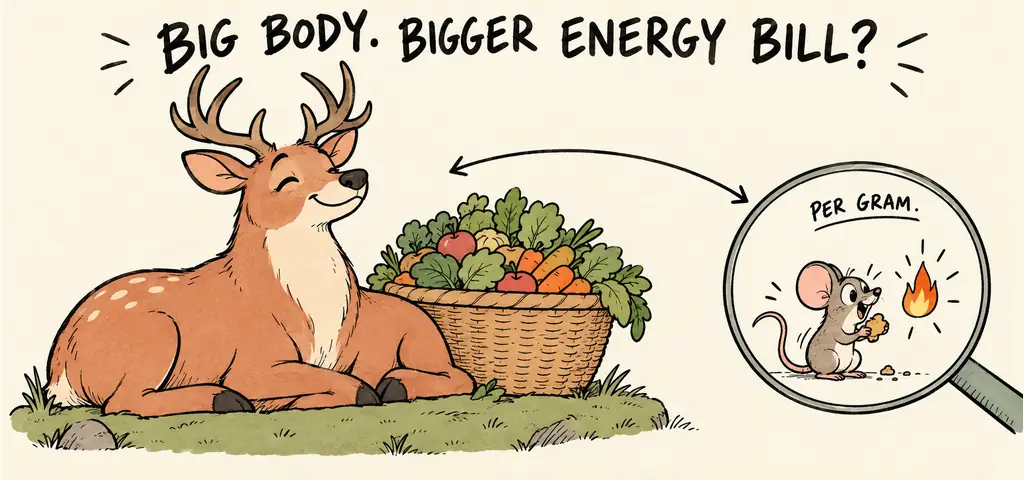
Metabolic scaling describes how energy use changes with body size. Total energy use and energy use per unit of mass are different measures, so always check which one a comparison uses. This guide connects those measures with physiology and ecological conditions.
A horse needs more food in total than a hummingbird. Per gram of body mass, however, the hummingbird uses energy much faster under comparable active conditions. During a cold night or an energy shortage it may enter torpor, lowering body temperature and metabolic rate. Metabolism continues. Fasting tolerance also depends on stored reserves and conditions, so body size alone cannot tell you exactly how long either animal could survive without food.
Watch the process
Life Requires Free Energy
An organism’s size, physiology, and surroundings affect its energy budget. Ecology connects that budget with the resources available and with interactions among organisms. Choose the scale of the study before interpreting its measurements.
Ecology is organized by scale, and the scale you choose decides what counts as data. An organism is one individual. A population is the members of a single species occupying a defined area over a defined interval. A community is all the interacting populations there. An ecosystem is the community plus the physical and chemical conditions it sits in, and the biosphere is every ecosystem together. The boundaries are drawn by the investigator: a rotting log is a fine ecosystem for a study of decomposition even though beetles walk in and out of it.
Distinguish habitat from niche. A habitat is where an organism lives. An ecological niche is how it lives there: the resources it uses, the conditions it tolerates, and the times and places it uses them. Two warbler species share one spruce tree, which is one habitat, while occupying different niches because one feeds at the crown and the other on the lower interior branches.
Habitat identifies a location; niche describes how an organism uses resources and interacts with its surroundings. Habitat answers “where?” and takes an address: the canopy, the intertidal zone, the gut of a termite. Niche answers “how does it make a living there?” and takes a job description: what it eats, what eats it, what temperature and pH it tolerates, when it is active, where it breeds. Two species can share an address and hold different jobs, which is exactly the warbler case. In a stable environment, complete overlap in a limiting niche can prevent stable coexistence, as described by competitive exclusion. When a stem says a species “lives in wet soil,” decide whether the sentence is naming an address or naming a tolerance, because the answer changes which term is correct. If you can replace the phrase with a map coordinate, it is habitat. If you can replace it with a range of conditions or a list of resources, it is niche.
There is a second word in this neighborhood worth pinning down now. A biome is a large region often classified on land by climate and characteristic vegetation, such as tundra, temperate deciduous forest, or desert. A biome is not a level of organization above the ecosystem in any strict sense; it is a climate-based category that groups ecosystems that look and function alike. Aquatic biomes are also distinguished by salinity, depth, flow, and other physical features. A study of one pond’s organisms and chemistry addresses an ecosystem; the pond can also belong to a broader aquatic category.
Influences on an organism divide into biotic factors, meaning other living things such as predators, competitors, and pathogens, and abiotic factors, meaning temperature, light, water, salinity, pH, and nutrient availability. The two interact constantly. A drought is abiotic, but it thins the plant cover, which intensifies competition and exposes herbivores to predators, and both of those consequences are biotic.
Every Organism Runs on a Budget
An organism must acquire free energy to maintain its organized structure and perform cellular work. Cells transfer energy through ATP, and energy eventually disperses as heat. Metabolic rate measures energy use per unit time. A sustained increase can raise food requirements, while stored reserves can cover a temporary shortfall. Activity and dormancy also change metabolism. Energy supply helps shape a species’ distribution along with temperature, water, interactions, and access to habitat.
Compare thermoregulation strategy and body size. Endotherms maintain body temperature using metabolic heat and ectotherms take it largely from the environment, so a resting endotherm typically has a higher metabolic rate than a resting ectotherm of similar mass under comparable conditions, needs far more food per gram, and in exchange stays active at temperatures that immobilize the ectotherm. Neither strategy is better; each wins in a different environment.
The second comparison is size, and it runs against intuition. Among comparable animals in similar physiological states, a large animal generally has a higher total metabolic rate than a small one because there is more of it, but divide by mass to get the mass-specific metabolic rate, the energy used per gram per hour, and the small animal wins by a wide margin. For endotherms, the surface-area-to-volume argument helps explain this pattern, although metabolic scaling also depends on physiology, insulation, and activity. Heat is lost across a surface and generated throughout a volume, and volume scales as the cube of a linear dimension while surface area scales only as the square, so surface area per unit of mass climbs as an animal shrinks. A small endotherm must burn fuel faster per gram to replace what it leaks, which is why a hummingbird feeds almost continuously and why some small mammals use torpor during energy shortages or cold nights.
Reading a Metabolic-Rate Table
In this simplified teaching data set, three endotherms are measured at rest under comparable conditions. A 20 g mouse uses 1.5 kJ per hour, a 2,000 g rabbit uses 25 kJ per hour, and a 200,000 g deer uses 700 kJ per hour. Which animal has the highest metabolic rate, and which has the highest mass-specific metabolic rate?
The first question is answered by reading the column: the deer, at 700 kJ per hour, uses the most energy. The second question requires division. The mouse uses \(1.5 / 20 = 0.075\) kJ per gram per hour. The rabbit uses \(25 / 2000 = 0.0125\) kJ per gram per hour. The deer uses \(700 / 200000 = 0.0035\) kJ per gram per hour. The order reverses.
Answer
The deer has the highest total metabolic rate; the mouse has the highest mass-specific rate, about 21 times the deer’s, consistent with the typical body-size pattern; heat loss per gram is one contributing explanation, not separately measured by this table.
What Organisms Do When Conditions Change
An organism does not sit still while its environment shifts. It responds, and the responses run from a few seconds to a whole season. Grouping them by timescale makes them easy to hold.
Fastest are the behavioral and physiological adjustments. A lizard shuttles between sun and shade to hold its body temperature in a narrow band, which is behavioral thermoregulation, meaning temperature control achieved by moving rather than by burning fuel. Moving has energetic costs and can trade off with foraging or predator avoidance, but it can reduce the need for metabolic heat production. An endotherm in the cold shivers, raises its fur or feathers, and constricts surface blood vessels instead, which increase heat production or reduce heat loss. This kind of correction is negative feedback, a control loop in which a change triggers a response that opposes it, and thermoregulation is the ecological face of the same idea.
Plants respond through growth, physiology, and sometimes rapid movements such as leaf closure. A familiar growth response is a tropism. A tropism is growth directed by the direction of a stimulus. In phototropism, a shoot bends toward light because the hormone auxin accumulates on the shaded side and lengthens the cells there, so the shaded flank grows faster and the tip tilts. Nothing pulls the plant toward the window; one side simply outgrows the other. Gravitropism orients roots downward and shoots upward through gravity sensing, including sedimentation of starch-containing structures, and differential growth involving auxin. Roots and shoots differ in their growth responses to auxin, and thigmotropism makes a tendril coil against whatever it touches. Notice that all three are directional, which is what separates a tropism from a general growth response.
On a daily timescale, most organisms run a circadian rhythm, an internal cycle of roughly 24 hours that persists even in constant conditions. A plant kept in continuous dim light still opens and closes its leaves on schedule for several days, which is the evidence that the clock is internal rather than a direct reaction to sunrise. Light does not create the rhythm; it resets it, the way you reset a watch that runs slightly fast.
On a seasonal timescale, the reliable cue is photoperiod, the way a 24-hour day is divided between light and dark, because it follows a predictable seasonal pattern at a given latitude. Temperature fluctuates from year to year, while seasonal day length is more predictable; the same day length can nevertheless occur in both spring and autumn. Photoperiodism is a response to that division. Day length and night length are complementary and provide seasonal cues, but many classic flowering experiments show a critical role for uninterrupted darkness. Photoperiodism broadly means a response to the timing of light and darkness; its mechanism is not identical in every organism. It times flowering in many plants, molting and breeding in many birds and mammals, and the onset of migration. Hibernation is a prolonged seasonal drop in metabolic rate and body temperature that lets an animal survive a period when food is unavailable, estivation is the same strategy applied to heat and drought, and torpor is a controlled reduction in metabolic rate, often short-term or overnight, used by hummingbirds and small bats. Migration solves the same problem by moving to a more suitable habitat instead of lowering metabolism in place. These responses can depend on seasonal cues, internal state, or immediate environmental conditions. Hibernation often includes repeated torpor bouts and periodic arousal.
Which Cue Is the Plant Actually Reading?
A short-day plant flowers in autumn. In a growth chamber, researchers give it a 14-hour dark period and it flowers. They give a second group a 14-hour dark period interrupted at its midpoint by a two-minute flash of red light, and that group does not flower. A third group gets a 10-hour dark period and does not flower. Temperature and daily light intensity are controlled, with replicate plants randomly assigned to each treatment. All cycles last 24 hours. What is the plant measuring?
Work through what each group rules out. The third group has a short night and does not flower, so a long night is necessary. That much is consistent with the plant measuring either night length or day length, since in a 24-hour cycle the two are complementary and you cannot separate them by that comparison alone.
The second group is the one that decides it. Its total dark time is nearly 14 hours, essentially the same as the first group’s, and its total light time is nearly 10 hours, essentially the same as the first group’s. If the plant were adding up hours of light, groups one and two would behave alike. They do not. The brief light pulse interrupted an otherwise long night, so the plant is measuring an uninterrupted stretch of night, not a daily total.
Notice how little the term “short-day plant” actually tells you. The name is historical and slightly wrong: the plant is a long-night plant. The experiment, not the label, is what tells you what is being measured.
Answer
The plant measures the length of the continuous dark period. The night-break result supports a role for night continuity over a simple total-hours model, and the short-night control rules out flowering that is independent of photoperiod altogether.
An organism must balance energy use with intake and stored reserves. Size, physiology, activity, and environment affect that budget. Lowering metabolism can reduce demand, but metabolism continues during torpor and hibernation.
Among comparable resting animals, smaller endotherms generally have higher energy use per gram. Below its thermoneutral range an endotherm may increase heat production; an ectotherm’s metabolism generally slows as body temperature falls within its viable range.
Do not read “higher metabolic rate” as “needs more food” without asking whether the sentence means total or per gram. The deer needs the most food; the mouse needs the most food per gram of itself. Those are different claims and the distractors are written from the confusion between them.
Organization, niche, and metabolic rate
Practice question 1
A researcher measures dissolved oxygen, water temperature, algal biomass, insect abundance, and fish abundance in a pond after a fertilizer spill. The level of organization under study is the
-
population
-
community
-
ecosystem
-
biome
Practice question 2
Two bird species feed in the same oak canopy, one taking insects from the outer twigs and the other probing bark on the trunk. The best description is that they
-
occupy the same habitat but different niches
-
occupy different habitats and the same niche
-
are in direct competitive exclusion and one must disappear
-
form a mutualistic symbiosis
Practice question 3
A 15 g bat and a 4,000 g badger are both endotherms. Assume both are resting, normothermic adults under comparable conditions and follow the usual body-size scaling pattern. Compared with the badger, the bat is expected to have
-
a lower total rate and a lower rate per gram, since it is smaller in every respect
-
a higher total rate and a higher rate per gram, since small animals are more active
-
a lower total rate and a higher rate per gram, since its surface-area-to-volume ratio is larger
-
the same rate per gram as the badger, since both are endotherms with the same body chemistry
Practice answer key
1. C; 2. A; 3. C.
Practice answer explanations
-
Organization, niche, and metabolic rate, Question 1. Choice C is correct. The study measures several interacting populations together with abiotic conditions such as temperature and dissolved oxygen, and community plus physical environment is the definition of an ecosystem. Choice A would fit a count of one species only. Choice B stops at the living components and leaves the oxygen and temperature data unaccounted for. Choice D names a large climate-defined region, which a single pond is not.
-
Organization, niche, and metabolic rate, Question 2. Choice A is correct. Both birds live in the same oak canopy, which is one habitat, but they use different resources in different parts of it, which is a difference in niche. Choice B inverts the two terms. Choice C misapplies competitive exclusion, which predicts extinction only when the limiting resources are identical, and these are partitioned. Choice D requires a benefit flowing to each species from the other, which nothing in the stem describes.
-
Organization, niche, and metabolic rate, Question 3. Choice C is correct. Under the stated comparable resting conditions and usual scaling assumption, the smaller bat is expected to use less energy in total but more per gram. Surface-area-to-volume ratio helps explain heat loss per gram. A reverses the typical mass-specific pattern, B reverses the total-rate comparison, and D ignores the stated body-size scaling. Activity, torpor, temperature, and other physiological differences would prevent treating the comparison as universal.
Continue your review at the AP Biology study hub.

Related to This Article
More math articles
- Factors and Factor Pairs for 4th Grade
- Calorimetry and Heat: Calculate q and Choose Its Sign
- FREE 6th Grade ACT Aspire Math Practice Test
- One firm’s curve is not the market curve
- Free Grade 3 English Worksheets for Iowa Students
- Chief diplomat
- Free Grade 3 English Worksheets for New Hampshire Students
- The Best Grade 4 ELA Practice Tests for Indiana Students
- Full-Length TASC Math Practice Test-Answers and Explanations
- Full-Length ISEE Lower Level Math Practice Test-Answers and Explanations









What people say about "Metabolic Scaling: How to Compare Animal Energy Needs"?
No one replied yet.