Metabolism

Search in Metabolism articles.

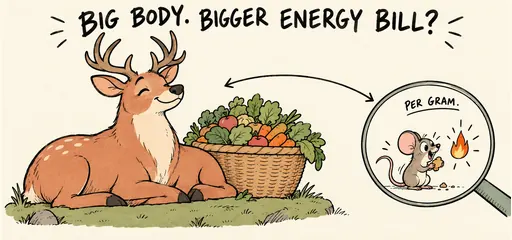
Hand-drawn deer beside a large food basket contrasts with a magnified mouse labeled per gram, comparing total and mass-specific energy use.

Metabolic Scaling: How to Compare Animal Energy Needs

A horse needs more food in total than a hummingbird. Per gram of body mass, however, the hummingbird uses energy much faster under comparable active conditions. During a cold night or an energy shortage it may enter torpor, lowering body temperature and metabolic rate. Metabolism continues. Fasting
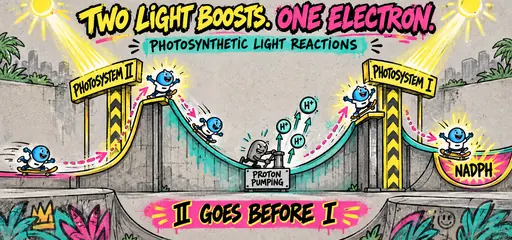
A comic electron follows two light-powered boosts, photosystem II then photosystem I, with proton pumping between them and an NADPH endpoint.

Photosynthetic Light Reactions: ATP, NADPH and Oxygen

A leaf appears green because it reflects and transmits a larger fraction of green light than of much of the red and blue light it receives. That does not mean green light is unused. Some green light is absorbed and can drive photosynthesis, including in deeper leaf layers. Distinguish a lower absorp
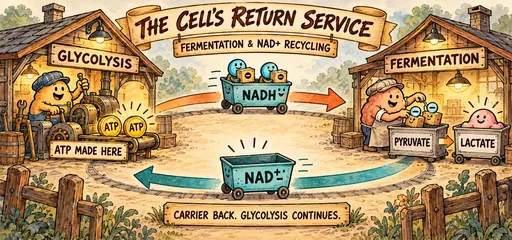
Hand-drawn fermentation comic: NADH delivers electrons to pyruvate, making lactate, while regenerated NAD+ returns to glycolysis, where ATP is made.

Fermentation and NAD+ Recycling: How Glycolysis Continues

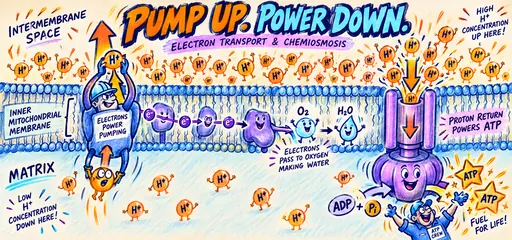
Crayon comic of mitochondrial electron transport pumping H+ into the intermembrane space and proton return through ATP synthase producing ATP in the matrix.

Electron Transport and Chemiosmosis: How ATP Forms

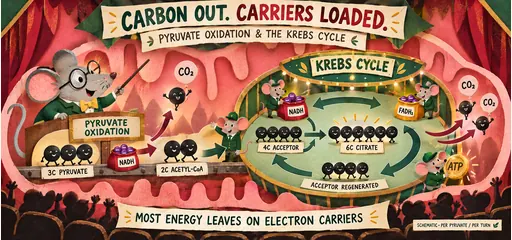
Handmade paper-theater comic showing pyruvate oxidation, acetyl-CoA entering the Krebs cycle, carbon dioxide release, acceptor regeneration and loaded electron carriers.

Pyruvate Oxidation and Krebs Cycle: Carbon and ATP Counts

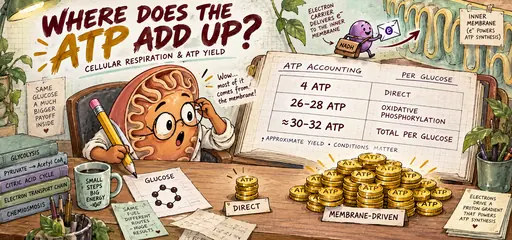
Watercolor mitochondrion accountant comparing 4 direct ATP with approximately 26–28 from oxidative phosphorylation, totaling about 30–32 ATP per glucose depending on conditions.

Cellular Respiration: Stages and 30–32 ATP Yield