Electron Transport and Chemiosmosis: How ATP Forms
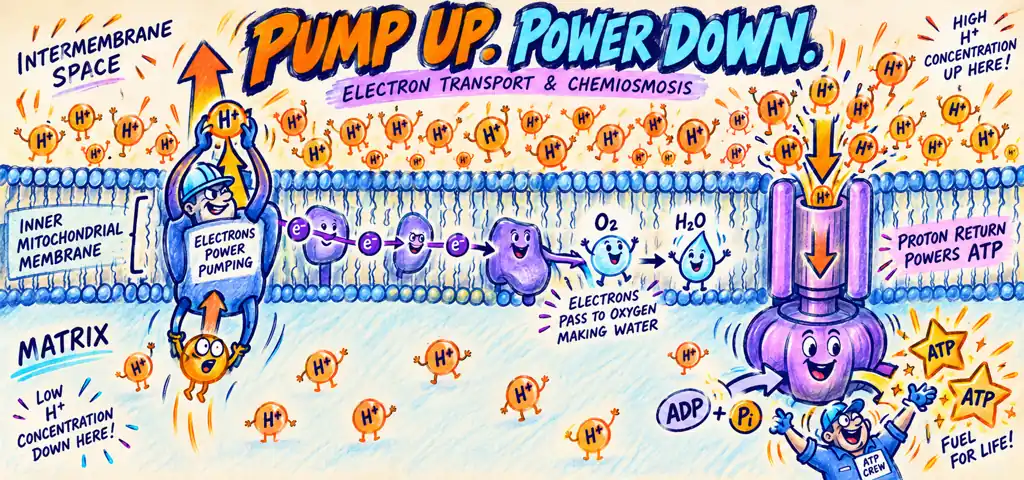
Electron transport builds a proton gradient; ATP synthase uses it to make ATP. In mitochondria, protons are pumped out of the matrix and return through ATP synthase into the matrix. Oxygen accepts electrons at the end of the respiratory chain. Follow electron flow, proton flow and ATP production separately.
A hydroelectric turbine captures part of the energy released as water moves downhill. The comparison helps explain ATP synthase: protons moving down an electrochemical gradient drive a rotating protein complex that makes ATP.
Watch the process
Cellular Respiration (UPDATED)
First, electron transfer toward oxygen supplies energy for proton pumping across the inner mitochondrial membrane. Proton return through ATP synthase then drives ATP production. These are connected processes with different components, so blocking the transport chain, blocking ATP synthase, and increasing membrane leakage produce different results.
The Chain Itself
The electron transport chain is a series of protein complexes and small mobile carriers embedded in the inner mitochondrial membrane. Matrix NADH supplies electrons to complex I. Electrons from succinate oxidation enter through enzyme-bound FAD at complex II, bypassing complex I. The familiar FADH2 shorthand describes this entry route; free FADH2 is not a mobile carrier that swims between these complexes. From there the electrons pass from carrier to carrier, and the order of the carriers is not arbitrary: the carriers have different reduction potentials, so electron flow toward oxygen releases free energy overall. Individual local steps need not each be a separate downhill drop.
The chain couples favorable electron transfer to proton pumping. Its intermediate carriers allow energy transfer to be linked to specific protein mechanisms rather than implying that every electron-transfer step pumps a proton.
Oxygen is the final electron acceptor: it receives electrons in a strongly favorable overall reduction, and it takes the spent electrons along with protons from the matrix to form water: \[\tfrac{1}{2}\,\text{O}_2 + 2\,\text{H}^+ + 2\,e^-\longrightarrow \text{H}_2\text{O} .\] This is the water that appears on the product side of the respiration equation, and it forms at complex four, not anywhere earlier. Without oxygen to accept electrons, upstream carriers become increasingly reduced and sustained respiratory electron flow stops.
Pumping and the Proton-Motive Force
The energy released at three points along the chain is used to move protons from the matrix into the intermembrane space, against their concentration gradient. Because the inner membrane is nearly impermeable to hydrogen ions, they stay where they are put, and two gradients build at once: a concentration difference, with more protons outside the matrix than inside, and a charge difference, with the intermembrane space made positive relative to the matrix. The two together are called the proton-motive force, the stored potential that drives protons back toward the matrix.
Membrane structure determines where this gradient forms. The inner membrane is folded into cristae, which multiply the surface area available for transport chains and ATP synthase, so a cell with high energy demand packs more cristae into each mitochondrion. The inner membrane is the essential barrier: it separates the matrix from the intermembrane space and strongly limits passive proton return. The outer membrane has pores, so it is inaccurate to treat the intermembrane space as sealed from the cytosol. An intact inner membrane allows the proton-motive force to drive oxidative ATP synthesis.
NADH’s electrons enter before the first pumping site and therefore drive pumping at three points. \(\text{FADH}_2\) enters after the first, so its electrons drive pumping at only two. Bypassing complex I reduces the pumping associated with that electron pair, explaining the lower approximate ATP yield for the complex-II route. Actual yield also depends on coupling, transport and leakage.
ATP Synthase and Chemiosmosis
ATP synthase is a protein machine that spans the inner membrane and provides a major coupled route back for protons; leaks and other transporters also use or dissipate the gradient. Protons flowing down their gradient through its membrane-embedded rotor turn it, the rotation twists a stalk that runs into the knob projecting into the matrix, and the twisting forces conformational changes in the knob’s catalytic sites that join ADP to inorganic phosphate. The proton cost depends on ATP synthase structure. A common effective estimate is about four proton equivalents per ATP delivered when associated transport costs are included; it is not a universal rotor stoichiometry.
Chemiosmosis couples ion movement down an electrochemical gradient to ATP synthesis. In mitochondria, electron transfer through the respiratory chain establishes the proton-motive force used in oxidative phosphorylation. Keep the two words apart from substrate-level phosphorylation, in which an enzyme moves a phosphate directly from an intermediate to ADP with no membrane and no gradient involved. Glycolysis and the Krebs cycle use substrate-level phosphorylation. At the inner mitochondrial membrane, ATP synthase couples proton return to ATP production.
Predicting the Effect of Four Metabolic Poisons
Assume isolated mitochondria have adequate substrates, oxygen, ADP, and phosphate and are compared shortly after treatment. For each of the following, predict what happens immediately to oxygen consumption, to the proton gradient, and to ATP synthesis, and give the reasoning rather than a memorized outcome. Compound 1 blocks the entry of electrons from NADH into the first complex. Compound 2 blocks the transfer of electrons to oxygen at the final complex. Compound 3 binds ATP synthase and jams its rotor. Compound 4 makes the inner membrane freely permeable to protons.
Set up the reasoning tool first. Three things are chained in one direction: electron flow builds the gradient, and the gradient drives ATP synthesis. Blocking the only supplied electron-entry route reduces downstream pumping. Blocking ATP synthase prevents coupled ATP production and can increase resistance to further pumping. A proton leak lowers the gradient and can accelerate respiration if electron supply and oxygen are adequate.
Compound 1, a chain blocker at the start. Electrons from NADH cannot enter, so pumping at the sites downstream of that entry point stops and the gradient falls. Oxygen consumption drops, because fewer electrons reach oxygen. ATP synthesis falls. A bypass is possible if a usable substrate such as succinate supplies electrons through complex II. Residual electron transport and ATP synthesis therefore depend on the substrates provided; they are not guaranteed after a complex-I block.
Compound 2, a blocker at oxygen. Cyanide and carbon monoxide act here. Electrons cannot reach oxygen, so upstream carriers accumulate in reduced states and sustained electron flow stops. Oxygen consumption falls to nearly zero, the gradient dissipates as protons leak back, and ATP synthesis stops. The Krebs cycle stops shortly afterward when \(\text{NAD}^+\) runs out. Note the order: the direct effect is on electron flow, and the ATP effect is second.
Compound 3, an ATP synthase blocker. The main coupled proton-return route is blocked, so the gradient grows steeper; membrane leaks and other transport routes may still permit some return. Pumping against a steeper gradient becomes harder, and electron flow and oxygen consumption fall; leaks can sustain residual respiration. ATP synthesis stops. The effect on electron flow is indirect: blocking the synthase indirectly slows the chain, because the chain is working against a gradient that no longer drains.
Compound 4, an uncoupler. Protons return through the membrane instead of through the synthase, so the gradient collapses and ATP synthesis fails. But the chain is now pumping against almost no back-pressure, so electron flow accelerates and oxygen consumption rises. Energy that would have become ATP leaves as heat. Newborn mammals use this mechanism in brown adipose tissue, using a protein that provides a controlled proton leak to generate heat.
Read the pattern. Oxygen consumption and ATP synthesis move together in three of the four cases and in opposite directions in the fourth. Rising oxygen consumption with falling ATP is characteristic of an uncoupler in this controlled comparison, under the supplied conditions.
Answer
A terminal chain block lowers oxygen use, gradient, and ATP; a complex-I block can be bypassed if an appropriate substrate supplies electrons downstream. A synthase blocker raises the gradient and lowers oxygen use and ATP. An uncoupler collapses the gradient, stops ATP, and raises oxygen consumption as the energy leaves as heat.
How Efficient Is Aerobic Respiration?
Complete oxidation of one mole of glucose releases about \(686\ \text{kcal}\). Using a yield of 32 ATP per glucose and \(7.3\ \text{kcal/mol}\) per ATP, calculate the fraction of that energy the cell captures, and interpret the remainder.
Step 1: find the energy captured. Multiply the ATP yield by the free energy of hydrolysis of each ATP. \[32 \times 7.3 = 233.6\ \text{kcal per mole of glucose.}\]
Step 2: express it as a fraction of what was available. \[\frac{233.6}{686} = 0.34, \text{ or about } 34\ \text{percent.}\]
Step 3: interpret both parts of the answer. The supplied values give a 34 percent accounting ratio. The remaining free-energy change is not automatically a measured quantity of heat: heat is related to enthalpy, and a living cell also performs other work. Real metabolic processes disperse energy and increase total entropy, but this arithmetic alone does not quantify those separate contributions.
Step 4: keep reference conditions consistent. ATP free energy depends on concentrations and conditions. Substituting an in-cell ATP value while leaving glucose oxidation at a different reference state does not produce a reliable efficiency measurement. Use matched thermodynamic assumptions, specify the ATP yield model, and distinguish a calculated free-energy ratio from measured heat.
Answer
About 34 percent of the free energy of glucose is captured as ATP using the supplied standard-state values and ATP yield. This illustrative ratio is not a direct measurement of an actual cell’s efficiency or heat production.
Distinctions to keep clear
The electron transport chain and ATP synthase perform different jobs. The electron transport chain makes no ATP. It moves electrons and pumps protons. ATP synthase makes all of the ATP at this stage, and it accepts no electrons at all. For precise accounting, distinguish the chain from ATP synthase: the chain builds the gradient that ATP synthase spends.
Track the named compartments. Mitochondrial electron transport pumps protons from the matrix to the intermembrane space; ATP synthase permits coupled return to the matrix. In chloroplasts, protons accumulate in the thylakoid lumen and return through ATP synthase to the stroma. The ATP-making side is the matrix in mitochondria and the stroma in chloroplasts. Do not replace these directions with a rule about the size or shape of a compartment.
Review: Electron Transport, the Proton Gradient, and Chemiosmosis
Electrons falling toward oxygen power proton pumping, and the returning protons power ATP synthase; the membrane converts one gradient into ATP.
A common idealized accounting gives about 26–28 ATP by oxidative phosphorylation and four ATP equivalents by substrate-level phosphorylation, for about 30–32 total per glucose. These are model yields, not a fixed output for every cell.
Blocking the chain, blocking the synthase, and puncturing the membrane give three different data patterns; check what happens to oxygen consumption before choosing.
Electron transport and chemiosmosis
Practice question 1
The immediate role of oxygen in aerobic respiration is to
-
combine with carbon to form the carbon dioxide that is exhaled
-
accept electrons at the end of the transport chain so that electron flow can continue
-
donate protons that are pumped into the intermembrane space
-
phosphorylate ADP at the catalytic sites of ATP synthase
Practice question 2
Isolated mitochondria are treated with a compound that binds ATP synthase and prevents proton flow through it. Compared with untreated controls, the treated mitochondria will show
-
a steeper proton gradient, reduced oxygen consumption, and little ATP synthesis
-
a collapsed proton gradient and increased oxygen consumption
-
normal ATP synthesis by substrate-level phosphorylation at the membrane
-
increased NADH oxidation and increased ATP synthesis
Practice question 3
NADH yields more ATP than \(\text{FADH}_2\) because
-
NADH carries four electrons while \(\text{FADH}_2\) carries two
-
NADH transfers its phosphate group directly to ADP
-
NADH delivers electrons earlier in the chain, so more proton-pumping sites are used
-
\(\text{FADH}_2\) cannot be reoxidized once it donates electrons
Practice answer key
1. B; 2. A; 3. C.
Practice answer explanations
-
Electron transport and chemiosmosis, Question 1. Choice B is correct. Oxygen’s immediate role is to accept electrons at the end of the chain, forming water, which is what allows the carriers upstream to be reoxidized and electron flow to continue. Choice A describes the carbon dioxide produced by decarboxylation, which involves no molecular oxygen. Choice C reverses the source of the pumped protons, which come from the matrix. Choice D assigns oxygen the job of ATP synthase.
-
Electron transport and chemiosmosis, Question 2. Choice A is correct. With the main ATP-producing proton-return route blocked, protons accumulate outside the matrix and the gradient steepens, pumping against it becomes harder, electron flow and oxygen consumption fall, and ATP synthesis stops. Choice B describes an uncoupler instead, which collapses the gradient and raises oxygen use. Choice C invents substrate-level phosphorylation at the membrane, which does not occur there. Choice D predicts more ATP from a blocked synthase.
-
Electron transport and chemiosmosis, Question 3. Choice C is correct. NADH delivers electrons before the first pumping site while \(\text{FADH}_2\) enters after it, so NADH drives pumping at three sites and \(\text{FADH}_2\) at two, and more pumped protons mean more ATP. Choice A misstates the electron count, since both carry two. Choice B invents a direct phosphate transfer from a carrier. Choice D is false, because \(\text{FADH}_2\) is routinely reoxidized and reused.
Continue your review at the AP Biology study hub.
Source and connected review
For an educational reference on respiratory complexes and chemiosmosis, see OpenStax Biology 2e: Oxidative Phosphorylation. Compare carrier recycling without a respiratory chain in our fermentation and NAD+ recycling lesson.

Related to This Article
More math articles
- Free Grade 8 English Worksheets for Illinois Students
- Geometry Puzzle – Challenge 65
- District of Columbia Algebra 1 Free Worksheets: 72 Free Printable Algebra 1 Practice PDFs
- The Best Grade 8 Math Book for Florida Students
- Algebra Puzzle – Challenge 50
- Sharecropping, the Crop-Lien System, Convict Leasing, and the New South
- The Best Grade 5 ELA Practice Tests for Nebraska Students
- Free GED Math Worksheets [Updated for 2026]
- ACT Math Test-Taking Strategies
- 49 Printable Arizona AASA Grade 5 Math Worksheets — Free Download with Step-by-Step Keys






What people say about "Electron Transport and Chemiosmosis: How ATP Forms"?
No one replied yet.