Evolution and Extinction: How Populations Respond to Change
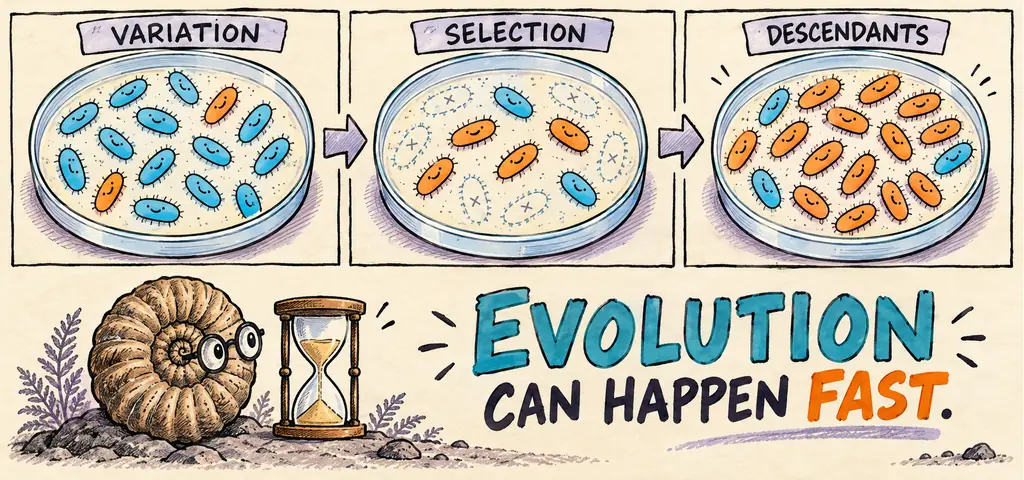
Influenza vaccines must be planned before the season in which they will be used. As circulating viruses evolve, their surface proteins can become a poorer match for the immune response the vaccine was designed to elicit. Mutation and selection are operating over months, which makes influenza an example of evolution that can be measured during a human lifetime.
Watch the process
Evolution Continues
Selection, drift, gene flow, and mutation continue to change populations. In a short time series, first establish what was measured: an allele frequency, a phenotype, or a physiological response. Those measurements support different conclusions.
An evolutionary explanation of a five-year data set uses the same mechanisms as an explanation of longer-term change. The time interval affects what you can observe, but it does not change the meaning of inherited population change.
Change You Can Measure in a Human Lifetime
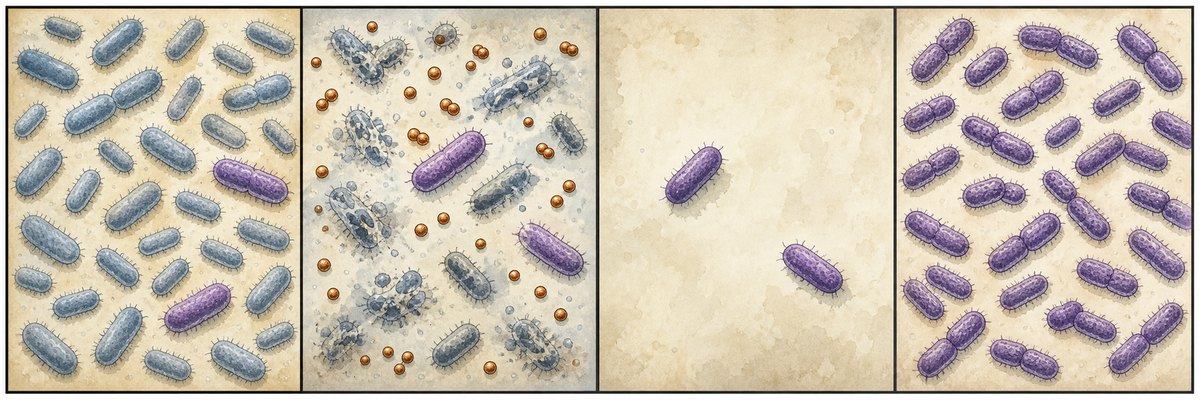
The clearest cases involve strong selection on a population that already carries variation. A hospital uses one antibiotic heavily; a few bacteria happen to carry an allele that lets them survive it, and those cells leave more descendants. The resistant type can become more common over successive generations. In this example, resistance was present before exposure; the drug favors variants that survive and reproduce. This does not mean mutations or gene transfer stop during treatment.
A stem may say a pesticide “caused” resistance, or that insects “developed” resistance in response to spraying. Both phrasings invert the mechanism. Write, and look for, the version that keeps the order right: variation existed, the agent changed survival and reproduction, allele frequencies shifted.
Reading a Resistance Data Set
A bacterial population is exposed to an antibiotic for twelve months. The frequency of a resistance allele rises from 0.02 to 0.61.
Does this show that the antibiotic caused a mutation? No. A frequency of 0.02 means the allele was already present in about two of every hundred copies before exposure began. The rise is consistent with resistant cells leaving more descendants under exposure, although allele frequencies alone do not identify every contributing mechanism.
Would the same rise happen in a population where the allele was absent? Not from selection alone. Selection can only shift frequencies among variants that exist; without the allele, the population would need a new mutation or gene flow from another population before selection had anything to act on.
Predict what happens if the drug is withdrawn. If carrying the allele reduces reproductive success in the drug-free environment, selection may favor susceptible variants. Resistance can persist when costs are small or compensated, or when other conditions continue to favor it. Withdrawal alone does not guarantee a decline.
Answer
The allele was already present at 0.02, so selection on standing variation is a supported explanation. The measurements do not show that exposure created the allele or rule out other processes during the study. Predict resistance after withdrawal using the new fitness conditions, not an automatic reversal.
Why Some Populations Evolve Fast Enough to Watch
Three properties make a population’s evolution observable on a human timescale, and a stem that mentions any of them is signaling that rapid change is expected.
Short generation time, the average interval between one generation and the next, matters most. Reproductive consequences accumulate across generations, and a bacterium dividing every twenty minutes passes through more generations in a weekend than a human population does in a millennium.
Large reproducing populations can generate many new variants because they contain many opportunities for mutation. Short generations, mutation rate, and selection strength together influence how quickly change becomes detectable. These factors do not guarantee that a particular mutation will appear or spread.
Two Named Patterns in Viral Evolution
The influenza case has two vocabulary items. Antigenic drift is the gradual accumulation of point mutations in surface-protein genes, which can alter antibody recognition. Despite its name, antigenic drift is not synonymous with random genetic drift; mutation and selection can both contribute. This variation is one reason influenza vaccine composition is reviewed regularly. Antigenic shift is an abrupt, major antigenic change in influenza A. It can arise through reassortment, when viruses infect the same cell and progeny acquire new combinations of genome segments. Not every reassortment event produces antigenic shift. A sufficiently novel virus can contribute to pandemic risk if it also spreads efficiently among humans; reassortment alone does not guarantee a pandemic.
Comparing Resistance Under Two Selection Regimes
Researchers randomly assign replicate bacterial cultures from the same inoculum to drug X alone or drugs X and Y together. Both conditions permit continued population growth under the experimental concentrations. The cultures begin with 2 percent carrying an X-resistance allele. The assay measures that same allele in both conditions. Mean percentages are shown; uncertainty is omitted in this simplified exercise.
| Month | 0 | 6 | 12 |
|---|---|---|---|
| X alone (percent X-resistance allele) | 2 | 34 | 78 |
| X and Y (percent X-resistance allele) | 2 | 4 | 5 |
Describe the contrast, propose a mechanism, and predict what might happen after X is withdrawn.
Step 1: compare the same measurement. The allele rose by 76 percentage points with X alone and by 3 points with X and Y. Both began with standing variation. The second row does not measure resistance to both drugs, so it cannot establish the frequency of double resistance.
Step 2: separate observation and explanation. The result is consistent with Y reducing the reproductive advantage of the X-resistant genotype. Test that hypothesis by comparing reproductive output of X-resistant and X-susceptible genotypes in each treatment. Replicate variation, viable population counts, and no-drug controls would strengthen the inference. The allele frequencies alone neither demonstrate the molecular target of Y nor quantify clinical treatment success.
Step 3: predict conditionally. After X withdrawal, resistance may decrease if its allele carries a reproductive cost in the new conditions. A cost-free allele can persist; other selection, drift, and gene flow also matter. A new mutation need not occur simultaneously at two targets: mutations can accumulate sequentially or arrive together by gene transfer.
Interpreting the result
The X-resistance allele increased much more with X alone. Reduced advantage in the combined condition is a testable explanation. Withdrawal favors loss only under an appropriate fitness cost; these data do not measure double resistance or establish a treatment recommendation.
Antibiotic and pesticide resistance illustrate evolution on short timescales. In viruses, inherited sequence variation can alter drug susceptibility or immune recognition. Influenza antigenic change can affect vaccine matching; HIV evolution can affect antiviral resistance and immune escape. These are distinct examples, not a claim that both have seasonal vaccines. Host shifts likewise involve exposure opportunities, host compatibility, and sometimes adaptive evolution; mutation alone does not explain every emergence event.
How Genetic Diversity Can Affect Persistence
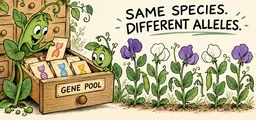
Rapid change is possible only where variation is available, so the second half of the question is what a population is carrying when the pressure arrives. A genetically diverse population is more likely to contain individuals suited to a new pathogen or a new climate; a population uniform at relevant loci has less standing variation for an adaptive response, although its existing genotype may already tolerate the change. Allelic richness and heterozygosity provide two ways to measure that variation.
A population’s stored genetic variation is the raw material selection needs; without it, selection cannot change frequencies among alternatives until mutation or gene flow supplies variation.
Drift can remove alleles; inbreeding reduces heterozygosity without necessarily removing alleles. Mutation and gene flow can add alleles.
A population can adapt as heritable variants associated with greater reproductive success become more common. Avoid saying it adapts on purpose; distinguish this change from individual acclimation.
Selection, Mutation, and Drug Response
A selective agent changes reproductive success; a mutagen increases mutation rate. A drug, a pesticide, or an immune system is a selective agent: it changes which variants reproduce. A mutagen is something that raises the rate at which new variants appear. Selection and mutation are different processes. Evidence that spraying favored resistant insects does not establish that spraying created their resistance alleles. Even in the rare case where an agent is also a mutagen, it still does not direct which mutation occurs, so the sentence remains wrong for a second reason.
Heritable population change differs from an individual physiological response. A person who takes a drug repeatedly may respond to it less over time, because their own physiology changed. A heritable rise in bacterial resistance can result from changing allele frequencies. Bacteria can also show nonheritable physiological tolerance, so reduced drug response alone does not establish genetic evolution. Separate an individual physiological response from inherited population change.
Extinction Is the Other Outcome
If a population cannot persist through tolerance, relocation, or adaptation, it may disappear. Extinction is a normal feature of evolutionary history, not an anomaly: the overwhelming majority of species that have ever lived are extinct, and a low background rate operates continuously. Against that baseline, the fossil record preserves several mass extinction events in which rates spiked far above background and a large fraction of existing lineages ended in a geologically short interval.
Mass extinctions illustrate two evolutionary consequences. First, they show that fitness is relative to conditions: traits that were advantageous for millions of years become irrelevant when the environment shifts faster than populations can track. Second, mass extinctions can be followed by diversification among surviving lineages as ecological opportunities change. Recovery takes time, varies among groups, and does not restore the lineages that went extinct. The diversification of mammals after the end-Cretaceous extinction is the standard case.
Current extinction rates are elevated well above the background rate, and the drivers are habitat loss and fragmentation, introduced species, overharvesting, pollution, and climate change. You are not asked to memorize rate figures. You are asked to connect a stated human activity to a mechanism, which may involve direct mortality, habitat loss, disrupted reproduction, or smaller populations losing genetic variation. Genetic diversity is one part of persistence, not its sole cause.
Continuing evolution, diversity, and extinction
Practice question 1
A field population of insects is sprayed with a new insecticide for three seasons. The frequency of a resistance allele rises from 0.03 to 0.55. Which statement best explains the result?
-
The insecticide induced mutations that produced the resistance allele in exposed insects
-
The allele was already present, and the insecticide changed which insects survived and reproduced
-
Individual insects adjusted their physiology over three seasons and passed the adjustment to offspring
-
Resistance spread because insects preferentially mated with resistant partners
Practice question 2
Two plant populations of equal size occupy similar habitats. Population X carries high heritable variation; population Y passed through a severe bottleneck and is nearly genetically uniform. Assume the difference includes resistance-related loci and neither population already has fixed complete resistance. A new fungal pathogen arrives. Which outcome is most likely, and why?
-
Both populations respond equally, because population size, not variation, determines survival
-
Population Y responds faster, because uniform populations transmit advantageous alleles more efficiently
-
Population X is more likely to persist, because it is more likely to contain individuals with alleles conferring resistance
-
Population Y is more likely to persist, because low variation reduces the number of susceptible genotypes
Practice question 3
Which statement about mass extinctions is best supported by the fossil record?
-
They eliminate lineages at random with respect to environmental conditions and leave no lasting pattern
-
They are followed by adaptive radiation among surviving lineages as vacated niches reduce competition
-
They occur only when a single external event exceeds every species’ physiological tolerance
-
They lower total diversity permanently, since the lineages lost are never replaced by new ones
Practice answer key
1. B; 2. C; 3. B.
Practice answer explanations
-
Continuing evolution, diversity, and extinction, Question 1. Choice B is correct. A starting frequency of 0.03 shows the resistance allele was present before spraying began; the insecticide changed which genotypes survived and reproduced, so its frequency rose. Choice A inverts the mechanism, because selective agents do not direct which mutations appear. Choice C describes an acquired physiological adjustment, which is not heritable. Choice D invokes mate choice, which the scenario gives no evidence for and which would not by itself track insecticide exposure.
-
Continuing evolution, diversity, and extinction, Question 2. Choice C is correct. Selection can act only on variation that already exists, so the population carrying more heritable variation is more likely to contain individuals with alleles conferring fungal resistance. Choice A treats population size as sufficient, but two populations of equal size differ here in variation, which is the variable that matters. Choice B misstates the consequence of uniformity: identical individuals share the same susceptibilities. Choice D reverses the relationship, since low variation reduces the chance that any resistant genotype is present at all.
-
Continuing evolution, diversity, and extinction, Question 3. Choice B is correct. The fossil record repeatedly shows diversification among surviving lineages after a mass extinction, because emptied niches reduce competition and open new selective opportunities. Choice A denies the environmental pattern the record shows. Choice C overstates the requirement, since mass extinctions can follow combined and cascading causes rather than one universal threshold. Choice D treats the loss as permanent, but the same record shows diversity rebuilding over several million years as surviving lineages radiate into the emptied niches.
Continue your review at the AP Biology study hub.
Source review: CDC guidance on influenza drift and shift and OpenStax on biodiversity and extinction.

Related to This Article
More math articles
- How to Unlock the Essentials: A Comprehensive Guide to Factors, GCD, Factorization, and LCM
- Best Laptops for Teachers
- Praxis Math Formulas
- How to Solve Logarithmic Equations: Definition and Properties
- The Best Grade 7 ELA Practice Tests for Illinois Students
- Michigan Algebra 1 Free Worksheets: Free Standards-Aligned Algebra 1 Worksheets, Answers Included
- ISEE Middle-Level Math Worksheets: FREE & Printable
- Cutting Wordiness and Fixing Order
- 5 Best GED Math Study Guides
- Full-Length HiSET Math Practice Test-Answers and Explanations





What people say about "Evolution and Extinction: How Populations Respond to Change"?
No one replied yet.