How New Species Form: Speciation and Reproductive Isolation
A mule can live and work for many years but is usually sterile. A horse and a donkey can produce this hybrid, yet the hybrid usually cannot pass genes into another generation. Fertilization alone therefore does not establish unrestricted gene flow. To study a species boundary, examine both the production of hybrids and their ability to survive and reproduce.
Watch the process
Speciation
Gene flow can oppose divergence by exchanging alleles between populations. Reduced gene flow can allow mutation, drift, and divergent selection to make the populations more distinct. Some divergence can persist despite limited gene exchange. Speciation involves the development of barriers that maintain separate lineages, rather than requiring every migrant or hybrid to disappear.
Under the biological species concept, a species is a group of natural populations whose members interbreed and produce fertile offspring and which are reproductively isolated from other such groups. This concept is useful for sexually reproducing organisms, but reproductive evidence can be unavailable or difficult to interpret. Fossils cannot be test-mated, asexual lineages do not interbreed, and geographically separated populations may never meet. Some close relatives also hybridize where their ranges overlap. Biologists therefore treat a species boundary as a hypothesis supported by reproductive, genetic, ecological, and morphological evidence together. Operationally the question is whether two lineages are evolving separately, not whether one test comes back positive.
Three other concepts fill the gaps. The morphological species concept groups organisms by body form, a major source of evidence for fossils, and it fails when two species look alike. The ecological species concept groups them by the role and resources they use, which works for asexual organisms. The phylogenetic species concept defines a species as the smallest group of populations diagnosable as a distinct evolutionary lineage; formulations differ, and morphological or molecular characters can supply evidence. None is correct while the others are wrong; they are different operational tests, and biologists apply whichever the evidence permits.
Speciation is the process by which one lineage becomes two, and it requires reproductive isolation. Reduced gene flow starts it, divergent mutation, drift, and selection push the gene pools apart, and isolating barriers can maintain the split when contact resumes.
Two Geographic Routes
Allopatric speciation begins with physical separation: a river changes course, a mountain range rises, or a few founders cross a barrier. Gene flow is reduced, and mutation, drift, and selection can then produce divergence. The amount of exchange depends on the barrier and the organisms’ ability to disperse. If the groups later meet, persistent reproductive barriers support separate lineage status. Geographic separation alone does not establish that speciation has occurred.
Sympatric speciation occurs without geographic separation, in populations that overlap in space, so it needs another mechanism to cut gene flow within one population. Polyploidy is the clearest and is common in plants: an error in cell division produces offspring with extra chromosome sets that cannot breed with the parent population but can breed among themselves, so a new species can begin in one generation, provided the new cytotype establishes a reproducing lineage. Habitat differentiation and mate choice can also do it, as when an insect population splits between two host plants in one field.
Two versions of polyploidy earn their own names. Autopolyploidy involves extra chromosome sets derived from one species. Doubling a diploid chromosome complement produces a tetraploid. Crosses between tetraploids and diploids can produce triploids with reduced fertility because chromosome pairing and segregation are disrupted. A new cytotype must still establish a reproducing lineage; chromosome doubling alone does not guarantee a lasting species. Allopolyploidy combines chromosome sets from different species. A hybrid may have reduced fertility when chromosomes cannot pair properly; chromosome doubling can supply pairing partners and restore fertility. Bread wheat has an allopolyploid history.
Habitat differentiation and mate choice work more slowly by the same logic. Apple maggot flies that shifted from hawthorn to introduced apple trees mate on the fruit they were raised on, cutting gene flow between host groups with no mountain range involved.
Prezygotic and Postzygotic Barriers
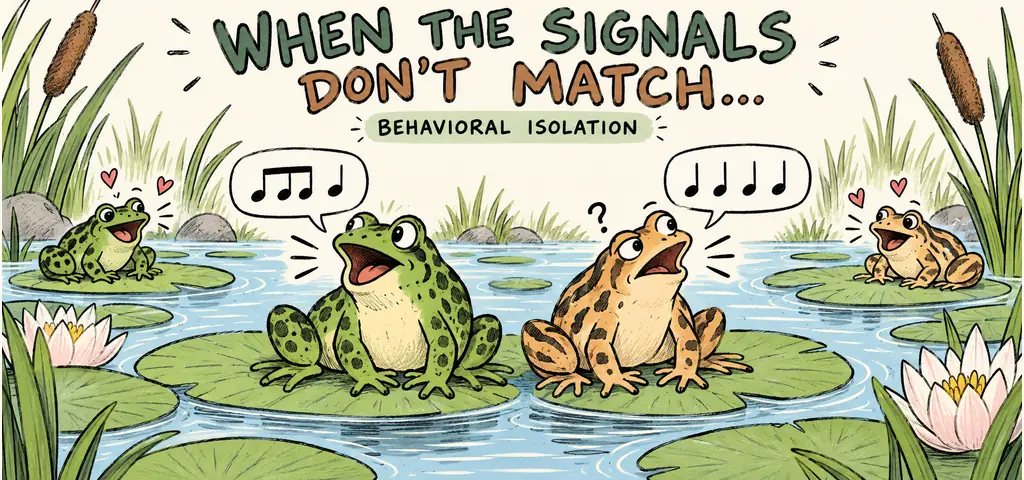
Isolating mechanisms are sorted by whether they act before or after a zygote forms. Prezygotic barriers prevent mating or fertilization: habitat isolation puts potential mates in different microenvironments, temporal isolation puts their breeding at different times, behavioral isolation means courtship signals do not match, mechanical isolation means structures do not fit, and gametic isolation means sperm and egg meet without fusing. Postzygotic barriers act after fertilization: reduced hybrid viability means the embryo develops poorly or dies, reduced hybrid fertility means the hybrid is healthy but sterile, as most mules are, and hybrid breakdown means the first hybrid generation is fine while its offspring are weak or sterile.
Use zygote formation as the dividing line. If a zygote never formed, the barrier is prezygotic no matter how far the process got.
What Happens When Diverging Populations Meet Again
Diverging populations can continue to produce some hybrids. A hybrid zone is a region where two diverging populations meet and produce at least some offspring together. Three outcomes are possible, and each is a prediction you can be asked to make.
Reinforcement occurs when hybrids have low fitness. An inherited tendency to avoid low-fitness hybrid matings can have an advantage, because it prevents the individual from wasting its reproductive effort on offspring that will not survive or breed. Selection therefore strengthens prezygotic barriers, and the two lineages become more distinct where they overlap than where they do not. Watch for that last clue in data: stronger prezygotic isolation in the contact zone than away from it is consistent with reinforcement. Hybrid fitness and alternative ecological explanations should also be examined.
Fusion occurs when hybrids do well: gene flow through the zone exceeds the divergence being generated, the differences wash out, and the populations merge. Divergence does not always lead to persistent separate lineages.
Stability occurs when hybrids keep forming but neither replace the parent forms nor disappear, so the zone persists with a sharp gradient in allele frequencies across it. That is evidence of a balance between gene flow and divergence, not evidence that speciation has finished or failed.
Rate and Radiation
Adaptive radiation is the rapid diversification of one lineage into many, each exploiting a different ecological opportunity. It can follow ecological opportunities associated with a mass extinction, colonization, or a key innovation; none guarantees a radiation. Darwin’s finches are a radiation, as is the diversification of mammals after the end-Cretaceous extinction.
Two models describe the tempo of change, and they read the same fossil record differently rather than contradicting each other. Gradualism describes slow accumulation of small changes. Punctuated equilibrium describes long spans of morphological stability, called stasis, interrupted by geologically brief episodes of rapid change, often in small isolated populations that leave few fossils. It does not claim change is instantaneous; brief here can mean tens of thousands of years.
Which Barrier, and Which Route?
Two populations of a flowering plant share a meadow. One flowers in early May and the other in late July, and hand-pollination between them in a greenhouse produces vigorous, fertile seedlings. Classify the isolation and the route.
Take the barrier first. Different flowering seasons prevent pollen exchange in the meadow, so temporal isolation is the demonstrated prezygotic barrier. Successful hand-pollination shows that fertilization and fertile first-generation hybrids are possible under those conditions. It does not exclude field-specific hybrid disadvantages or later-generation hybrid breakdown.
Now the route. Sharing a meadow today does not establish where divergence began. The populations might have diverged together or come into contact after geographic separation. Historical distribution and genetic evidence would help distinguish sympatric from allopatric origin.
Answer
Temporal isolation is supported. The geographic route of origin cannot be determined from current overlap alone, and viable first-generation hybrids do not exclude every postzygotic barrier.
Deciding Whether Two Populations Are One Species
Two populations of a salamander live on opposite sides of a mountain ridge. A researcher collects the following data.
| Observation | East slope | West slope |
|---|---|---|
| Mean adult length (mm) | 84 | 79 |
| Breeding season | March, April | March, April |
| Courtship display | tail-wave, 3 cycles | tail-wave, 3 cycles |
| Percent of lab crosses producing eggs | 91 | |
| Percent of hybrid eggs hatching | 88 | |
| Hybrid fertility at maturity | fertile | |
| Migration across ridge (marked animals) | 0 of 240 in 6 years | |
Are these one species or two, and what is actually keeping them apart?
Step 1: evaluate reproductive evidence. The lab crosses show that fertile first-generation hybrids can form. This is consistent with one species under a biological species interpretation, but it is not decisive. Within-population cross controls are needed to judge whether 88 percent hatching represents reduced hybrid viability. Later-generation fitness and mating behavior in natural contact also remain untested.
Step 2: evaluate geography. No crossings were detected among 240 marked animals. The ridge plausibly restricts gene flow, but nondetection does not establish exactly zero migration. Geographic isolation can start allopatric divergence; it differs from intrinsic incompatibilities that persist after the geographic barrier is removed.
Step 3: interpret morphology. Mean lengths differ by 5 mm, but sample sizes, variation, and common-environment rearing are needed to evaluate the difference. It could involve environmental effects as well as inherited divergence. Size alone does not settle species status.
Step 4: propose the next evidence. Compare within- and between-population crosses, offspring survival and fertility through a second generation, mate choice under natural conditions, and genetic evidence of gene exchange. Continued isolation could promote divergence, while renewed contact could permit gene flow; neither outcome is guaranteed.
Interpreting the result
The evidence supports geographic separation with retained capacity for fertile hybridization. It does not conclusively resolve species status or exclude all reproductive barriers.
Test the Reproductive Barrier
Geographic separation can restrict gene flow without establishing an intrinsic reproductive barrier. A river between two populations stops gene flow while it is there, and that is what starts allopatric speciation, but geography alone does not demonstrate an intrinsic reproductive barrier. Such a barrier is a property of the organisms that keeps gene pools separate even when the organisms are in the same place. The test question is simple: if you put the two groups together, would they interbreed successfully? Successful crossing suggests retained compatibility, but one cross does not exclude ecological or later-generation barriers.
Zygote formation separates prezygotic from postzygotic barriers. Did a zygote form? If sperm and egg never fused, for any reason at all, the barrier is prezygotic, including gametic isolation where the sperm reached the egg and failed to fertilize it. If a zygote formed and then anything went wrong, the barrier is postzygotic, including a hybrid that dies in the first week and a hybrid that lives for decades and is sterile.
Speciation is the accumulation of barriers to gene flow until two populations evolve as separate lineages.
Reduced gene flow can permit divergence through mutation, drift, and selection. Separate lineages may persist despite some hybridization, so exactly zero gene exchange is not a universal test of species status.
Geography is what starts allopatric speciation, not what completes it. Ask whether the groups would still fail to interbreed if the barrier were removed.
Speciation and isolation
Practice question 1
Two insect species mate readily, but the offspring die during larval development. This is an example of
-
behavioral isolation
-
gametic isolation
-
reduced hybrid viability
-
temporal isolation
Practice question 2
A polyploid plant arises in a field and breeds with other polyploids but not with the surrounding diploid population. This is best described as
-
allopatric speciation, because the polyploids are reproductively separated
-
sympatric speciation, because the new lineage arose within the range of the parent population
-
gene flow, because chromosome sets moved between populations
-
adaptive radiation, because a new form appeared
Practice question 3
A fossil lineage changes little for four million years, shifts rapidly over fifty thousand years, then stabilizes. The pattern fits
-
gradualism, because the lineage did change over the four million years
-
punctuated equilibrium, with long stasis interrupted by geologically brief change
-
an absence of selection during the stable intervals
-
adaptive radiation, because the rapid interval produced a burst of new forms
Practice answer key
1. C; 2. B; 3. B.
Practice answer explanations
-
Speciation and isolation, Question 1. Choice C is correct. A zygote formed and then failed to develop, which places the barrier after fertilization and identifies reduced hybrid viability. Choices A and D name prezygotic barriers that prevent mating from occurring, but the stem says mating happened readily. Choice B also acts before a zygote exists, and the stem states that offspring were produced.
-
Speciation and isolation, Question 2. Choice B is correct. The new lineage arose inside the geographic range of the parent population with no physical barrier, which is sympatric speciation; polyploidy is its most common mechanism in plants. Choice A requires geographic separation that the stem does not provide. Choice C misuses gene flow, which moves alleles between populations rather than blocking reproduction. Choice D names a pattern of diversification into many forms, not a single origin event.
-
Speciation and isolation, Question 3. Choice B is correct. Long stasis interrupted by geologically brief change is the pattern punctuated equilibrium describes, and fifty thousand years is brief on that scale. Choice A notices that change occurred but ignores its distribution in time; gradualism describes gradual accumulation of changes across the four million years, not concentrated in one short interval. Choice C confuses stasis with an absence of selection, because stasis can coexist with stabilizing selection and does not by itself reveal the cause. Choice D names diversification into many lineages, while the stem describes one lineage changing along its own branch.
Continue your review at the AP Biology study hub.
For further explanation, see OpenStax’s Formation of New Species and Reconnection and Speciation Rates.

Related to This Article
More math articles
- Algebra Puzzle – Challenge 50
- The Lorenz curve plots cumulative shares
- Coordination and Subordination
- NCLEX-RN Study Material Audit: Keep, Patch, or Replace? (2027 Prep)
- What Does the STAAR Test Stand For?
- Latin Roots for Actions and Ideas
- Overview of the HiSET Mathematics Test
- 7th Grade MEAP Math Worksheets: FREE & Printable
- 6th Grade OST Math Worksheets: FREE & Printable
- Middle-Range Theory and Evidence





What people say about "How New Species Form: Speciation and Reproductive Isolation"?
No one replied yet.