Free Grade 8 English Worksheets for Connecticut Students
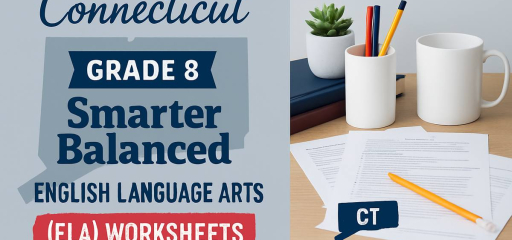
Eighth grade asks something new of readers. It is not enough to locate a supporting detail anymore, a student has to look at several candidates and judge which one supports the point most strongly, then say why. That move, from finding to evaluating, is the quiet center of Grade 8 English.
The same shift runs through writing. A Grade 8 argument has to do more than state a claim and pile on reasons; it has to take the opposing view seriously, name the counterclaim honestly and answer it. Grammar turns more analytical too: gerunds, participles, and infinitives; the deliberate choice between active and passive voice; the five verb moods; and the sentence that slips from one mood to another and needs to be caught.
These worksheets were made for that stretch of the year. Whether a student is in Bridgeport, New Haven, Hartford, or Stamford, they offer one skill at a time and enough practice to make it stick.
What’s on this page
Forty-six single-skill PDFs, each aligned to the Connecticut Core Standards for ELA at Grade 8. Each file targets one standard and nothing more. A student working on conflicting evidence is not also being quizzed on roots and affixes; a student on verbals is not slowed by a reading passage.
Every PDF opens with a one-page Quick Review written in plain language. Practice items follow and build from approachable to demanding. The closing page is a student-facing answer key with brief explanations, written so a student can check their own work and learn from the reasoning, not just see the right letter.
Reading: Literature
- Citing Strong Evidence and Making Inferences, [RL.8.1] pick the strongest support and reason past what the text says outright
- Theme and Objective Summary, [RL.8.2] name the lesson and retell it without sliding into opinion
- Dialogue, Incidents, and Character Decisions, [RL.8.3] trace how a line of dialogue or one event turns a character
- Word Choice, Figurative Meaning, and Tone, [RL.8.4] how a single word choice sets the mood and reveals attitude
- Comparing Literary Structure and Style, [RL.8.5] two texts, two structures, and why each author built it that way
- Point of View, Suspense, and Humor, [RL.8.6] how what the reader knows but a character doesn’t creates tension or comedy
- Evaluating Text and Film Versions, [RL.8.7] what a director kept, cut, or changed, and the effect of each choice
- Modern Stories and Traditional Patterns, [RL.8.9] spot the old myth or pattern living inside a new story
Reading: Informational Text
- Citing Evidence in Informational Text, [RI.8.1] pull the strongest article evidence for both stated and inferred ideas
- Central Idea and Objective Summary, [RI.8.2] find the main idea and summarize without leaking judgment
- Connections Among Ideas and Events, [RI.8.3] how a text links people, events, and ideas through comparison and cause
- Technical, Figurative, and Connotative Meaning, [RI.8.4] three different jobs one word can do in nonfiction
- Text Structure and the Role of Sentences, [RI.8.5] how one sentence or paragraph holds up the author’s larger point
- Author Point of View and Conflicting Evidence, [RI.8.6] find the author’s stance and how they handle evidence that disagrees
- Evaluating Mediums and Formats, [RI.8.7] weigh print, video, and audio for what each does best
- Evaluating Arguments, Claims, and Evidence, [RI.8.8] sort sound reasoning from weak, and relevant evidence from filler
- Conflicting Information Across Texts, [RI.8.9] two texts disagree on fact or interpretation, figure out where and why
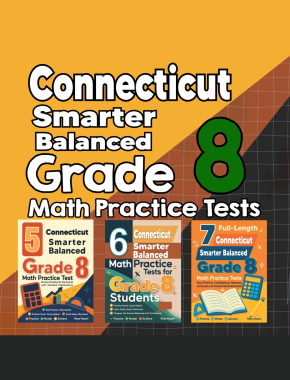
Working on Math Too? Try the Connecticut Smarter Balanced Grade 8 Math Bundle
Many third graders are getting ready for the Smarter Balanced in both subjects. If your child also needs math practice that matches the same standards, this companion bundle is the shortest path, workbook, study guide, and full practice tests in one download.
Writing
- Argument Writing: Claims, Reasons, and Evidence, [W.8.1] Grade 8 is the year the counterclaim must be answered, not just named
- Informative and Explanatory Writing, [W.8.2] teach a reader with a thesis, ordered sections, and clean transitions
- Narrative Writing, [W.8.3] pacing, dialogue, sensory detail, and an ending that lands
- Writing for Task, Purpose, and Audience, [W.8.4] same idea, reshaped for three different readers and goals
- Planning, Revising, and Editing, [W.8.5] sometimes the real revision is starting the paragraph over
- Short Research Projects, [W.8.7] ask a focused question, then let the findings sharpen it
- Gathering, Evaluating, and Citing Sources, [W.8.8] judge a source’s credibility, then cite it the way a teacher expects
Speaking & Listening
- Collaborative Discussions, [SL.8.1] come prepared, build on others, and disagree without dismissing
- Analyzing Media Purpose and Motive, [SL.8.2] name what a piece of media wants from you and how it is trying to get it
- Evaluating a Speaker’s Argument, [SL.8.3] find the claim, the reasoning, the evidence, and the soft spots
- Presenting Claims and Findings, [SL.8.4] open with the point, preview the order, and stay in it
- Using Digital Media in Presentations, [SL.8.5] make slides, audio, and visuals carry weight, not just decorate
- Adapting Speech to Context, [SL.8.6] the register you use with friends is not the register a presentation needs
Grammar
- Verbals: Gerunds, Participles, and Infinitives, [L.8.1a] verb forms doing the work of nouns, adjectives, and adverbs
- Active and Passive Voice, [L.8.1b] choose the voice on purpose instead of by accident
- Verb Mood: Indicative, Imperative, Interrogative, Conditional, Subjunctive, [L.8.1c] five moods and the meaning each one signals
- Correcting Shifts in Voice and Mood, [L.8.1d] catch the sentence that changes voice or mood mid-thought
Conventions: Punctuation, Spelling
- Punctuation for Pauses and Breaks: Comma, Ellipsis, Dash, [L.8.2a] the three marks that control how a sentence breathes
- Ellipses for Omitted Text, [L.8.2b] trim a quotation honestly without changing what it meant
- Spelling Grade-Appropriate Words, [L.8.2c] homophones, doubled letters, and the words eighth graders miss most
Knowledge of Language and Style
- Voice and Mood for Effect, [L.8.3a] use active or passive voice and verb mood as deliberate style tools
Vocabulary and Word Study
- Using Context Clues, [L.8.4a] name the kind of clue, then use it on purpose
- Greek and Latin Roots and Affixes, [L.8.4b] one root unlocks ten unrelated words
- Using Reference Materials Effectively, [L.8.4c] match the tool, dictionary, thesaurus, glossary, to the question
- Verifying Word Meaning, [L.8.4d] confirm the guess in context before committing to it
- Figures of Speech: Verbal Irony and Puns, [L.8.5a] catch the meaning that runs opposite the words
- Word Relationships and Nuance, [L.8.5b] sort synonyms by the small differences that actually matter
- Connotation: Shades of Meaning, [L.8.5c] same fact, different feeling, different word
- Academic and Domain-Specific Vocabulary, [L.8.6] words that travel across subjects and words tied to one field
How to use these worksheets at home
Connecticut packs a lot into a small map, a student might go from a Hartford classroom to a Stamford commute town to a quiet shoreline evening near Long Island Sound, all in the same week. These PDFs travel just as easily. Each one is a single sitting of about twelve to fifteen minutes, short enough to slot between everything else.
Keep it light and regular: two PDFs a week, a couple of days apart, paired so they reinforce each other. A reading skill and a related writing skill is the best combination. Try *Citing Strong Evidence and Making Inferences* on a Wednesday, then *Argument Writing: Claims, Reasons, and Evidence* on the weekend, by the time the student writes, weighing strong evidence is already a habit.
Whether the work happens at a kitchen table in New Haven, a desk in Bridgeport, or a quiet corner near the water, the routine holds. Print the PDF the night before, keep the answer key aside, and let your student check their own work when they are done. Reading the explanations is the step that turns a worksheet into actual understanding.
A note about Smarter Balanced at Grade 8
Connecticut students take the Connecticut Smarter Balanced Summative Assessment in English language arts each spring. It is aligned to the Connecticut Core Standards for ELA, the same standards these worksheets are built around.
The Grade 8 Smarter Balanced assessment combines selected-response and constructed-response items with a performance task, and it rewards analysis over recall: which quotation most strongly supports a claim, how an author handles evidence that disagrees, what a paragraph does for the whole text. The performance task has students read sources and write from them, the reading-into-writing move these PDFs practice directly.
Because each worksheet isolates a single standard, you can treat the lead-up to spring as a checklist. Find the two or three skills your student struggles with most, work just those, and leave the solid ones alone.
Want everything in one bundle?
If a single organized program would serve you better than a folder of separate files, the bundle pulls everything into one clear sequence for the spring Smarter Balanced assessment.
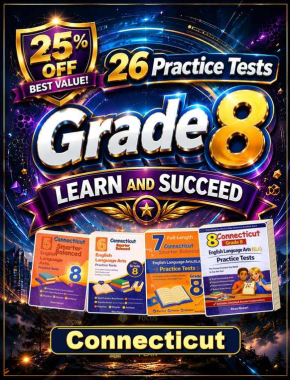
Connecticut Grade 8 ELA Preparation Bundle, four practice-test books, full-length practice tests, complete answer keys with explanations.
A short closing
Eighth-grade English is a short coastline walk with a lot of ground in it. You cover it one stretch at a time, and the view keeps widening. Bookmark this page, print one PDF tonight, and let your student start with a single skill. The next step is always close.
Best Bundle to Ace the Connecticut Smarter Balanced Grade 8 ELA
Looking for the best resource to help your kid ace the Connecticut Smarter Balanced? Try this bundle, four full practice-test books (5 + 6 + 7 + 8 tests) covering the same Grade 8 reading, writing, and language skills your child is already learning. Instant PDF download, answer keys included.

Related to This Article
More math articles
- Algebra Puzzle – Challenge 51
- 8th Grade Math Worksheets for Florida (FAST): 72 Free Printable PDFs
- 5th Grade SBAC Math FREE Sample Practice Questions
- Free GED Math Practice Test and 20 Sample Questions
- Mean, Median, Mode, and Range: A Plain-English Statistics Guide for 2026
- How maths helps in everyday life
- Measurements – Time
- Mutations and Genetic Evidence
- How to Find Domain and Range of Relations
- Top 10 Tips for Managing Time Effectively on the SAT Math







What people say about "Free Grade 8 English Worksheets for Connecticut"?
No one replied yet.