8th Grade MAP Math FREE Sample Practice Questions

8- A
Percent of cities in the type of pollution A:
\(\frac{6}{10} × 100=60\%\)
Percent of cities in the type of pollution C:
\(\frac{4}{10} × 100 = 40\%\)
Percent of cities in the type of pollution E:
\(\frac{9}{10}× 100 = 90\%\)
9- A
Let the number of cities be added to the type of pollution B be \(x\). Then:
\(\frac{x + 3}{8}=0.625→x+3=8×0.625→x+3=5→x=2\)
10- A
AB\(=12\) And AC\(=5\)
BC\(=\sqrt{(12^2+5^2 )} = \sqrt{(144+25)} = \sqrt{169}=13\)
Perimeter \(=5+12+13=30\)
Area \(=\frac{5×12}{2}=5×6=30\)
In this case, the ratio of the perimeter of the triangle to its area is:
\(\frac{30}{30}= 1\)
If the sides AB and AC become twice as long, then:
AB\(=24\) And AC\(=10\)
BC\(=\sqrt{(24^2+10^2 )} = \sqrt{(576+100)} = \sqrt{676} = 26\)
Perimeter \(=26+24+10=60\)
Area \(=\frac{10×24}{2}=10×12=120\)
In this case, the ratio of the perimeter of the triangle to its area is:
\(\frac{60}{120}=\frac{1}{2}\)
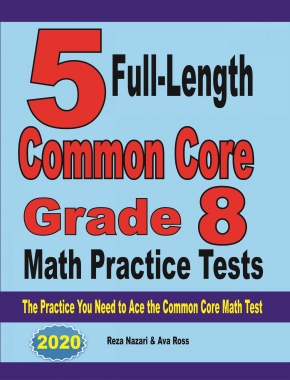
Looking for the best resource to help you succeed on the MAP Grade 8 Math test?
The Best Books to Ace the 8th Grade MAP Math Test

About the MAP (Measures of Academic Progress)
MAP (Measures of Academic Progress by NWEA) is a computer-adaptive assessment that measures student growth and achievement in mathematics.
The MAP (Measures of Academic Progress) assessment format includes Computer-adaptive multiple choice. Students are evaluated on their ability to:
- Understand and apply mathematical concepts
- Solve multi-step problems requiring reasoning
- Communicate mathematical thinking
- Use appropriate mathematical models and strategies
Grade 8 Sample Problems with Solutions
Sample Problem 1: Proportional Relationships
A recipe calls for 3 cups of flour for every 2 cups of sugar. If you want to make a batch using 8 cups of sugar, how many cups of flour do you need?
Solution
Set up a proportion: \(\frac{3}{2} = \frac{x}{8}\)
Cross-multiply: \(2x = 3 \times 8\)
\(2x = 24\)
\(x = 12\)
Answer: You need 12 cups of flour.
Key concept: Proportional relationships require that the ratio of two quantities remains constant. Use cross-multiplication to solve proportions.
Sample Problem 2: Multi-Step Linear Equations
Solve: \(3(x + 4) – 2x = 5 + x\)
Solution
Step 1: Distribute the 3
\(3x + 12 – 2x = 5 + x\)
Step 2: Combine like terms on the left
\(x + 12 = 5 + x\)
Step 3: Subtract x from both sides
\(12 = 5\)
Answer: No solution (inconsistent equation).
Key concept: When variables eliminate and you get a false statement, the equation has no solution.
Sample Problem 3: Pythagorean Theorem
A right triangle has legs measuring 5 cm and 12 cm. What is the length of the hypotenuse?
Solution
Use the Pythagorean theorem: \(a^2 + b^2 = c^2\)
\(5^2 + 12^2 = c^2\)
\(25 + 144 = c^2\)
\(169 = c^2\)
\(c = \sqrt{169} = 13\)
Answer: The hypotenuse is 13 cm.
Key concept: The Pythagorean theorem applies to right triangles. The hypotenuse is opposite the right angle.
Sample Problem 4: Statistics and Data Analysis
A student’s test scores are: 78, 85, 82, 91, 88, 85, 90. Find the mean, median, and mode.
Solution
Mean: \(\frac{78 + 85 + 82 + 91 + 88 + 85 + 90}{7} = \frac{599}{7} \approx 85.6\)
Median: Arrange in order: 78, 82, 85, 85, 88, 90, 91. The middle value is 85.
Mode: The value appearing most often is 85 (appears twice).
Key concept: Mean is average, median is the middle value, mode is most frequent. Each reveals different data patterns.
Sample Problem 5: Exponents and Scientific Notation
Express \(3^{-2}\) as a fraction and simplify.
Solution
Using the rule \(a^{-n} = \frac{1}{a^n}\):
\(3^{-2} = \frac{1}{3^2} = \frac{1}{9}\)
Answer: \(\frac{1}{9}\)
Key concept: Negative exponents indicate reciprocals. They do not make results negative.
Sample Problem 6: Angles and Geometric Properties
Two angles are supplementary. One measures \(4x + 15\) degrees, the other \(3x – 5\) degrees. Find both angle measures.
Solution
Supplementary angles sum to 180 degrees:
\((4x + 15) + (3x – 5) = 180\)
\(7x + 10 = 180\)
\(7x = 170\)
\(x \approx 24.3\)
First angle: \(4(24.3) + 15 \approx 112.2\) degrees
Second angle: \(3(24.3) – 5 \approx 67.8\) degrees
Answer: Approximately 112.2 and 67.8 degrees
Key concept: Supplementary angles sum to 180 degrees. Complementary angles sum to 90 degrees.
Study Tips for the MAP (Measures of Academic Progress)
Before the Test
- Review Standards: Focus on grade 8 standards tested by MAP (Measures of Academic Progress). Understand essential concepts.
- Practice with Real Problems: Use released test items. Get familiar with the test format.
- Understand, Don’t Memorize: Learn why formulas work. This helps apply them to unfamiliar problems.
- Work with a Study Group: Discussing problems helps see different approaches and solidify understanding.
- Build Error Analysis Skills: When you get a problem wrong, understand where you went wrong.
During the Test
- Read Questions Carefully: Do not rush. Reread questions to understand what is being asked.
- Show Your Work: Even on multiple choice, jotting down key steps helps catch errors and may earn partial credit.
- Check Your Work: If time permits, verify your calculations, especially for multi-step problems.
- Manage Your Time: Allocate time to harder problems. Do not spend 10 minutes on one item if five questions remain.
- Use Available Tools: If calculators are permitted, use them strategically to verify calculations.
Common Pitfalls to Avoid
- Forgetting to simplify fractions or reduce to lowest terms
- Mixing up formulas (for example, circumference versus area for circles)
- Not checking if an answer makes sense in context (for example, negative length)
- Careless arithmetic errors always double-check calculations
- Misidentifying what the question asks for
Grade 8 Math Topics Commonly Tested
Number and Operations
- Rational and irrational numbers
- Operations with fractions and decimals
- Scientific notation
- Exponents and laws of exponents
Ratios, Proportions, and Percent
- Unit rates and proportional relationships
- Solving proportions
- Percent increase and decrease
- Direct and inverse variation
Algebra and Expressions
- Evaluating algebraic expressions
- Simplifying expressions with variables
- Writing and solving linear equations
- Systems of linear equations
- Slope and linear functions
- Graphing linear equations
Geometry
- Angles (complementary, supplementary, vertical)
- Triangles and their properties
- Pythagorean theorem
- Area and perimeter of polygons
- Volume and surface area of solids
- Transformations (translation, rotation, reflection)
- Congruence and similarity
Statistics and Probability
- Mean, median, mode, and range
- Data displays and interpretation
- Probability experiments
- Compound probability
- Sampling and statistical inference
Related Resources and Links
State-Specific Courses
Prepare comprehensively for the MAP (Measures of Academic Progress) with our full course:
The Ultimate Grade 8 Missouri Math Course provides complete review and practice for all tested standards.
Topic-Specific Practice
Master individual concepts with targeted practice resources:
- Proportions and Ratios Practice
- Linear Functions and Graphing
- Multi-Step Equations
- Exponents and Powers
- Statistics: Mean, Median, Mode
Test Format Information
The MAP (Measures of Academic Progress) is administered in computer-adaptive multiple choice. Understanding the format helps you prepare effectively.
Our practice questions mirror the style and rigor of actual test items, providing realistic preparation.
Frequently Asked Questions
What is the passing score for the MAP (Measures of Academic Progress)?
Passing scores vary by state and year. Check your state’s Department of Education website for current cut scores.
How long is the MAP (Measures of Academic Progress)?
Test length depends on the specific format and administration. Most grade 8 assessments take 2 to 4 hours across multiple sessions.
Can I use a calculator on the MAP (Measures of Academic Progress)?
Calculator use varies by test section and state. Some sections allow calculators, others do not. Review your state’s guidelines.
What topics are most heavily tested?
Algebra, proportional relationships, and geometry are consistently emphasized across grade 8 state assessments. Strong skills in these areas are critical.
How should I prepare for constructed response questions?
Practice showing all your work. Explain your reasoning step-by-step. Include relevant mathematical notation and terminology.
What if I don’t do well on the test?
Many states offer retake opportunities. Use practice resources to identify weak areas and target your study efforts accordingly.
About the MAP (Measures of Academic Progress)
MAP (Measures of Academic Progress by NWEA) is a computer-adaptive assessment that measures student growth and achievement in mathematics.
The MAP (Measures of Academic Progress) assessment format includes Computer-adaptive multiple choice. Students are evaluated on their ability to:
- Understand and apply mathematical concepts
- Solve multi-step problems requiring reasoning
- Communicate mathematical thinking
- Use appropriate mathematical models and strategies
Grade 8 Sample Problems with Solutions
Sample Problem 1: Proportional Relationships
A recipe calls for 3 cups of flour for every 2 cups of sugar. If you want to make a batch using 8 cups of sugar, how many cups of flour do you need?
Solution
Set up a proportion: 3/2 = x/8
Cross-multiply: 2x = 3 x 8
2x = 24
x = 12
Answer: You need 12 cups of flour.
Key concept: Proportional relationships require that the ratio of two quantities remains constant. Use cross-multiplication to solve proportions.
Sample Problem 2: Multi-Step Linear Equations
Solve: 3(x + 4) – 2x = 5 + x
Solution
Step 1: Distribute the 3: 3x + 12 – 2x = 5 + x
Step 2: Combine like terms on the left: x + 12 = 5 + x
Step 3: Subtract x from both sides: 12 = 5
Answer: No solution (inconsistent equation).
Key concept: When variables eliminate and you get a false statement, the equation has no solution.
Sample Problem 3: Pythagorean Theorem
A right triangle has legs measuring 5 cm and 12 cm. What is the length of the hypotenuse?
Solution
Use the Pythagorean theorem: a^2 + b^2 = c^2
5^2 + 12^2 = c^2
25 + 144 = c^2
169 = c^2
c = 13
Answer: The hypotenuse is 13 cm.
Key concept: The Pythagorean theorem applies to right triangles. The hypotenuse is opposite the right angle.
Sample Problem 4: Statistics and Data Analysis
A student’s test scores are: 78, 85, 82, 91, 88, 85, 90. Find the mean, median, and mode.
Solution
Mean: (78 + 85 + 82 + 91 + 88 + 85 + 90) / 7 = 599 / 7 = 85.6
Median: Arrange in order: 78, 82, 85, 85, 88, 90, 91. The middle value is 85.
Mode: The value appearing most often is 85 (appears twice).
Key concept: Mean is average, median is the middle value, mode is most frequent. Each reveals different data patterns.
Sample Problem 5: Exponents and Scientific Notation
Express 3^(-2) as a fraction and simplify.
Solution
Using the rule a^(-n) = 1/a^n:
3^(-2) = 1 / 3^2 = 1/9
Answer: 1/9
Key concept: Negative exponents indicate reciprocals. They do not make results negative.
Sample Problem 6: Angles and Geometric Properties
Two angles are supplementary. One measures 4x + 15 degrees, the other 3x – 5 degrees. Find both angle measures.
Solution
Supplementary angles sum to 180 degrees:
(4x + 15) + (3x – 5) = 180
7x + 10 = 180
7x = 170
x = 24.3
First angle: 4(24.3) + 15 = 112.2 degrees
Second angle: 3(24.3) – 5 = 67.8 degrees
Answer: Approximately 112.2 and 67.8 degrees
Key concept: Supplementary angles sum to 180 degrees. Complementary angles sum to 90 degrees.
Study Tips for the MAP (Measures of Academic Progress)
Before the Test
- Review Standards: Focus on grade 8 standards tested by MAP (Measures of Academic Progress). Understand essential concepts.
- Practice with Real Problems: Use released test items. Get familiar with the test format.
- Understand, Don’t Memorize: Learn why formulas work. This helps apply them to unfamiliar problems.
- Work with a Study Group: Discussing problems helps see different approaches and solidify understanding.
- Build Error Analysis Skills: When you get a problem wrong, understand where you went wrong.
During the Test
- Read Questions Carefully: Do not rush. Reread questions to understand what is being asked.
- Show Your Work: Even on multiple choice, jotting down key steps helps catch errors and may earn partial credit.
- Check Your Work: If time permits, verify your calculations, especially for multi-step problems.
- Manage Your Time: Allocate time to harder problems. Do not spend 10 minutes on one item if five questions remain.
- Use Available Tools: If calculators are permitted, use them strategically to verify calculations.
Common Pitfalls to Avoid
- Forgetting to simplify fractions or reduce to lowest terms
- Mixing up formulas such as circumference versus area for circles
- Not checking if an answer makes sense in context such as negative length
- Careless arithmetic errors always double-check calculations
- Misidentifying what the question asks for
Grade 8 Math Topics Commonly Tested
Number and Operations
- Rational and irrational numbers
- Operations with fractions and decimals
- Scientific notation
- Exponents and laws of exponents
Ratios, Proportions, and Percent
- Unit rates and proportional relationships
- Solving proportions
- Percent increase and decrease
- Direct and inverse variation
Algebra and Expressions
- Evaluating algebraic expressions
- Simplifying expressions with variables
- Writing and solving linear equations
- Systems of linear equations
- Slope and linear functions
- Graphing linear equations
Geometry
- Angles (complementary, supplementary, vertical)
- Triangles and their properties
- Pythagorean theorem
- Area and perimeter of polygons
- Volume and surface area of solids
- Transformations (translation, rotation, reflection)
- Congruence and similarity
Statistics and Probability
- Mean, median, mode, and range
- Data displays and interpretation
- Probability experiments
- Compound probability
- Sampling and statistical inference
Related Resources and Links
State-Specific Courses
Prepare comprehensively for the MAP (Measures of Academic Progress) with our full course:
The Ultimate Grade 8 Missouri Math Course provides complete review and practice for all tested standards.
Topic-Specific Practice
Master individual concepts with targeted practice resources:
- Proportions and Ratios Practice
- Linear Functions and Graphing
- Multi-Step Equations
- Exponents and Powers
- Statistics: Mean, Median, Mode
Test Format Information
The MAP (Measures of Academic Progress) is administered in computer-adaptive multiple choice. Understanding the format helps you prepare effectively.
Our practice questions mirror the style and rigor of actual test items, providing realistic preparation.
Frequently Asked Questions
What is a good MAP math score for 8th grade?
On the NWEA MAP Growth math test, 8th graders typically score in the 220s to low 230s on the RIT scale, with scores rising slightly from fall to spring. A score above that range is above average for the grade. Percentile ranks matter more than the raw RIT number: a 50th percentile means your child scored about the same as half of 8th graders nationally.
How are MAP 8th grade test scores reported?
MAP Growth reports a RIT score, a number on a scale that stays the same across grades, so you can track growth from year to year. Reports also include a national percentile and goal-area scores in topics like algebraic thinking, geometry and statistics. Comparing fall and spring RIT scores shows how much your 8th grader grew during the year.
Is there a MAP 8th grade math practice test?
There is no official full practice test, because MAP is computer adaptive and changes difficulty based on each answer. NWEA offers a short practice test so students can get familiar with the tools and format. For content practice, work on grade 8 topics such as linear equations, functions, exponents, the Pythagorean theorem and volume of cylinders, cones and spheres.
What is on the MAP test for grade 8 math?
The grade 8 MAP math test covers four broad areas: operations and algebraic thinking, the real and complex number systems, geometry, and statistics and probability. Because it is adaptive, a strong student may see questions above grade level, such as systems of equations or quadratic expressions. A typical item might ask for the slope between (2, 3) and (6, 11), which is 8 ÷ 4 = 2.
Is there a MAP test grade 8 math PDF?
NWEA does not release a printable MAP test, since every student sees a different, adaptive set of questions. You can still find printable grade 8 math practice worksheets and sample problems with answers that match the same skills. Printing a set of mixed problems and timing your child is a simple way to prepare for the real test.

Related to This Article
More math articles
- Free Grade 5 English Worksheets for Ohio Students
- Free Texas Grade 2 English Worksheets
- FREE 8th Grade MAP Math Practice Test
- Why Inequality Persists
- OAR Math Practice Test Questions
- Congressional Representation: Delegate, Trustee or Politico?
- From a Question to Operationalization
- Metabolic Scaling: How to Compare Animal Energy Needs
- 401(k) Withdrawal Calculator
- Top 10 Tips to Overcome PSAT Math Anxiety






What people say about "Grade 8 MAP Math Sample Practice Questions"?
No one replied yet.