Principles of American Government
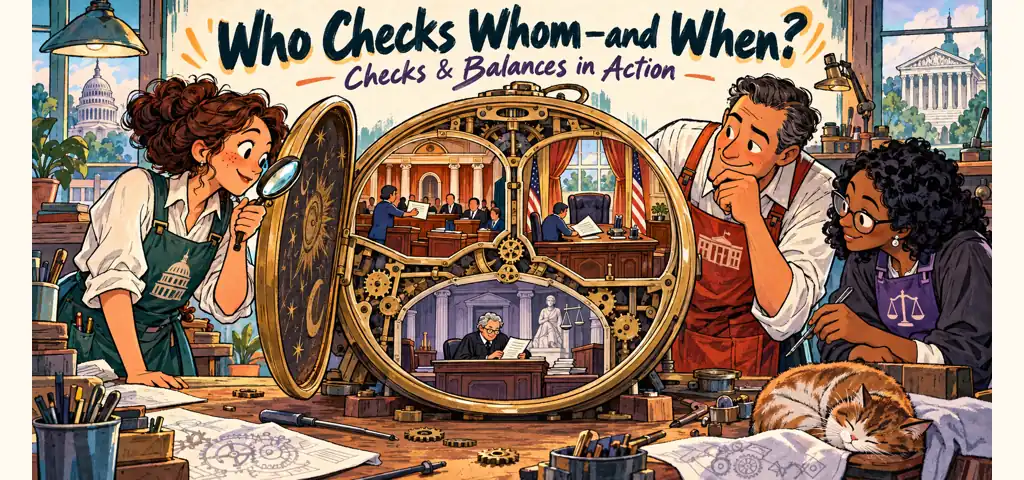
A constitutional check is a specific tool through which one institution can delay, condition, review, or prevent another institution’s proposed action. The president may veto legislation. Congress may override. The Senate may reject nominees or decline to consent to a treaty. Congress may investigate administration, condition appropriations, or legislate more precise limits. The House may impeach, the Senate may try the impeachment, and courts may refuse effect to unconstitutional government action in cases within their jurisdiction. “Checks and balances” is therefore not one power. It is a family of procedures with different actors and consequences.
Checks operate at different stages. Confirmation works before an officer receives an appointment. Oversight examines how law is being administered. A veto intervenes after both houses pass identical legislative text but before it becomes law through the ordinary presentment process. Impeachment addresses serious abuse by an officer. Judicial review occurs when a legal dispute reaches a court with jurisdiction. A choice that names a genuine check at the wrong stage is still wrong. Timing and sequence often provide the clue that distinguishes two otherwise plausible answers.
A practical reading of principles of american government
No check creates unlimited supervisory authority. A committee hearing cannot itself remove an executive officer. The president cannot dismiss a federal judge for an unpopular decision. A court cannot issue an advisory opinion merely because two branches disagree. The Senate’s confirmation role does not make senators the day-to-day managers of an executive department. Each tool has an object, a procedure, and a limit. Using a check lawfully may frustrate another branch without violating separation of powers. Frustration is often what makes the check effective.
Principles of American Government: a common mistake
Translate every scenario into one clear sentence: “The Senate checks presidential appointment through confirmation,” or “Congress checks a regular veto through a two-thirds vote in each chamber.” If the sentence cannot identify the institution, instrument, and required procedure, the label is too vague. Also ask what comes next. Rejection of one nominee permits another nomination. A sustained veto leaves the bill unenacted. House impeachment moves the process to a Senate trial. The system usually creates a response, not an automatic final victory.
Apply the lesson on principles of american government
Pick an institution connected to principles of american government and describe one related action it can take, plus one action it cannot take.
Video lesson: Principles of American Government
Heimler's History gives a focused explanation of this topic in Principles of AMERICAN GOVERNMENT [AP Government Review, Unit 1 Topic 6].
If the player does not load, watch this lesson directly on YouTube.
Connect this lesson to the larger course
For a broader map connecting principles of american government to founding ideals, the Constitution, and federalism, use the AP U.S. Government and Politics learning hub.

Related to This Article
More math articles
- Federal and state court systems
- Assimilation, Carlisle, and the Dawes Severalty Act
- Fiscal Federalism in Practice
- Words for Risk, Cause, and Result
- The Best Grade 3 ELA Practice Tests for Hawaii Students
- CPA BAR Forecasting: Read Assumptions Before the Model (2027 Prep)
- Hypotheses, Theories, and Scientific Explanations
- Top Free Websites for FTCE General Knowledge Math Preparation
- Washington Algebra 1 Free Worksheets: 64 Free Printable Algebra 1 Worksheets with Step-by-Step Keys
- Chapter 33: The Media and Politics



















What people say about "Principles of American Government"?
No one replied yet.