Checks on Presidential Power
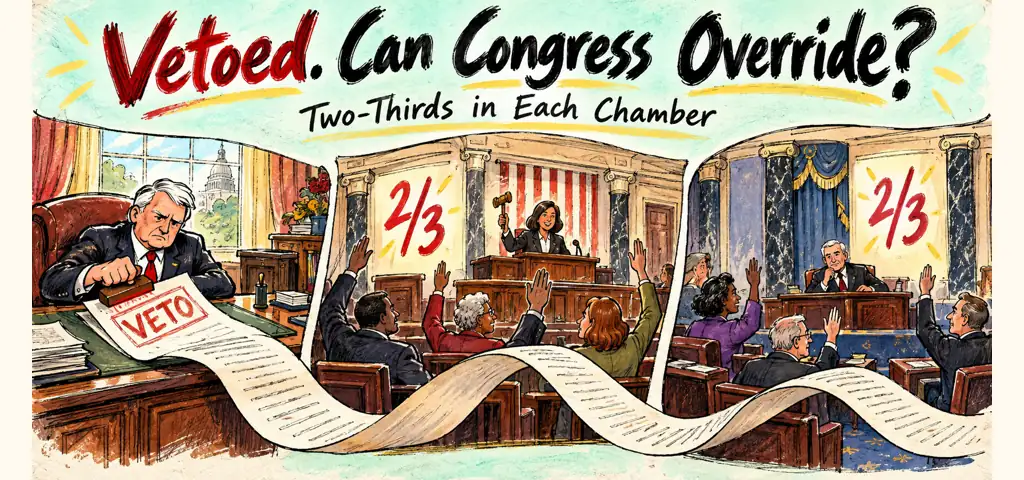
After both houses pass identical legislative text, the bill is presented to the president. The president may sign it, return it with objections, or take no action. A returned bill is a regular veto. Congress may override it only if two-thirds of each chamber votes to do so, after which the bill becomes law without the president’s signature. The veto therefore checks Congress, while the override prevents that check from becoming absolute.
Timing matters. If the president does not sign or return a bill within ten days, excluding Sundays, it ordinarily becomes law. If Congress adjourns during that period in a way that prevents return, the bill fails through a pocket veto, which Congress cannot override because no returned bill exists. The president cannot cancel isolated provisions of a bill while approving the rest. The Supreme Court invalidated the statutory line-item veto because Article I requires approval or rejection of the bill presented.
A practical reading of checks on presidential power
The prospect of a veto shapes legislation before presentment. Members of Congress may revise a bill to secure presidential approval or enough votes for an override. A veto message can also frame political disagreement for the public. Yet the president does not possess a general power to enact substitute statutory language. Executive recommendations and bargaining precede the formal choice among constitutional presentment options.
Checks on Presidential Power: a common mistake
For a scenario, separate proposal, enactment, and administration. A threat to reject a pending bill is veto bargaining. A signed bill followed by executive implementation concerns execution. A two-thirds vote in only the Senate is insufficient for an override. Each house must reach the threshold separately. Likewise, a presidential signing statement may explain an interpretation but does not exercise the Article I veto over selected words.
Apply the lesson on checks on presidential power
Pick an institution connected to checks on presidential power and describe one related action it can take, plus one action it cannot take.
Video lesson: Checks on Presidential Power
CrashCourse gives a focused explanation of this topic in Separation of Powers and Checks and Balances: Crash Course Government and Politics #3.
If the player does not load, watch this lesson directly on YouTube.
Connect this lesson to the larger course
For a broader map connecting checks on presidential power to Congress, the presidency, the courts, and the bureaucracy, use the AP U.S. Government and Politics learning hub.

Related to This Article
More math articles
- Society and Social Structure
- Algebra 2 Formula Flashcards
- A Comprehensive Collection of Free SHSAT Math Practice Tests
- 7th Grade Math Worksheets for Arizona (AASA): 95 Free Printable PDFs
- Migration, Urbanization, Borders, and Development
- Full-Length 7th Grade FSA Math Practice Test
- 3rd Grade PACE Math Worksheets: FREE & Printable
- The Best Grade 7 Math Book for Virginia Students
- How to Graph Box Plot?
- Vector-Valued Functions: Fundamentals and Applications











What people say about "Checks on Presidential Power"?
No one replied yet.