How Political Parties Change and Realign
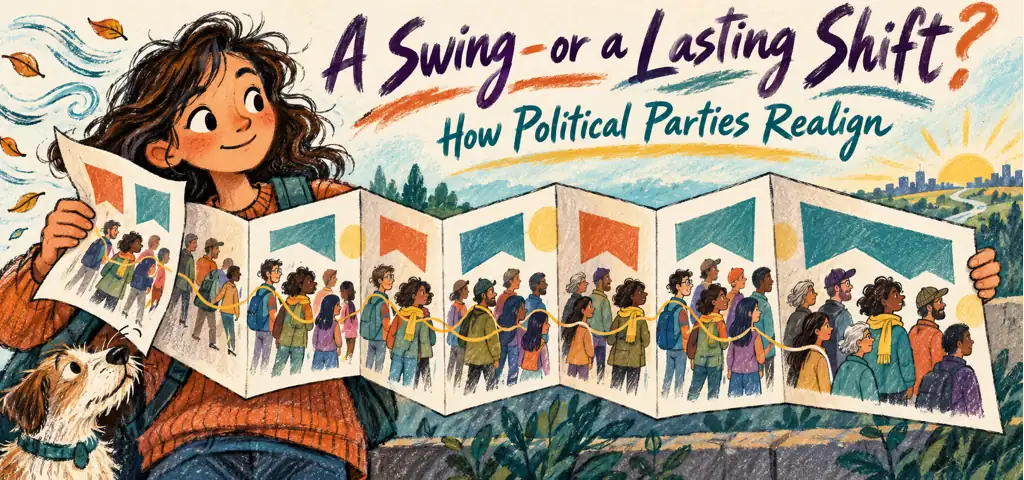
A party realignment is a durable reorganization of party coalitions, issue divisions, geographic support, or governing dominance. It can occur rapidly around a crisis or accumulate across decades. The defining feature is not drama but persistence. Researchers look for groups that change recurring party loyalty, issues that reorganize platforms, regions that shift over several contests, and governing programs that continue after one candidate leaves office. Realignment can happen through several mechanisms. Existing voters may convert from one party to another. Younger generations may enter with different attachments. Migration may change the composition of states or districts. One coalition may mobilize citizens who previously participated less. Parties may recruit new leaders, adopt new issues, or lose the ability to contain a conflict. These processes can overlap, so a serious explanation does not assume that millions of voters switched parties on one day.
How Political Parties Change and Realign in practice
Temporary movement is not enough. Voters may punish an incumbent party during recession, war, scandal, or an unpopular campaign and then return. A candidate may attract personal support that does not transfer to other nominees. A landslide can therefore be historically memorable without producing realignment. Conversely, gradual change may be real even when no single election supplies an obvious dividing line. This lesson owns the transformation itself. Ask what changed: coalition membership, issue conflict, geography, organization, or governing dominance. Then test the change across later presidential, congressional, state, and local elections and in the program officials pursue after victory. The New Deal provides strong evidence because group loyalties, policy commitments, and governing control persisted. The South’s later partisan transition shows that the same kind of structural change can unfold gradually. Dealignment is different because attachment weakens without necessarily moving to the opposing coalition. A critical election, discussed next, is the focal contest associated with a transformation. Realignment is the durable pattern that the wider evidence establishes.
How Political Parties Change and Realign: where the analysis gets complicated
A concrete scenario for how political parties change and realign
A party gains a new voter coalition in one election. What evidence across the next several elections would turn that swing into a realignment?
Check your reasoning
A party realignment is a durable shift in voter coalitions and patterns of party competition, often visible across several elections. It is deeper than a one-election swing. A critical election produces unusually large and durable changes in turnout, issues, party coalitions, or control, often associated with realignment.
Video lesson: How Political Parties Change and Realign
CrashCourse gives a focused explanation of this topic in Party Systems: Crash Course Government and Politics #41.
If the player does not load, watch this lesson directly on YouTube.
Connect this lesson to the larger course
For a broader map connecting how political parties change and realign to participation, parties, elections, interest groups, and media, use the AP U.S. Government and Politics learning hub.

Related to This Article
More math articles
- How to Multiply and Divide Integers? (+FREE Worksheet!)
- A Comprehensive Collection of Free TSI Math Practice Tests
- CLEP U.S. History I 042: French Revolution, Neutrality, and Jay’s Treaty
- Reading Tables, Percentages, and Graphs
- Free Grade 6 English Worksheets for Utah Students
- ACCUPLACER Math Practice Test PDF with Answers
- Direct Synonym Questions: Finding the Closest Meaning
- The Best Grade 3 ELA Practice Tests for Alabama Students
- Solve equilibrium equations without losing the economics
- The Ultimate AFOQT Math Formula Cheat Sheet













What people say about "How Political Parties Change and Realign"?
No one replied yet.