Functions of Political Parties
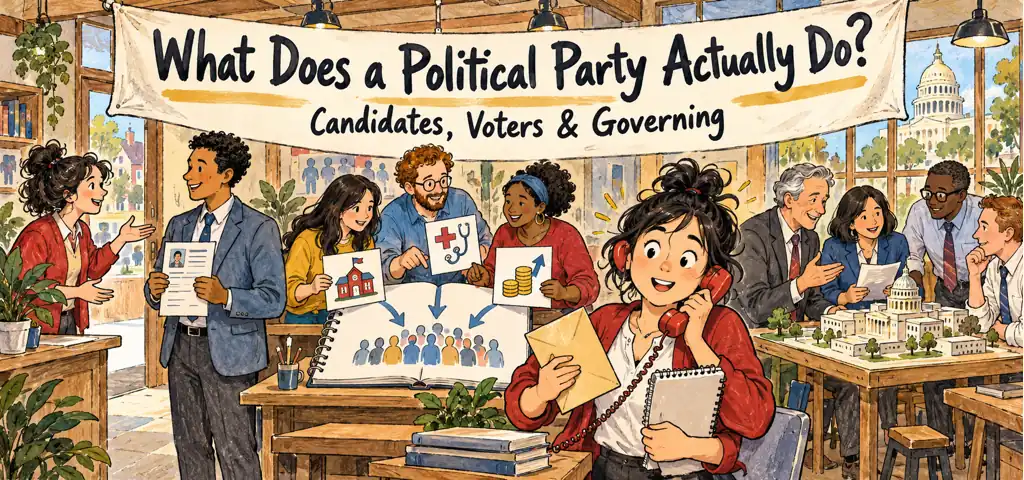
Political parties seek to win public office under a shared label and use that victory to organize government. To do so, they recruit candidates, choose nominees, raise resources, mobilize voters, develop platforms, coordinate campaigns, and structure legislative leadership. Parties also aggregate interests: they combine demands about taxes, schools, security, health, and many other subjects into a coalition broad enough to compete for power.
Recruitment comes before nomination. Party leaders and activists identify people with experience, community ties, fundraising ability, or a compelling public profile and encourage them to run. Nomination then selects the party’s official candidate through a primary, caucus, convention, or another lawful procedure. Because American nominations are decentralized and candidate centered, party organizations influence the field but do not always control the winner.
Functions of Political Parties: the working rule
Campaign mobilization converts preference into participation. Parties register voters, provide information, contact supporters, coordinate volunteers, and turn people out. Targeted contact matters because a favorable citizen who stays home contributes no vote. Platforms state the party’s general program and help candidates, activists, and voters understand its coalition. A platform is politically meaningful but is not an enforceable contract that every officeholder must follow line by line.
Functions of Political Parties: limits and hard cases
Parties simplify choice through labels and cues, then organize officials after the election. A familiar party label gives a voter a rough forecast of a candidate’s coalition and likely priorities when complete information is costly. An interest group may endorse and lobby, but its main goal is policy influence. A party nominates a broad slate, contests elections, and seeks control of government. Recruitment identifies who might run. Nomination chooses the party’s candidate. Mobilization brings supporters to the polls. Governing organization coordinates officials after victory.
A new case involving functions of political parties
Place a voter, a county committee, and a senator in the party’s three faces. What different job does each perform?
Check your reasoning
Parties recruit and nominate candidates, aggregate interests, mobilize voters, structure choices, organize government, and create a label voters can use for accountability. Parties identify and encourage candidates who can raise resources, represent coalitions, and compete in particular constituencies.
Video lesson: Functions of Political Parties
CrashCourse gives a focused explanation of this topic in Political Parties: Crash Course Government and Politics #40.
If the player does not load, watch this lesson directly on YouTube.
Connect this lesson to the larger course
For a broader map connecting functions of political parties to participation, parties, elections, interest groups, and media, use the AP U.S. Government and Politics learning hub.

Related to This Article
More math articles
- How to Pass the FTCE Math Test?
- How Students Can Create Memorable Fictional Characters for Narrative Writing
- The Best Grade 7 Math Book for Idaho Students
- Consultants and polling
- Algebra Puzzle – Challenge 33
- Relationships among agencies, committees, and interest groups
- Free Grade 4 English Worksheets for New Hampshire Students
- Million-Dollar Wins on Negative-EV Bets: How Both Can Be True
- How to Understand Dilations: A Step-by-Step Guide
- Ecclesia, Church, Denomination, Sect, and New Religious Movement





















What people say about "Functions of Political Parties"?
No one replied yet.