NREMT AEMT Clinical Judgment Questions: Read the Task Before the Cue (2027 Prep)
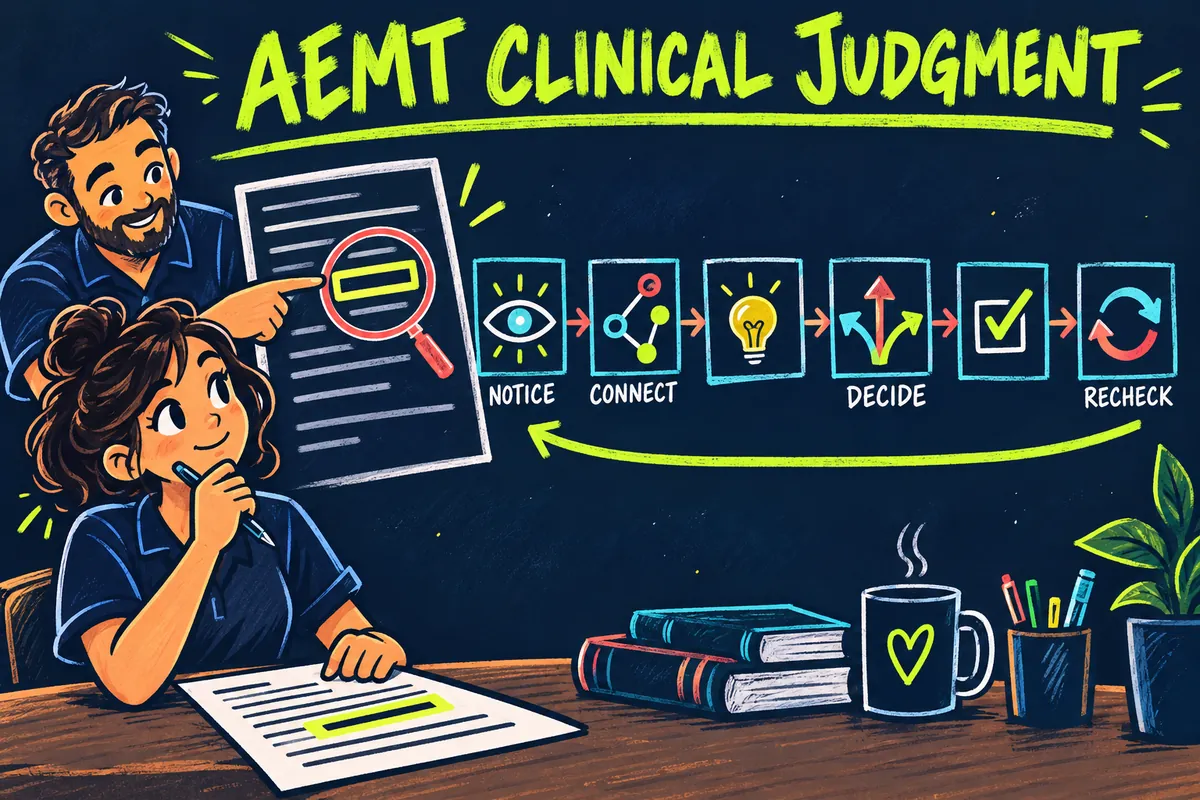
An NREMT AEMT clinical-judgment question is easier to read when you first identify the thinking task it asks you to do. Is it asking you to notice a cue, interpret it, form a possible explanation, compare options, choose a response, or judge what happened afterward? Name that task before you select an answer. A familiar medical word may catch your eye, but the verb in the question usually tells you what kind of reasoning is being tested.
The National Registry’s AEMT test plan groups clinical judgment with the information cycle and describes it across En Route, Scene, and Post-Scene portions of a scenario. Its sample packet illustrates several item formats and six reasoning steps: recognize cues, analyze cues, define a hypothesis, generate solutions, take action, and evaluate. The six steps describe reasoning. En Route, Scene, and Post-Scene describe scenario settings. They answer different questions. See the official AEMT test plan and clinical-judgment sample packet.
A quick way to name the task
Read the last sentence of the stem first, then ask: “What kind of answer would satisfy this request?” Use these cards as a reading guide, not as a promise that every question will fit only one label.
Recognize cues
What the task asks: Find relevant information
Ask yourself: Which stated detail matters for the question?
Analyze cues
What the task asks: Connect details and context
Ask yourself: What pattern or change do the supplied details suggest?
Define a hypothesis
What the task asks: State a plausible working explanation
Ask yourself: Which explanation best fits the evidence given so far?
Generate solutions
What the task asks: Consider possible approaches
Ask yourself: What options could address the stated problem?
Take action
What the task asks: Choose the requested next response
Ask yourself: Which option best meets the stated priority and constraints?
Evaluate
What the task asks: Judge the result or need to reassess
Ask yourself: What does the reported response or new information mean now?
Worked reading example: track what the question asks
Imagine a fictional training vignette that gives a short set of observations and then adds one new detail. The stem asks, “Which additional finding should change your interpretation of the information already provided?” No diagnosis or treatment is needed to answer this reading question. The phrase “change your interpretation” signals analysis: connect the new detail to the earlier information. The most dramatic detail may not answer the question, and a next action belongs only when the stem asks for one.
Now change only the final sentence: “Which possible explanation best fits the information at this point?” That asks for a hypothesis. Change it again: “After the stated response, which new finding should prompt you to reassess?” That asks you to evaluate. The scenario facts can stay the same while the requested thinking step changes. A disease name or familiar keyword can pull your attention away. Read the actual task first.
Use the stem’s verb as a signpost
Words such as identify, interpret, explain, consider, choose, and evaluate can help, but do not classify by one word alone. Read the whole request. “Which finding is most important to notice?” points toward cue recognition. “What do these details mean together?” points toward analysis. “Which explanation best fits?” asks for a hypothesis. “Which option should be selected?” asks for a response. “What does the change after the response tell you?” asks for evaluation.
If you are torn between two steps, write a five-word paraphrase beside the stem: “find a detail,” “connect the details,” “name an explanation,” “compare options,” “select a response,” or “judge the result.” Then check whether your chosen answer actually has that shape. A response can be medically familiar yet still fail to answer a question asking you to interpret information.
Three common reading slips
Treating the six steps as a rigid ladder. The labels help organize reasoning. A scenario can ask about several steps, and each question may isolate a different part. New information can lead you to revisit earlier thinking. The official packet is a sample of item styles, not a guarantee of a fixed sequence.
Mixing scenario phases with reasoning steps. En Route, Scene, and Post-Scene are the test plan’s scenario contexts. Recognize, analyze, hypothesize, generate, act, and evaluate are reasoning actions. A question can ask for a different reasoning action as the scenario information changes.
Jumping from a clue straight to a favorite answer. Pause long enough to separate what the stem states from what you infer. If the question asks what a new detail means, answer that interpretive task first. Choose an action only when the stem asks for one.
A 20-second check before choosing
- Read the final question and underline its action word.
- Mark whether it asks for information, meaning, a possible explanation, options, a response, or a result.
- Return to the scenario and use only the details supplied for that decision.
- Eliminate choices that answer a different task, even if they sound plausible.
- Re-read the question once with your choice inserted. Does it answer the exact request?
Keep learning the AEMT content. This routine helps you show the reasoning the item asks for and keeps one vivid clue from taking over your reading.
Practice identifying the step
For each prompt below, name the reasoning step before thinking about an answer. These are short reading drills, not clinical-care instructions.
A. “Which detail in the description is relevant to the decision that follows?” This asks you to recognize cues: select stated information.
B. “Taken together, what do the two changes described suggest?” This asks you to analyze cues: connect the information rather than repeat one detail.
C. “Which explanation best accounts for the pattern described so far?” This asks you to define a hypothesis: choose a working explanation supported by the given pattern.
D. “Which approach should be considered to address the stated concern?” This asks you to generate solutions: think of possible approaches. If the stem instead asked which response to select now, it would be asking about taking action.
E. “After the reported response, what does the new information tell you?” This asks you to evaluate: judge the result and whether the reasoning needs another pass.
The wording sets the task. These examples omit patient findings and treatment choices. They teach question-reading, not medical practice.
How this fits the AEMT exam
The current official AEMT plan describes a fixed-length linear computer-based test. Clinical Judgment accounts for 31% to 35% of the exam, and the plan includes item formats beyond a four-option question. The National Registry’s sample materials are useful for seeing how instructions and answer interactions may look. When an item asks you to select more than one response, arrange information, or interact with a graphic, follow its directions before responding.
The plan’s clinical-judgment content is integrated with the information cycle. That means your preparation should connect what you know with how you use information across a changing scenario, along with learning what the six labels mean. Keep the current official plan as your source of truth if a course, flashcard set, or older article describes a different exam format.
For level-specific practice and the broader exam overview, visit our NREMT AEMT practice-test and preparation hub. Use the hub to choose a next study step. Return to official NREMT materials for current exam specifications.
Sources and scope
This article explains how to identify the reasoning task described in official NREMT AEMT clinical-judgment materials. It is an exam-preparation reading strategy. It does not provide a clinical protocol or diagnosis guide, and it cannot replace current training or medical direction. Official resources: AEMT Test Plan, Clinical Judgment Domain Sample Packet, and Get Ready for the New Examinations.

Related to This Article
More math articles
- Identities of Complex Numbers
- Ocean Water Changes with Depth
- Formation of political attitudes
- How to Prepare for the THEA Math Test?
- Predicting Crash Points: Why the Math Says No
- How Do You Pass the CBEST Math?
- Registration requirements
- FREE 4th Grade SBAC Math Practice Test
- Oregon OSAS Grade 6 Math Free Worksheets: Printable Grade 6 Math Practice with Answer Keys
- Michigan M-STEP Grade 7 Math Worksheets: 95 Free Printable PDFs with Answer Keys
















What people say about "NREMT AEMT Clinical Judgment Questions: Read the Task Before the Cue (2027 Prep) - Effortless Math"?
No one replied yet.