The New Right, Religious Conservatism, and the Election of 1980
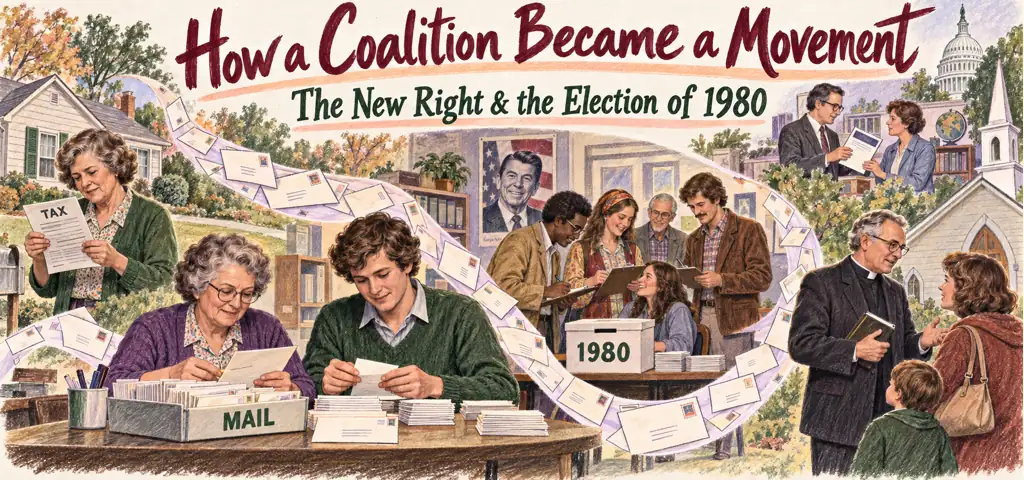
Chapter 15 of the CLEP History of the United States II study guide on Effortless Math covers The New Right, Religious Conservatism, and the Election of 1980: the key terms, the core ideas, and worked examples showing how this topic is tested on the exam.
CLEP History of the United States II, Chapter 15
The New Right built institutions before it won the presidency
Conservative organizers created direct-mail networks, political action committees, magazines, foundations, legal groups, and training organizations. Richard Viguerie used targeted mailing lists for fundraising and mobilization. The Heritage Foundation supplied policy arguments, while the American Conservative Union and other groups rated politicians. This infrastructure linked donors, issues, activists, and candidates beyond one election.
Goldwater's defeat supplied a movement network
Barry Goldwater lost overwhelmingly in 1964, but his campaign recruited activists and popularized limited government, anticommunism, and opposition to federal civil-rights power. Young Americans for Freedom had issued the Sharon Statement in 1960, joining free markets, constitutional restraint, and victory over communism. Movement participants later entered party organizations and campaigns. Electoral defeat can therefore strengthen an ideological network even while failing to win policy immediately.
Tax revolt made government cost a mass issue
Inflation pushed property assessments and nominal incomes upward, while bracket structures and public spending angered voters. California's Proposition 13 showed the power of a concrete tax limit. Conservatives connected high taxes to bureaucracy, inflation, welfare, and declining family autonomy. The coalition was not uniform: homeowners seeking predictable bills did not necessarily endorse every social or foreign-policy position.
Religious conservatives entered partisan politics through several conflicts
Evangelicals and fundamentalists mobilized around abortion, school prayer, textbooks, sexuality, feminism, and perceived federal intrusion into religious schools. The IRS dispute over tax exemptions for racially discriminatory private schools also helped activate leaders, though later narratives often centered abortion alone. The Moral Majority, founded by Jerry Falwell in 1979, registered voters and connected conservative Protestants to Republican campaigns.
The religious landscape was changing
Membership and authority declined in several mainline Protestant denominations after the mid-1960s, while evangelical and nondenominational churches grew. Media ministries and suburban megachurches created new networks. A religious revival did not automatically mean conservative politics; Black churches, Catholic social teaching, peace activism, and progressive congregations supported different causes. The political shift involved organization and issue alignment, not belief alone.
Neoconservatives traveled a different route
Some former liberals and leftists became critical of Great Society administration, student radicalism, affirmative action, and perceived weakness abroad. Journals and policy institutions developed a neoconservative critique that accepted parts of the welfare state while favoring stronger anticommunism and skepticism toward social engineering. They differed from libertarians who opposed broad government power and traditionalists who emphasized inherited moral order.
Friedman tied market competition to political independence
In Capitalism and Freedom, Milton Friedman argued that competitive markets disperse economic power among many private hands. A dissenter who can find work, customers, or support outside government is less dependent on political authorities for a livelihood. He did not claim markets guarantee equal incomes or eliminate conflict. His mechanism connected economic choice to political freedom by reducing the concentration of power, not by making prosperity alone produce democracy.
Reagan translated movement themes into an optimistic campaign
Ronald Reagan argued that government, taxation, inflation, and international weakness had produced decline. He promised tax cuts, military rebuilding, deregulation, and social conservatism while presenting America as capable of renewal. His communication style softened the sharper edges of movement argument. The campaign benefited from Carter's economic and foreign-policy difficulties, but Reagan's victory also reflected years of conservative organization.
The 1980 result was decisive but not a total ideological mandate
Reagan defeated Carter and independent John Anderson and helped Republicans win the Senate. Economic distress, the hostage crisis, dissatisfaction with Carter, and conservative mobilization all mattered. Many voters crossed party lines without endorsing every policy. Democrats retained the House. An election result can open a governing opportunity without proving that the electorate agreed on one explanation or program.
Ayn Rand and traditionalists exposed philosophical differences
Ayn Rand's novels defended individual achievement and rational self-interest against collectivism. Religious traditionalists grounded duty in faith and moral order, which Rand rejected. Both might oppose state planning, but for different reasons. Fusionist conservatism attempted to hold libertarian economics, traditional morality, and anticommunism together. Its strength came from coalition; its internal tensions never disappeared.
distinguish a coalition from a creed
A voter supports tax limits, another school prayer, and another a stronger military.
Direct mail and issue organizations built a movement between elections
Conservative organizers collected donor lists, mailed targeted appeals, rated legislators, trained candidates, and circulated policy arguments outside older party institutions. Richard Viguerie's direct-mail operations and groups focused on guns, taxes, abortion, or business regulation could mobilize supporters around a single issue, then connect them to a broader coalition. These networks reduced dependence on local party leaders and national television. They also rewarded urgent language and ideological consistency because fundraising depended on convincing recipients that a clear threat required immediate action. Organizational technology, ideas or charismatic candidates, helped convert grievance into durable political participation.
The Equal Rights Amendment became a test of conservative coalition building
Congress sent the ERA to the states in 1972 with broad initial support. Phyllis Schlafly's STOP ERA campaign argued that the amendment would unsettle gendered protections, family law, and traditional roles; supporters answered that constitutional equality should not depend on sex. Ratification stalled three states short even after Congress extended the deadline. The contest linked religious conservatives, homemaker activism, and Republican movement politics. It also demonstrates that women's political mobilization operated on both sides of feminism. Opposition was not passive tradition: it used organization, testimony, newsletters, and state-level strategy to defeat a national amendment.
Watch the history in motion
This short lesson adds voices, images, and chronology to the ideas you just studied.
Video: Ronald Reagan and CONSERVATISM [APUSH Review Unit 9 Topic 2] Period 9: 1980-Present, Heimler's History.
Try four CLEP-style questions
- Why did Goldwater's 1964 campaign matter despite his defeat?
- It recruited activists and strengthened a conservative network later used within the Republican Party.
- It converted New Deal welfare programs into church-administered grants during the Johnson administration.
- It won the presidency while losing only the electoral votes of the Deep South.
- It ended conflict between libertarians and religious traditionalists over moral regulation.
- It made the Democratic Party the permanent home of southern white conservatives.
- What did the Moral Majority primarily provide?
- A federal court system for resolving disputes among churches and public schools
- A labor federation representing clergy employed by television and radio networks
- A theological agreement binding every American religious denomination to one platform
- Voter mobilization linking conservative Protestant issues to Republican electoral politics
- A congressional agency that distributed grants to private religious academies
- How did neoconservatives differ from many libertarians?
- They treated most federal social policy as illegitimate regardless of its design or result.
- They often accepted parts of the welfare state while favoring a stronger anticommunist foreign policy.
- They rejected the use of military power and regarded Soviet foreign policy as primarily defensive.
- They based political membership on evangelical doctrine rather than foreign or domestic policy.
- They retained the New Left's confidence in expansive social planning and campus protest.
- What is the strongest interpretation of Reagan's 1980 victory?
- Conservative organization and Carter's difficulties created a governing opening, not unanimous agreement.
- Every Reagan voter supported the same combination of tax, religious, and foreign policies.
- The result abolished partisan competition because Democrats lost both houses permanently.
- Economic conditions were irrelevant once the Moral Majority endorsed the Republican ticket.
- The election proved that New Deal and Great Society programs had already been repealed.
Check your answers and reasoning
Independent preparation. CLEP is a registered trademark of the College Board, which does not endorse this lesson.

Related to This Article
More math articles
- How to Study for a Math Test in 1 Week (Day-by-Day Plan)
- How to Graph Transformation on the Coordinate Plane: Dilation?
- The Best Grade 2 English Worksheets for Colorado Students
- Distance, Rate, and Time Problems: Six Worked Examples
- 5th Grade NJSLA Math Worksheets: FREE & Printable
- The Ultimate OAE Elementary Education Math (018-019) Course (+FREE Worksheets & Tests)
- FREE 3rd Grade STAAR Math Practice Test
- Math Topics You Need to Learn in Medicine
- How to Divide Polynomials Using Long Division?
- The Best Grade 5 Math Book for Utah Students















What people say about "The New Right and the Election of 1980"?
No one replied yet.