Reaganomics, Union Decline, Inequality, and Deregulation
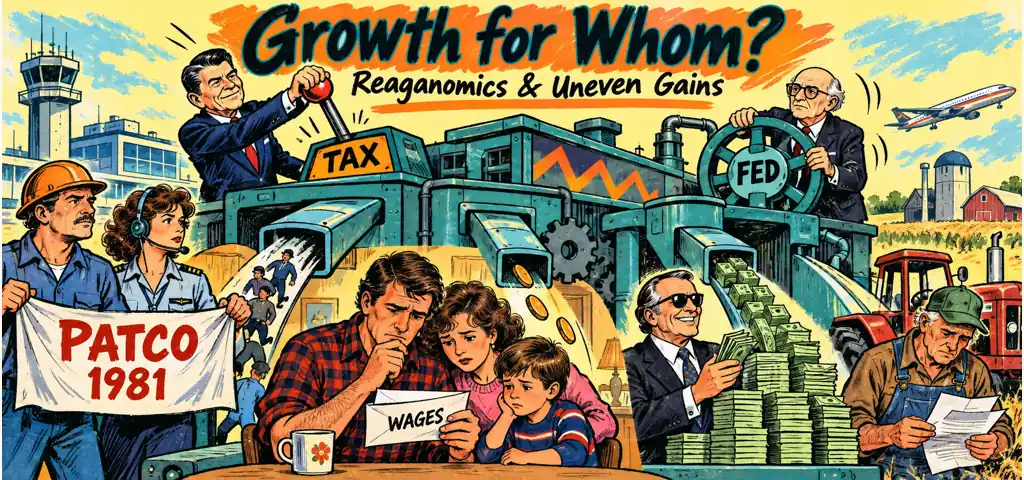
Chapter 15 of the CLEP History of the United States II study guide on Effortless Math covers Reaganomics, Union Decline, Inequality, and Deregulation: the key terms, the core ideas, and worked examples showing how this topic is tested on the exam.
CLEP History of the United States II, Chapter 15
Supply-side economics made an incentive claim
Reagan argued that high marginal tax rates discouraged work, saving, and investment. Lower rates, supporters said, would expand economic activity and eventually recover some lost revenue. Keynesian tax cuts could also stimulate demand, but through a different mechanism. The Economic Recovery Tax Act of 1981 reduced individual rates, accelerated business depreciation, and indexed brackets later; it did not produce enough growth to pay for itself fully.
The 1986 tax law exchanged preferences for lower rates
The Tax Reform Act of 1986 lowered the top individual rate and reduced the number of brackets while eliminating or narrowing many deductions, exclusions, and tax shelters. The broader taxable base helped finance the lower statutory rates. Reagan supported the measure, but its passage required bargaining with Democratic and Republican committee leaders. The act was therefore not another simple rate cut or the creation of a national sales tax. It was a bipartisan trade: fewer preferences and a broader base in exchange for lower rates and a claim of greater neutrality.
Spending choices changed the fiscal result
The administration increased defense spending while seeking domestic reductions. The 1981 reconciliation process bundled changes to food, education, welfare, and other programs into one budget measure, helping avoid separate votes. Social Security remained politically protected and received a bipartisan financing package in 1983. Tax cuts, defense growth, recession, and interest costs contributed to large deficits.
Volcker's disinflation shaped Reagan's first term
The Federal Reserve's tight-money policy began under Carter and drove interest rates high. The 1981-1982 recession produced severe unemployment, farm distress, and factory closures, but inflation fell. Recovery began in 1983, aided by monetary easing, tax changes, defense demand, and pent-up consumption. Assigning the entire recession or recovery to the president ignores the Fed's independent role.
PATCO changed expectations about strikes
In August 1981, members of the Professional Air Traffic Controllers Organization struck in violation of federal law. Reagan ordered them back and fired more than eleven thousand who refused. The government decertified the union. Private employers read the episode as evidence that permanently replacing strikers could carry lower political costs. PATCO did not directly change private labor law, but it altered the climate of labor relations.
Union decline had several causes
Private-sector union density fell because of deindustrialization, relocation to less-unionized regions, employer resistance, labor-law weakness, automation, foreign competition, and growth in services. Public-sector unions retained greater strength. The decline reduced bargaining power over wages and benefits, but it was not caused by one strike or a simple fall in worker interest. Industry, region, and law mattered.
Deregulation crossed party lines
Airline deregulation began under Carter, and Reagan extended deregulatory priorities in finance, telecommunications, energy, and enforcement. Airline competition lowered many fares and expanded some routes while producing consolidation, hub dependence, and service loss for some communities. Deregulation changes who sets prices and entry rules; it does not mean an industry has no safety, labor, or consumer regulation.
The savings-and-loan crisis exposed incentive failures
Congress and regulators expanded the investments thrifts could make while deposit insurance protected savers and weak supervision allowed risky growth. Managers could pursue high returns knowing losses might fall on the insurance system. Hundreds failed, requiring an expensive federal cleanup. The crisis illustrates moral hazard: protection from loss can encourage risk when oversight and capital are inadequate.
Inequality grew through markets and policy
Returns to education, technology, financial gains, weakening unions, executive compensation, tax changes, and global competition widened income differences. The recovery created jobs, but gains were uneven. Rising household income sometimes depended on more earners and hours. Measuring only averages can conceal divergence between top incomes, median wages, family structure, and poverty.
The 1980s homelessness crisis had several institutional causes
Cities saw homelessness on a scale not experienced since the Depression as state mental hospitals emptied without adequate community services, inexpensive single-room housing disappeared, and federal housing support contracted. Recession, job loss, disability, family disruption, and substance use affected individuals, but none alone explains the national rise. The decisive pattern joined reduced institutional care to a shrinking supply of deeply affordable housing and weak income support.
Farm and rural industries were restructured
High interest rates, falling land values, debt, and weaker commodity prices produced the 1980s farm crisis. Foreclosures spread through rural banks and communities. Meatpacking moved from older unionized urban plants to rural facilities closer to livestock, often with lower wages, faster lines, and a workforce including new immigrants. Relocation changed local opportunity while weakening established bargaining structures.
distinguish price competition from full social cost
Airfares fall after entry controls loosen, but service disappears from a small city.
Tax changes affected rates, bases, deficits, and incentives differently
The 1981 law reduced individual rates and accelerated business depreciation, while the 1986 reform lowered top rates further but broadened the tax base and removed many preferences. Supporters expected investment and work incentives; critics emphasized gains to high earners and pressure on revenue. Defense spending, recession, entitlement commitments, and tax cuts all contributed to large deficits. A rate reduction does not reveal the change in taxes paid without income, deductions, inflation, and the taxable base. Distribution and total revenue require separate evidence.
PATCO made public authority central to union decline
When federal air-traffic controllers struck in 1981 despite a legal ban on strikes by federal employees, Reagan fired those who refused to return and barred them from federal service. The action did not outlaw private unions, but it signaled a harder climate for organized labor and encouraged employers willing to resist strikes or hire replacements. Union decline also reflected deindustrialization, southern and western growth, legal rules, employer campaigns, and service-sector expansion. PATCO was a powerful event within a longer structural change, not a single sufficient cause.
Watch the history in motion
This short lesson adds voices, images, and chronology to the ideas you just studied.
Video: Here's Why Reaganomics is so Controversial | History, HISTORY.
Try four CLEP-style questions
- How does a supply-side tax cut differ from a Keynesian tax cut in its central argument?
- Supply-side policy transfers rate setting to the Federal Reserve; Keynesian policy ends monetary policy.
- Supply-side reasoning requires higher marginal rates, while Keynesian policy prohibits deficits.
- Supply-side reasoning applies only to imports, while Keynesian policy applies only to agriculture.
- Supply-side reasoning stresses incentives and productive capacity; Keynesian reasoning stresses demand.
- The two approaches make identical claims about saving, investment, and consumption.
- Why did the PATCO strike matter beyond federal air-traffic control?
- The settlement guaranteed federal workers the unrestricted right to strike.
- The firings created a new federal statute withdrawing collective-bargaining rights from private workers.
- Congress transferred air-traffic control to a union-owned private corporation.
- The union won recognition and negotiated a shorter week after Reagan withdrew the deadline.
- The firings signaled greater political acceptance of resisting and replacing strikers.
- What incentive problem contributed to the savings-and-loan crisis?
- Congress required managers to reimburse the government before making any loan.
- Depositors bore every loss personally because federal insurance had been abolished.
- Insured deposits and weak supervision allowed managers to pursue risks whose losses could become public.
- Strict capital rules prevented institutions from expanding after risky investments.
- Thrifts were prohibited from holding mortgages and could invest only in Treasury securities.
- Which explanation of private-union decline is strongest?
- Public-sector unionization disappeared first and then forced private membership lower.
- The PATCO firing legally dissolved every private union charter in the United States.
- Manufacturing employment expanded fastest in the most heavily unionized northern industries.
- Industrial relocation, employer resistance, legal weakness, automation, and service growth interacted.
- Federal law required workers in new service industries to reject collective bargaining.
Check your answers and reasoning
Independent preparation. CLEP is a registered trademark of the College Board, which does not endorse this lesson.

Related to This Article
More math articles
- Interference, Diffraction, and Polarization
- Biological Indicators and Process Challenge Devices
- Full-Length 7th Grade IAR Math Practice Test
- 5th Grade Scantron Math Worksheets: FREE & Printable
- Series Behavior with the n-th Term Test: Divergence Test
- Free Grade 4 English Worksheets for Missouri Students
- FREE 3rd Grade OST Math Practice Test
- Is There a Trick to Simplifying Radicals?
- 4th Grade MAP Math FREE Sample Practice Questions
- Cutting and Dissecting Instruments
















What people say about "Reaganomics, Deregulation, and Inequality"?
No one replied yet.