Reagan’s Cold War, Iran-Contra, and the Soviet Collapse
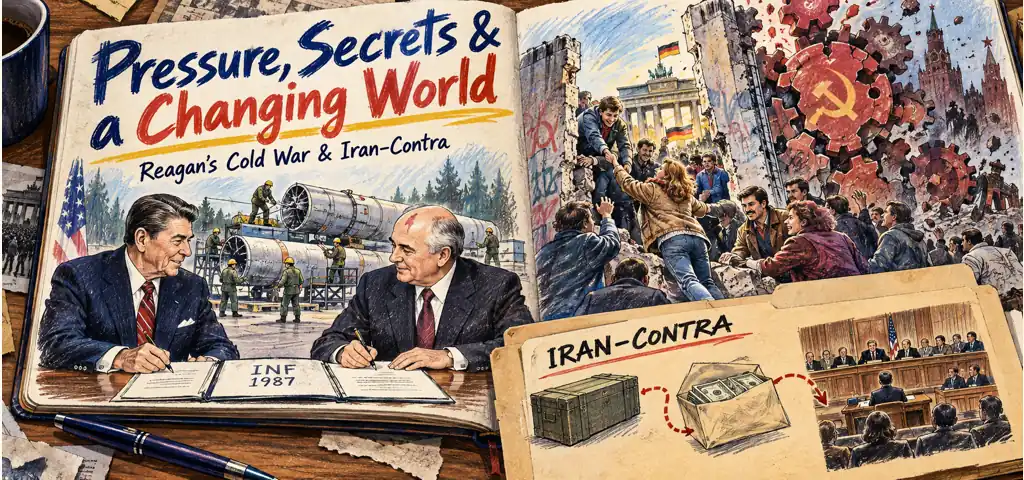
Chapter 15 of the CLEP History of the United States II study guide on Effortless Math covers Reagan’s Cold War, Iran-Contra, and the Soviet Collapse: the key terms, the core ideas, and worked examples showing how this topic is tested on the exam.
CLEP History of the United States II, Chapter 15
Reagan rejected détente's tone while retaining negotiation
Reagan described the Soviet Union as an "evil empire," increased defense spending, and emphasized ideological competition. His administration supported anticommunist forces abroad and deployed new missiles in Europe. Yet it also negotiated when conditions changed. A period can contain confrontation and diplomacy; the question is when leaders judged pressure, risk, and bargaining to be useful.
The Reagan Doctrine backed insurgencies against Soviet-aligned governments
The United States aided the mujahideen in Afghanistan, the Contras in Nicaragua, and anticommunist forces in Angola and elsewhere. Support ranged from weapons and money to intelligence and diplomacy. Advocates called it rollback of Soviet influence; critics cited proxy violence, abusive allies, and weak congressional control. The doctrine did not send American armies to overthrow every communist government directly.
Nuclear strategy combined buildup and defense research
The administration expanded strategic forces and proposed the Strategic Defense Initiative in 1983, envisioning technologies to intercept ballistic missiles. Supporters hoped defense might reduce reliance on retaliation. Critics doubted technical feasibility, costs, and compatibility with the ABM framework and feared it could intensify offensive competition. SDI was primarily a research and development program, not an operational shield that made nuclear weapons obsolete.
The nuclear-freeze movement challenged escalation
Religious leaders, scientists, physicians, and activists warned about arms racing and nuclear winter. The Catholic bishops' 1983 pastoral letter accepted deterrence only conditionally and urged arms control and movement toward disarmament. Scientific work on nuclear winter argued that smoke from urban fires could disrupt climate and agriculture. These arguments expanded the issue from blast damage to planetary consequences.
Congress tried to restrict the Contra war
Reports of Contra abuses and opposition to another covert war led Congress to enact Boland Amendments limiting aid intended to support military operations against Nicaragua's government. The precise language changed over time and applied to specified agencies and purposes. Administration officials searched for other funding and legal theories rather than accepting the restriction's policy goal.
Iran-Contra connected two secret policies
Officials secretly facilitated arms sales to Iran, despite an embargo and public opposition to bargaining for hostages. Money from the sales was diverted to support the Contras. Lieutenant Colonel Oliver North and others concealed activity and destroyed documents. Reagan said he had not authorized the diversion, but investigations found weak oversight and a policy environment that encouraged evasion. The scandal concerned secrecy, appropriations, and accountability as well as foreign policy.
Gorbachev changed the bargaining environment
Mikhail Gorbachev became Soviet leader in 1985 and pursued glasnost, perestroika, and reduced international burdens. Reagan and Gorbachev met repeatedly. At Reykjavik in 1986 they came close to sweeping reductions but disagreed over SDI. The 1987 Intermediate-Range Nuclear Forces Treaty eliminated an entire class of land-based missiles and included intrusive verification. It was a genuine arms-reduction treaty, unlike a limit that merely froze launchers.
The Soviet bloc unraveled through internal and external pressures
Economic stagnation, national movements, reform, the Afghan war, information flows, and the cost of military competition weakened Soviet control. Eastern European regimes fell in 1989, and the Berlin Wall opened. A failed coup accelerated the Soviet Union's dissolution in 1991. American pressure mattered, but claiming one president or one weapons program "caused" collapse ignores decisions and crises within the Soviet system.
audit a covert-policy chain
Congress restricts money for a proxy force; officials obtain revenue through a secret arms transaction.
Afghanistan imposed costs without following a simple American script
The Soviet Union invaded Afghanistan in 1979 to sustain a friendly government. During the 1980s the United States, Pakistan, Saudi Arabia, and others supported mujahideen resistance, including provision of Stinger missiles. Soviet forces withdrew in 1989 after heavy costs and political disillusionment, but Afghanistan did not become stable or democratic. Rival factions continued fighting, and outside aid had strengthened armed networks beyond American control. The case illustrates a recurring limit of proxy strategy: assistance can raise an adversary's costs while leaving the sponsor with little authority over the recipient's later program.
The INF Treaty joined political risk to unusually deep verification
Signed in 1987, the Intermediate-Range Nuclear Forces Treaty eliminated an entire class of American and Soviet land-based missiles and allowed on-site inspections. Reagan accepted negotiated removal after years of buildup and protest, while Gorbachev accepted intrusive verification to reduce burdens and improve relations. The treaty differed from an arms ceiling because covered missiles were destroyed rather than merely capped. It also complicates a story of either unbroken confrontation or effortless friendship. Pressure, domestic movements, leadership change, verification, and mutual interest combined to make a specific agreement possible.
Central American conflicts tested the boundary between anticommunism and human rights
The Reagan administration supported governments in El Salvador and Guatemala and the Contra insurgency against Nicaragua's Sandinista government. Officials emphasized Soviet and Cuban influence, while critics documented killings, disappearances, and abuses by American-backed forces. Congress conditioned or restricted aid at different points, and regional governments pursued the Esquipulas peace process. The issue was not whether communist influence or right-wing violence existed; evidence supported both. The policy dispute concerned which danger justified aid, what conditions could control recipients, and whether covert war displaced diplomacy.
Public opinion constrained nuclear policy without dictating it
The nuclear-freeze movement, religious groups, scientists, local resolutions, and mass demonstrations argued that a halt to new weapons could reduce danger. Administration officials warned that freezing unequal or unverifiable forces would weaken deterrence. Reagan's rhetoric shifted in his second term as he met Gorbachev and described the possibility of eliminating nuclear weapons, though modernization continued. Movements did not negotiate treaties, and presidents did not act in isolation from public fear. The interaction changed political language, bargaining room, and the cost of appearing indifferent to nuclear risk.
Watch the history in motion
This short lesson adds voices, images, and chronology to the ideas you just studied.
Video: The END of the Cold War [APUSH Review Unit 9 Topic 3] Period 9: 1980-Present, Heimler's History.
Try four CLEP-style questions
- What did the Reagan Doctrine seek to do?
- Restore détente by ending aid to every party in regional conflicts
- Place American ground armies under permanent United Nations command
- Support anticommunist forces resisting Soviet-aligned governments in selected regions
- Recognize all communist governments in exchange for immediate nuclear disarmament
- Withdraw from alliances and rely exclusively on defenses inside the United States
- Why did critics question the Strategic Defense Initiative?
- The plan reduced defense spending by closing every nuclear laboratory.
- The system had already intercepted every Soviet missile during an operational deployment.
- It required elimination of research on radar, satellites, and missile detection.
- It applied only to conventional artillery and had no relationship to strategic weapons.
- They doubted its feasibility and feared effects on cost, arms competition, and existing treaties.
- What made Iran-Contra a separation-of-powers scandal?
- The Supreme Court directed Oliver North to destroy executive-branch documents.
- Congress ordered the arms sales and required diversion of the proceeds to Nicaragua.
- The administration disclosed every transaction before funds changed hands.
- Iran transferred hostages to the Contras under an openly ratified treaty.
- Officials used concealed arms transactions to support a force Congress had restricted.
- What distinguished the INF Treaty from SALT I's interim launcher limits?
- INF eliminated a class of missiles and provided verification rather than merely freezing counts.
- INF paired intermediate-missile reductions with negotiated limits on NATO conventional deployments.
- INF created the Strategic Defense Initiative as a joint Soviet-American command.
- INF applied only to submarine launchers already covered by the 1972 agreement.
- INF required Congress to fund the Contras as part of nuclear arms reduction.
Check your answers and reasoning
Independent preparation. CLEP is a registered trademark of the College Board, which does not endorse this lesson.

Related to This Article
More math articles
- The Ultimate 7th Grade RICAS Math Course (+FREE Worksheets)
- 6 Keys to Studying Effectively for Your Math Class
- Circle Area & Circumference Practice (Free)
- CBEST Test Facts and FAQs
- Systems of Linear Inequalities Worksheet with Answers
- Drill Bits and Hole Features: A Practical Guide
- Marketing Math: What’s a New Customer Really Worth?
- Arizona Grade 2 English Worksheets — Free Printable PDFs
- Understanding the Coordinate Plane for 5th Grade: x-axis, y-axis, Origin
- Top 10 Tips to Overcome CHSPE Math Anxiety




















What people say about "Reagan's Cold War and the Soviet Collapse"?
No one replied yet.