Roosevelt’s Square Deal, Consumer Protection, and Conservation
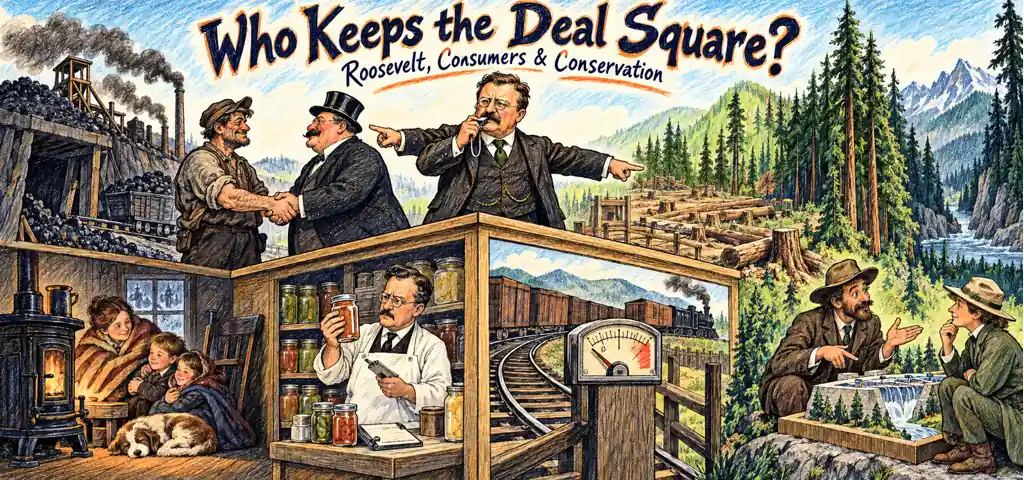
Chapter 6 of the CLEP History of the United States II study guide on Effortless Math covers Roosevelt’s Square Deal, Consumer Protection, and Conservation: the key terms, the core ideas, and worked examples showing how this topic is tested on the exam.
CLEP History of the United States II, Chapter 6
The Square Deal claimed a public referee
Theodore Roosevelt described a Square Deal among capital, labor, and the public rather than automatic support for either employer or union. During the 1902 anthracite coal strike, he invited operators and union leaders to the White House and pressed for arbitration because a winter coal shortage threatened the public. Earlier presidents had often used federal force principally to restore employer operations. Roosevelt did not recognize a general legal right to bargain, but his intervention suggested that the national executive could mediate a major dispute and consider public welfare.
Trust policy distinguished size from conduct
Roosevelt did not seek to dissolve every large corporation. His administration prosecuted the Northern Securities railroad holding company, and the Supreme Court ordered dissolution in 1904, showing that the Sherman Act could reach a powerful combination of capital. The Bureau of Corporations, created in 1903, investigated interstate corporations and reported to the president. Information could support negotiation, publicity, or prosecution. The policy aimed at federal supervision of concentrated power, distinguishing combinations seen as abusive from large enterprises considered efficient or manageable.
Railroad regulation recovered prospective power
Court decisions had reduced the Interstate Commerce Commission largely to reviewing past conduct and had denied it authority to prescribe future rates. The Hepburn Act of 1906 empowered the ICC to set maximum railroad rates, expanded jurisdiction to pipelines, express and sleeping-car companies, and strengthened access to records. Shippers could still litigate, and regulation remained difficult, but the law addressed the central defect: a commission unable to state the rate that would govern next.
Consumer laws followed investigation
Upton Sinclair intended The Jungle to expose labor exploitation, but public reaction focused on filthy meatpacking. Federal investigators confirmed serious conditions. The Meat Inspection Act of 1906 placed federal inspection in packing plants engaged in interstate commerce. The Pure Food and Drug Act prohibited interstate sale of adulterated or misbranded food and drugs. Neither law guaranteed nutritional quality or safe working conditions. They created national floors for products moving through an interstate market.
Conservation and preservation asked different questions
Gifford Pinchot defined conservation as scientific management for sustained public use: forests, water, and minerals should produce benefits without waste. John Muir emphasized preservation of wild places for beauty, spiritual experience, and nature beyond commodity use. Both opposed uncontrolled private destruction, but they divided over dams and managed extraction. Hetch Hetchy valley inside Yosemite made the conflict concrete. The 1913 Raker Act authorized San Francisco's reservoir, a conservationist public-use victory over preservation.
Forest policy expanded executive reservation
The Forest Reserve Act provision of 1891 let presidents withdraw forested public land by proclamation. Roosevelt used the power extensively, raising federal reserves from about 46 million acres in 1901 to roughly 150 million by 1909. Pinchot's Forest Service, created in 1905, managed national forests for regulated multiple use rather than leaving them unimpaired. The Weeks Act of 1911 added authority to buy private forest lands at headwaters of navigable streams, enabling eastern national forests where the public domain was limited.
Older warnings supplied ecological reasoning
George Perkins Marsh's Man and Nature argued that human action, especially deforestation, had eroded soils, worsened floods, and helped ruin ancient Mediterranean lands. North America could repeat the pattern. His history treated nature as responsive to cumulative human choices, not an inexhaustible store. The cutover lumber economy illustrated the incentive problem: firms stripped Michigan and Wisconsin pine, then moved to cheap uncut forests in the South and Pacific Northwest because waiting decades for regrowth while paying taxes promised poor returns. Public rules had to change the time horizon.
Water policy built the arid West
The Newlands Reclamation Act of 1902 used proceeds from western public-land sales to finance federal dams and irrigation works, with repayments intended to replenish a reclamation fund. Projects made farms and cities possible while transforming rivers and Native and local water claims. The Rivers and Harbors Act of 1899 prohibited unpermitted refuse discharges into navigable waters and tributaries, later becoming an anti-pollution tool. These policies joined navigation, settlement, and environmental control before a modern environmental agency existed.
Mary Austin wrote from an arid landscape
In The Land of Little Rain (1903), Mary Austin presented the country between the Sierra Nevada and Death Valley as a living arid environment with its own plants, animals, Indigenous peoples, workers, and rhythms. She later criticized the transfer of Owens Valley water to Los Angeles. The 233-mile Los Angeles Aqueduct, completed in 1913, carried Owens River water by gravity to support metropolitan growth while drying farms and intensifying a conflict over water rights and regional power. Her perspective resists treating desert as empty land awaiting urban use.
Monuments and parks used different legal routes
The Antiquities Act of 1906 authorized a president to proclaim national monuments on federally owned land to protect historic landmarks, structures, and objects of scientific interest. A national park normally required congressional legislation. Yellowstone, set aside in 1872, became the first U.S. national park. Presidential monument authority allowed rapid protection but could provoke disputes over size and executive power. Legal route and management mission are distinct: designation tells who acts; mission tells how land is used.
Park support depended on a public constituency
The National Park Service Organic Act of 1916 directed the agency to conserve scenery, natural and historic objects, and wildlife while providing enjoyment in a manner leaving them unimpaired for future generations. National forests instead permitted regulated resource use. First director Stephen Mather built roads, licensed concessions, and courted automobile visitors because popular use could create congressional and public support for the young agency. Access could protect parks politically while also increasing development pressure.
Wildlife revealed the limits of abundance
Commercial hunters shipped passenger pigeons by rail in enormous numbers and treated the flocks as inexhaustible. Habitat loss and mass killing helped drive the species to extinction in 1914. The Lacey Act of 1900 made interstate shipment of wildlife taken in violation of state law a federal offense. That rule helped states enforce game laws against outside markets; it did not authorize national monuments or federal purchases of private forest land. Bird advocates called wildlife a public trust, not an unlimited commodity. The case moved conservation beyond scenery toward population and reproductive limits. A resource can collapse even when each hunter responds rationally to a market rewarding immediate capture.
The governors' conference made resources national policy
Roosevelt's 1908 White House Conference of Governors examined forests, water, minerals, soils, and coordinated resource planning. Bringing state executives, scientists, and national officials together framed conservation as an intergovernmental problem rather than a collection of isolated parks. River basins and forests crossed political boundaries; scientific inventories supported planning. The meeting exemplified Progressive governance through data and coordination.
Conservation split Roosevelt's successor
Secretary of the Interior Richard Ballinger opened some previously withdrawn lands and was accused by Pinchot and allies of favoring private development. President Taft dismissed Pinchot in 1910 after Pinchot publicly challenged the administration. The Ballinger-Pinchot controversy alienated Progressive Republicans and deepened the rupture that led to the 1912 party split. An administrative dispute over land policy therefore became evidence about presidential alignment and party control.
distinguish designation from management
A president protects a federal archaeological site by proclamation; Congress creates a scenic reserve; foresters permit scheduled timber harvest.
The Square Deal expanded federal capacity unevenly
Roosevelt's program joined labor mediation, corporate investigation, rate authority, product standards, and resource management. It did not create a national welfare state or eliminate private enterprise. Consumer and conservation policies extended federal responsibility where interstate systems and long time horizons defeated local action. The same policies also displaced communities, privileged metropolitan users, or placed experts above local claims. Public interest became a stronger national category, but deciding its content remained political.
Watch the history in motion
This short lesson adds voices, images, and chronology to the ideas you just studied.
Video: The PROGRESSIVE Era [APUSH Unit 7 Topic 4] Period 7: 1898-1945, Heimler's History.
Try four CLEP-style questions
- What common justification links federal mediation in the coal strike with federal standards for interstate food, despite their different instruments?
- National action chiefly protected producers from competition rather than consumers or households.
- Federal title to mines and packinghouses made the government responsible for their daily operation.
- Disclosure alone let consumers and coal users correct both problems without public intervention.
- Each measure created a permanent collective-bargaining board governing the affected industry.
- Large private systems endangered a public dependent on fuel or safe products, supporting a national public-interest claim.
- Why could the Bureau of Corporations and the strengthened ICC be complementary rather than interchangeable?
- Both supplied information to the president but lacked authority affecting later conduct.
- The Bureau prescribed railroad rates, while the ICC investigated corporations for the president.
- Prospective authority made factual investigation unnecessary before regulation.
- Investigation disclosed corporate conduct, while prospective rate authority could impose a rule on future railroad transactions.
- The Bureau and the ICC were two names for the same Commerce and Labor office.
- Which comparison best explains why Marsh and a cutover lumber company would reach opposite decisions about the same forest?
- Marsh treated clearing as an immediate profit problem, while the firm emphasized future erosion.
- Marsh valued long-term land consequences; the firm faced cheap timber elsewhere and little return from waiting for regrowth.
- Both used a fifty-year time horizon and expected the same return from regrowth.
- The firm internalized downstream soil and flood costs more fully than Marsh did.
- Marsh favored moving to cheap standing timber, while the company favored restoration in place.
- Two corporations are equally large, but one uses discriminatory rates and exclusionary agreements while the other operates under ordinary competitive rules. Which judgment best fits Roosevelt's trust policy?
- Equal size requires identical prosecution because corporate scale itself supplied the complete legal test.
- The firm using exclusionary practices should receive immunity because its conduct makes national supervision unnecessary.
- Size alone does not settle the public-interest question; conduct and effects help determine whether supervision or prosecution is warranted.
- The competitively operating firm should be dissolved first because regulation was reserved for abusive combinations.
- Both firms should be converted into federal agencies before investigators examine either one's practices.
Check your answers and reasoning
Independent preparation. CLEP is a registered trademark of the College Board, which does not endorse this lesson.

Related to This Article
More math articles
- Free Kansas Grade 2 Math Worksheets
- 4th Grade Georgia Milestones Assessment System Math Practice Test Questions
- Free Grade 8 English Worksheets for Nevada Students
- Smarter Balanced Algebra 1 Free Worksheets: 64 Printable Standards-Aligned Algebra 1 PDFs with Answer Keys
- 8th Grade OST Math Practice Test Questions
- The Best Grade 8 Math Book for Louisiana Students
- Segregation and Jim Crow
- Top 10 3rd Grade SBAC Math Practice Questions
- How to Deciphering the Sequence: A Comprehensive Guide to Consecutive Numbers
- Common Core Algebra 1 Free Worksheets: 64 Free Printable PDFs Aligned to CCSS Algebra 1



















What people say about "Roosevelt's Square Deal and Conservation"?
No one replied yet.