RBT Frequency, Rate, Duration and Latency: Worked Examples (2027 Prep)
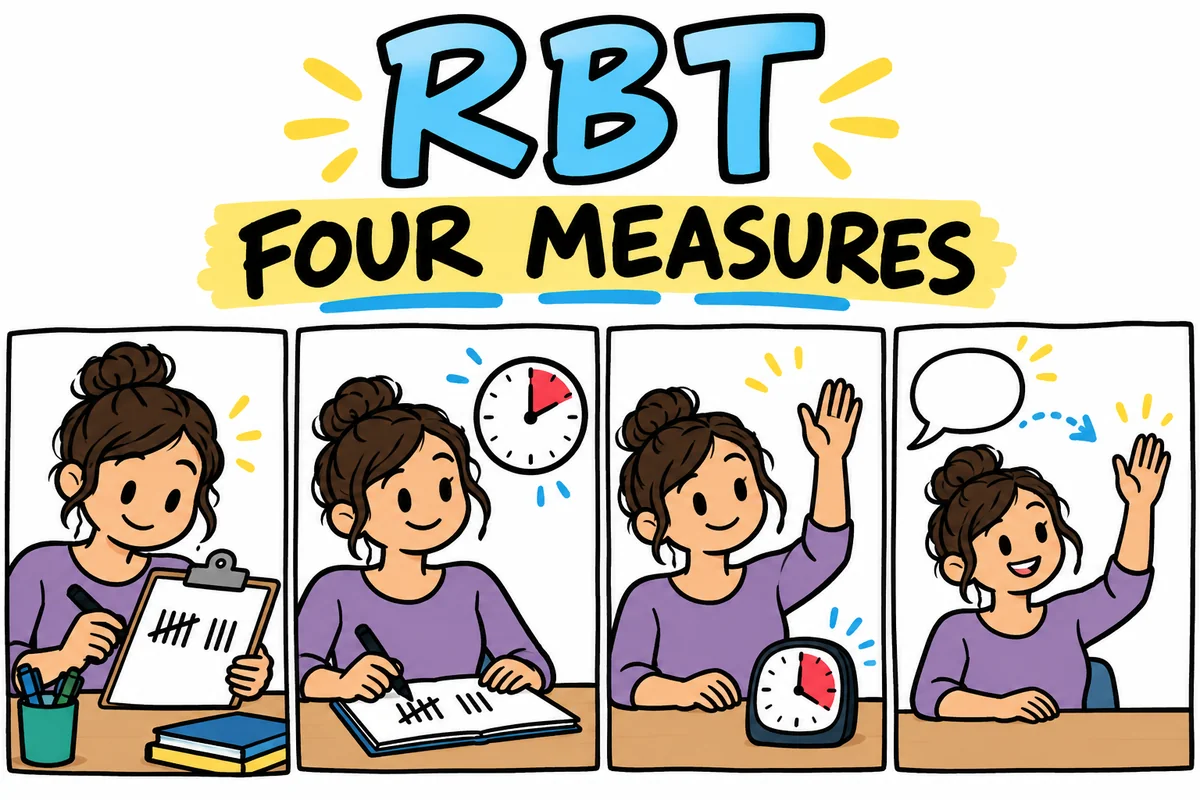
With a tally sheet, a stopwatch, and a two-minute observation in front of you, which number belongs in your notes? Frequency counts occurrences. Rate relates that count to observation time. Duration measures how long a behavior lasts, and latency measures the wait from a defined event to the start of a response.
The arithmetic becomes easier when you keep those questions attached to a real timeline. We will use one invented observation throughout, with every timestamp shown, so you can trace each result back to the record. This is a learning example, not a client record or a treatment recommendation.
Where this fits in RBT preparation
The BACB RBT Test Content Outline, third edition, applies to examinations beginning in 2026 and lists frequency, duration, latency, and interresponse time under task A.1 for continuous measurement. Task A.6 covers calculations such as rate, mean duration, and percentage. This walkthrough connects those two tasks, with a short explanation of interresponse time near the end. BACB RBT Test Content Outline, third edition
For study purposes, work through each calculation below. In service delivery, follow the measurement procedure and operational definition assigned by your supervisor. If a start point or stopping rule is unclear, ask before collecting the data.
One observation, with the clock visible
Imagine an adult learner practicing how to request a speaking turn by raising one hand. For this example, an episode starts when that hand crosses above shoulder height and ends when it drops below shoulder height. Each new upward crossing after an episode ends counts as another occurrence.
Observation starts at 0 seconds and continues without interruption until 120 seconds. The instructor finishes a single cue, "Raise your hand when you want a turn," at 0 seconds. There are no later cues in this example. The learner raises a hand during three separate episodes.
| Episode | Start (s) | End (s) | Duration (s) |
|---|---|---|---|
| 1 | 7 | 12 | 5 |
| 2 | 40 | 48 | 8 |
| 3 | 90 | 102 | 12 |
Frequency: count the episodes
Count the rows in the observation table. There are three hand-raising episodes, so the frequency is 3 occurrences during the two-minute observation.
Count each episode once. The five-second episode and the twelve-second episode each add one to the tally, even though you can see in the table that the learner kept a hand raised for different amounts of time. Save those seconds for duration.
In this article, frequency means the event count. You may see frequency used to mean a rate in other materials, so read the units beside a number and follow the terminology in your training. A bare "3" is a count. "1.5 occurrences per minute" reports a rate.
Rate: divide the count by observation time
The observation lasted 120 seconds. Convert that to minutes by dividing by 60, then use the resulting 2 minutes as the denominator under your count of three occurrences.
Rate = 3 occurrences / 2 minutes = 1.5 occurrences per minute.
A decimal rate is fine. You counted three complete episodes across two minutes, and division expresses that count per minute without suggesting that anyone performed half a hand raise. You could report the same rate as 0.025 occurrences per second, but keep one time unit consistent when comparing records.
Suppose a separate four-minute observation contains four occurrences. Its rate is 4 / 4 = 1 occurrence per minute. That session has a larger count and a lower rate. The sessions differ in length, which is why the denominator matters. Even with a common unit, check the activities and opportunities to respond before interpreting a change.
Duration: subtract each start time from its end time
Look at episode 2. It begins at 40 seconds and ends at 48 seconds, so its duration is 48 – 40 = 8 seconds. The first episode lasts 5 seconds, and the third lasts 12 seconds.
Add the episode durations to find total duration.
Total duration = 5 + 8 + 12 = 25 seconds.
Average duration per episode = 25 seconds / 3 episodes = about 8.33 seconds per episode.
Which duration does your form request? If it asks for the average episode length, enter about 8.33 seconds per episode, while a field for total duration needs the full 25 seconds accumulated across all three episodes. Check the label before copying a result.
You can also express duration as a percentage of observation time. Use the same units above and below the division line.
Percentage of observation time = (25 seconds / 120 seconds) x 100 = about 20.83%.
Keep the unrounded fraction until the last calculation. The IRIS Center at Vanderbilt explains duration recording and this percentage calculation in its observation guidance. IRIS Center: Duration and Latency Recording
Latency: time the wait before the response starts
The cue finishes at 0 seconds, and the first hand-raising episode begins at 7 seconds. Under our stated timing rule, latency is 7 – 0 = 7 seconds.
Stop the latency clock at the beginning of the response. If you stop at 12 seconds, you have included the first episode's five-second duration as well as the wait.
Our record contains one cue, so it supports one cue-to-response latency. To calculate another latency at the later onset of 40 seconds, you would need another recorded cue or other defined antecedent to start timing from. The IRIS Center describes latency as the elapsed time from a specified antecedent to the beginning of the behavior. IRIS Center: Duration and Latency Recording
A procedure might use cue onset, cue completion, or another precisely defined event as its reference. Record the rule you are following. If no response occurs before a trial ends, record that outcome and the observation limit according to the procedure. A missing response does not have zero latency.
What belongs in the reusable record
Keep the timestamps. If a subtraction needs checking later, you can return to the original start and end times on the record instead of trying to reconstruct the episode from a summary number. The accompanying blank observation record (CSV) has space for the observation window, behavior definition, cue timing rule, episode timestamps, and any interruption.
If you lose sight of the behavior for part of the observation, mark the gap. Unobserved time cannot be treated as a confirmed zero. Bring the incomplete record to your supervisor so the summary follows the assigned procedure. IRIS also emphasizes defining a behavior clearly enough for observers to identify and measure it consistently. IRIS Center: Implementation and Progress Monitoring
A nearby idea: interresponse time
Interresponse time, or IRT, measures the gap from the end of one response to the start of the next. In our timeline, the first gap is 40 – 12 = 28 seconds. The next is 90 – 48 = 42 seconds.
Those gaps use the response endpoints. Latency uses the defined cue or other antecedent as its starting point. If the two terms get tangled while you study, draw a small mark at the event that starts each clock. Then trace the clock to its stopping point.
Keep the question beside the number
Before you submit a measurement, read its label and unit together. "3 occurrences," "1.5 occurrences per minute," "25 seconds total," and "7 seconds after the cue" all describe this same observation. Each preserves a different part of it.
For the next part of your preparation, the Effortless Math RBT study hub brings together the exam outline, measurement topics, and practice resources. Use it to choose the topic you want to work on next. Effortless Math RBT study hub
Official outline and research checked October 11, 2026. This independent study tutorial uses an original hypothetical observation. 2027 preparation edition. Official specifications were checked on October 11, 2026. Confirm current rules with the exam provider before a later appointment.

Related to This Article
More math articles
- 10 Most Common PERT Math Questions
- Free Grade 7 English Worksheets for Arizona Students
- 7 Best Digital Pen Tablets for Online Math Teaching in 2026
- Oklahoma OSTP Grade 5 Math: 48 Free Single-Page Printables, One Skill Each, Answer Keys Included
- The Best Grade 8 ELA Practice Tests for Maryland Students
- 8th Grade OST Math Practice Test Questions
- Second Amendment
- Math, Graphs, and Economic Reasoning
- How to Simplify Radical Expressions? (+FREE Worksheet!)
- The Best Grade 7 Math Book for Nevada Students


















What people say about "RBT Frequency, Rate, Duration and Latency: Worked Examples (2027 Prep) - Effortless Math"?
No one replied yet.