Ford, Carter, Human Rights, Camp David, and the Hostage Crisis
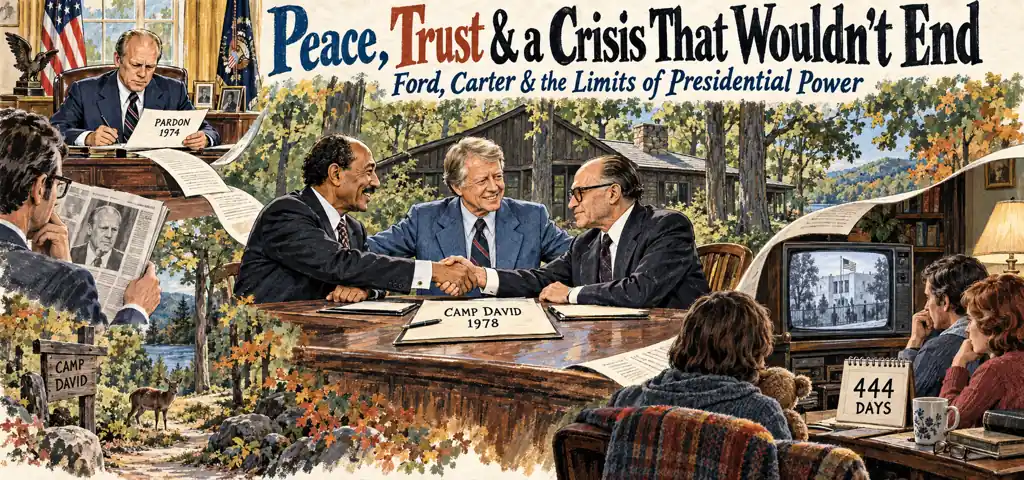
Chapter 15 of the CLEP History of the United States II study guide on Effortless Math covers Ford, Carter, Human Rights, Camp David, and the Hostage Crisis: the key terms, the core ideas, and worked examples showing how this topic is tested on the exam.
CLEP History of the United States II, Chapter 15
Ford inherited a crisis of trust and economy
Gerald Ford took office after Nixon's resignation and promised openness, but his September 1974 pardon of Nixon generated suspicion that a deal had been made. Ford argued the pardon would end national distraction; critics believed it prevented accountability. Inflation, recession, and unemployment shaped the 1974 midterms and 1976 election. His "Whip Inflation Now" campaign relied initially on voluntary restraint and became a symbol of limited policy reach.
Congress challenged presidential foreign policy
Ford continued détente, signed the Helsinki Final Act, and managed the final collapse of South Vietnam. Congress denied additional aid and scrutinized intelligence abuses. The Mayaguez rescue in 1975 displayed force after Cambodia seized an American merchant ship, but the operation cost American lives after the crew was being released. The episode shows why action can serve symbolic resolve while remaining operationally disputed.
Carter made human rights a declared foreign-policy standard
Jimmy Carter criticized support for abusive allies and elevated human rights in diplomacy, arms sales, and aid. The policy helped dissidents and changed official language, but strategic concerns produced inconsistency. The administration pressured some Latin American governments while maintaining relations with others, and it normalized ties with China. Human rights was a priority competing with security, trade, and Cold War strategy, not an automatic rule.
The Panama Canal treaties traded control for a long transition
Two 1977 treaties provided for transfer of canal control to Panama by the end of 1999 and permanent neutrality with American rights to defend access. Carter argued that ending the colonial-style arrangement would improve hemispheric relations and secure cooperation. Opponents portrayed transfer as surrender of an American asset. The treaties did not immediately close the canal or remove every American role.
Camp David converted presidential mediation into two frameworks
Carter brought Egyptian president Anwar Sadat and Israeli prime minister Menachem Begin to Camp David in 1978. One framework addressed a broader peace process; the other led to the 1979 Egypt-Israel treaty. Israel returned the Sinai to Egypt, and Egypt recognized Israel. Palestinian autonomy provisions did not produce a final regional settlement. The achievement was historic bilateral peace, not resolution of every Arab-Israeli conflict.
SALT II became a signed but unratified limit
Carter and Soviet leader Leonid Brezhnev signed SALT II in 1979, limiting strategic delivery vehicles and some missile developments. Senate opposition was already substantial, and the Soviet invasion of Afghanistan ended prospects for ratification. Both governments observed many limits for a time. The treaty's fate illustrates the difference between negotiation, signature, Senate consent, and practical restraint.
The Iranian Revolution destroyed a central alliance
The United States had supported Shah Mohammad Reza Pahlavi as a strategic ally despite authoritarian rule. Revolution forced him out in 1979, and Ayatollah Ruhollah Khomeini led an Islamic Republic. When Carter admitted the shah for medical treatment, militants seized the American embassy in Tehran on November 4, taking hostages. Memories of American intervention, especially the 1953 coup, shaped Iranian suspicion.
The hostage crisis consumed the presidency
The hostages remained captive for 444 days. Carter pursued sanctions, diplomacy, and a failed April 1980 rescue, Operation Eagle Claw, in which eight American servicemen died. The crisis symbolized reduced American control and dominated news. The hostages were released on January 20, 1981, after the Algiers Accords, minutes after Reagan became president; their release resulted from negotiation, not a completed military rescue.
Volcker chose recession to break inflation
Carter appointed Paul Volcker Federal Reserve chair in 1979. The Fed restricted money and allowed interest rates to rise sharply, contributing to recessions but eventually reducing inflation. Carter also faced energy shortages and delivered the "crisis of confidence" speech, urging conservation and civic purpose. Critics heard blame and malaise; supporters saw an attempt to address structural dependence and public distrust.
distinguish a diplomatic stage from a final result
A president signs an arms agreement, but the Senate never gives consent.
Energy policy mixed conservation, production, and institutional change
Carter called the energy problem the "moral equivalent of war," promoted conservation, and signed legislation that reduced price controls over time while encouraging alternative fuels and efficiency. He created the Department of Energy in 1977, bringing scattered programs together. The Three Mile Island accident in 1979 intensified concern about nuclear safety, although utility orders for new reactors had already slowed because of cost, demand, and regulation. Energy politics therefore cannot be reduced to a choice between drilling and abstinence; price rules, technology, safety, imports, and consumer behavior interacted.
The 1980 election combined performance judgments with coalition change
Inflation, unemployment, the hostage crisis, conflict within the Democratic Party, and Carter's difficulty projecting control weakened the incumbent. Reagan offered tax reduction, military strength, conservative social themes, and optimism, while independent John Anderson attracted some moderate voters. The result advanced the New Right, but many voters were also reacting to immediate conditions rather than endorsing a complete ideological program. Election returns show who won under a particular economy and set of alternatives. They do not prove that every voter agreed with every plank or that older welfare programs had lost all support.
Watch the history in motion
This short lesson adds voices, images, and chronology to the ideas you just studied.
Video: AP US History Topic 27 The 1970's – Ford and Carter David Busch Buschistory, David Busch.
Try four CLEP-style questions
- Why did Ford's pardon of Nixon damage public trust?
- Critics suspected it prevented accountability and might reflect an undisclosed bargain.
- It nullified the Watergate prosecutions of other officials along with Nixon's potential liability.
- It returned Nixon to the presidency without a new national election.
- It prohibited Congress from enacting campaign-finance and intelligence reforms.
- It required Ford to resign after serving the remainder of Nixon's term.
- What did the Camp David process accomplish most directly?
- It created a Palestinian state recognized by every Arab government and Israel.
- It produced the framework for an Egypt-Israel peace treaty and Sinai withdrawal.
- It transferred the Suez Canal from Egypt to joint American-Soviet administration.
- It ended civil war in Lebanon through a permanent multinational occupation.
- It merged Israeli and Egyptian armed forces into a regional defense alliance.
- Why did SALT II never receive Senate ratification?
- The Supreme Court ruled that presidents could not negotiate arms agreements.
- Existing opposition intensified after the Soviet invasion of Afghanistan.
- The treaty applied only to conventional troops stationed in Western Europe.
- Carter withdrew it after the Soviet Union met the treaty's strategic limits ahead of schedule.
- China vetoed the agreement through its permanent seat in the United Nations.
- Which statement best explains the hostage release?
- The Panama Canal treaties supplied the legal procedure for resolving the embassy seizure.
- Operation Eagle Claw rescued every captive without American or Iranian casualties.
- Negotiations produced the Algiers Accords; the hostages left Iran on Reagan's inauguration day.
- SALT II required Iran to transfer the hostages to a Soviet diplomatic mission.
- Congress recognized the shah as Iran's president in exchange for immediate release.
Check your answers and reasoning
Independent preparation. CLEP is a registered trademark of the College Board, which does not endorse this lesson.

Related to This Article
More math articles
- Algebra Puzzle – Challenge 40
- Government, Politics, and Power
- A Comprehensive Collection of FREE ACT Math Practice Tests
- Comparing and Ordering Decimals for 5th Grade: Step-by-Step Guide
- The College Mathematics Exam Overview
- The Ultimate 6th Grade MAP Math Course (+FREE Worksheets)
- The Ultimate 6th Grade OSTP Math Course (+FREE Worksheets)
- How to Add and subtract Fractions with Like Denominators in Recipes
- Free Grade 4 English Worksheets for Iowa Students
- The Bay of Pigs, Berlin, and the Cuban Missile Crisis






















What people say about "Ford, Carter, Camp David and the Hostage Crisis"?
No one replied yet.