Strikes, the First Red Scare, and the Palmer Raids
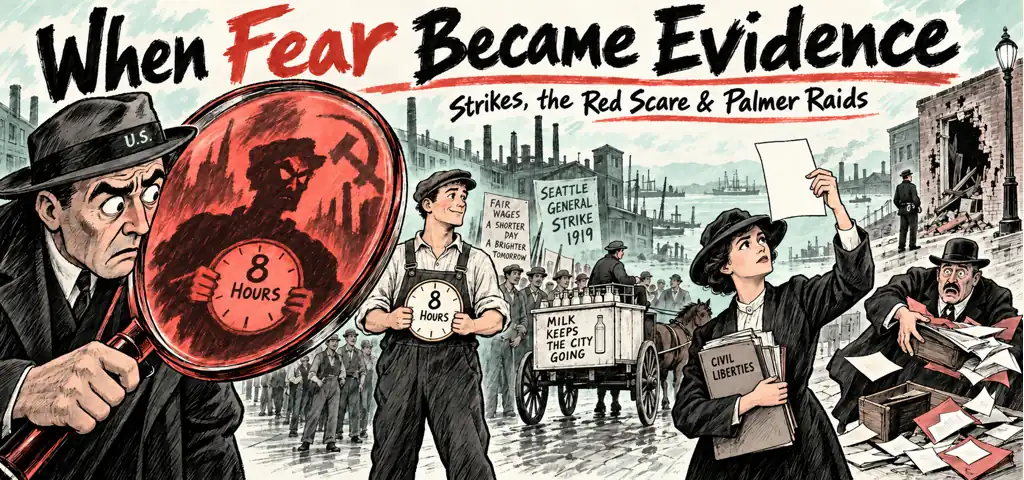
Chapter 7 of the CLEP History of the United States II study guide on Effortless Math covers Strikes, the First Red Scare, and the Palmer Raids: the key terms, the core ideas, and worked examples showing how this topic is tested on the exam.
CLEP History of the United States II, Chapter 7
Reconversion destabilized work
The armistice ended federal war contracts, returned soldiers to the labor market, and weakened emergency labor boards just as prices remained high. Workers who had gained wages, union membership, or recognition during mobilization tried to preserve those advances. Employers sought managerial control and portrayed wartime concessions as temporary. In 1919 more Americans struck than in any earlier year. Inflation and institutional reconversion explain the broad wave better than a claim that most strikers sought revolution.
Seattle tested the meaning of a general strike
A shipyard dispute expanded into the Seattle General Strike of February 1919, when roughly 60,000 workers stopped work. Union committees maintained essential services such as hospital laundry and milk distribution. The strike ended after five days without the revolutionary seizure critics predicted. Its breadth frightened officials and employers because workers demonstrated coordination across trades. The event was radical in form but more disciplined and reformist in operation than the label "Bolshevik uprising" suggested.
Boston made public employment distinct
Boston police struck in September 1919 over wages, hours, and union recognition. Disorder followed, the state militia restored order, and Massachusetts governor Calvin Coolidge declared that no one had a right to strike against public safety. The city dismissed the strikers and hired a new force. Unlike a private factory dispute, a police strike raised the question whether essential public employees could withhold labor, giving opponents a stronger public-order argument.
The steel strike confronted corporate power
About 300,000 steelworkers struck beginning in September 1919 for union recognition, an eight-hour day, and improved conditions. Companies refused to negotiate, used injunctions and local police, recruited Black and Mexican strikebreakers, exploited ethnic and language divisions, and branded organizers foreign radicals. The strike collapsed by January 1920. Its defeat resulted from employer resources, state support, labor fragmentation, and the Red Scare frame, not from one cause alone.
Coal brought injunction and negotiation
United Mine Workers members struck in November 1919. The Wilson administration obtained an injunction under wartime food and fuel authority, arguing that coal was essential, while union leaders formally canceled the strike and miners continued it. A settlement raised wages and created a commission to study prices and pay. The episode shows the government acting as prosecutor, emergency manager, and negotiator. Federal intervention did not consistently favor either labor or capital across every dispute.
The Bolshevik Revolution changed interpretation
The 1917 Russian Revolution gave Americans a vivid image of a revolutionary party taking power amid war and social collapse. In the United States, newspapers and officials increasingly interpreted strikes, immigrant radicalism, socialism, and anarchism through a Bolshevik frame. Some activists did advocate revolution. Yet treating wage disputes or interracial organizing as proof of a coordinated foreign plot allowed employers and officials to discredit much broader dissent.
Bomb scares supplied a security trigger
In spring 1919 anarchists mailed bombs to public figures. In June coordinated explosions damaged homes and public buildings, including Attorney General A. Mitchell Palmer's Washington residence. The attacks were real, though they did not prove that millions of immigrants or strikers belonged to one conspiracy. Palmer expanded a campaign against radicals, while the Justice Department's General Intelligence Division under young J. Edgar Hoover compiled files and coordinated raids.
Raids sacrificed procedure
Federal agents and local police raided organizations in November 1919 and January 1920, arresting thousands. Officers often lacked valid warrants, seized records broadly, beat prisoners, denied timely access to counsel, and held people in poor conditions. Immigration law allowed deportation of noncitizens for certain radical affiliations, but arrests swept beyond people against whom evidence supported deportation. The central civil-liberties issue is not whether bomb violence existed; it is whether state power distinguished evidence from association and fear.
Deportation made citizenship status decisive
The government deported 249 noncitizens, including Emma Goldman and Alexander Berkman, aboard the Buford in December 1919. Deportation is an immigration proceeding, not a criminal sentence, though its consequences are severe. Citizens could be prosecuted for crimes or speech offenses but could not be expelled through the same immigration authority. The distinction between citizen and noncitizen shaped available sanctions and procedural protections.
The predicted uprising did not arrive
Palmer warned of revolutionary violence on May Day 1920. When the predicted nationwide uprising failed to occur, his credibility collapsed. Lawyers, judges, journalists, and Labor Department officials had already criticized abuses and weak evidence. The episode shows how a security campaign can lose authority when its broad prediction becomes testable. Failure of the prediction did not erase actual bombings; it undermined the claim of an imminent, coordinated mass revolt.
Race and labor were joined in the backlash
Employers used Black and Mexican workers as strikebreakers while often denying them union membership or equal conditions. Some unions intensified exclusion; others attempted interracial organizing. Officials associated radicalism with immigrants, and white mobs associated Black self-defense with subversion. The postwar reaction therefore separated workers through race and nationality while claiming to defend social order. Labor defeat, immigration restriction, and racial violence reinforced one another without being identical movements.
Civil-liberties organizations learned from repression
The National Civil Liberties Bureau, rooted in wartime defense of conscientious objectors and antiwar speakers, became the American Civil Liberties Union in 1920. Lawyers challenged raids, deportations, and speech restrictions. Institutional opposition did not immediately undo convictions or immigration law. It created durable advocacy and legal capacity, turning lessons from wartime repression into an organization prepared for later constitutional battles.
test the radicalism claim
A steelworker demands an eight-hour day, an anarchist mails a bomb, and an agent arrests everyone present at a foreign-language meeting.
The postwar state reordered bargaining power
Emergency boards receded while injunctions, police, corporate publicity, deportation, and intelligence files grew more important. Workers struck to defend material and organizational gains; officials faced genuine disorder and attacks; political actors then stretched those threats into a broad category of disloyalty. The First Red Scare mattered because fear changed the institutions available to settle conflict. It made bargaining demands easier to recast as security offenses.
Watch the history in motion
This short lesson adds voices, images, and chronology to the ideas you just studied.
Video: The Palmer Raids Explained: US History Review, Hip Hughes (HipHughes).
Try four CLEP-style questions
- Companies refuse negotiation, obtain injunctions, use police, recruit strikebreakers, and exploit language and craft divisions during the steel strike. Which explanation of defeat fits the evidence?
- Corporate resources, state support, workforce fragmentation, and replacement labor combined; no single weakness explains the outcome.
- The strike failed because workers withdrew their demands before employers mobilized against them.
- The strike ended when the federal government recognized one industrywide union as the sole bargaining agent.
- A national police union redirected the dispute from steel mills to public employment.
- Workers won the eight-hour day but rejected a contract because it lacked a League guarantee.
- The government obtains an injunction against striking coal miners but also negotiates a wage increase and a commission. What does the combination demonstrate?
- Federal intervention followed a fixed pro-union rule in every industry considered essential.
- Government could combine coercion, emergency management, and mediation within one dispute.
- Negotiation prevented officials from invoking emergency authority over national fuel distribution.
- The settlement converted wartime food-and-fuel law into a permanent bargaining statute.
- The injunction transferred mine ownership and operating authority to the United Mine Workers.
- A citizen and a noncitizen attend the same radical meeting, but officials seek to deport only the noncitizen. Which legal distinction is most relevant?
- Citizenship determines whether speech inside the United States receives any constitutional protection.
- A citizen can be deported administratively, while a noncitizen first requires criminal conviction.
- Naturalization courts impose prison sentences on citizens while immigration officials try ordinary crimes.
- Meeting attendance supplies identical proof of criminal guilt and deportability for both participants.
- Immigration law can remove a noncitizen; it cannot expatriate a citizen through that power.
- Why does comparing Seattle, Boston, and steel complicate the phrase "the strike wave"?
- All three were directed by the same national union and ended through arbitration.
- The disputes shared postwar pressure but differed in industry, public function, tactics, and government response.
- Only the Boston dispute involved wages or recognition.
- Seattle and steel involved public employees, while Boston involved private factories.
- Each strike produced a successful permanent union contract.
Check your answers and reasoning
Independent preparation. CLEP is a registered trademark of the College Board, which does not endorse this lesson.

Related to This Article
More math articles
- How to Solve a Quadratic Equation by Completing the Square?
- Ohio OST Algebra 1 Free Worksheets: Printable OST-Ready Algebra 1 Worksheets with Step-by-Step Keys
- Candidate characteristics
- How to Decipher Limits and Function Values
- The Best Grade 4 ELA Practice Tests for Minnesota Students
- Entry determines whether profit persists
- Middle-Range Theory and Evidence
- Eclipses and Stellar Life Cycles
- How to Find Slope? (+FREE Worksheet!)
- Chapter 14: Bureaucratic Accountability














What people say about "Strikes, the Red Scare, and Palmer Raids"?
No one replied yet.