The Fourteen Points, Versailles, and the League Fight
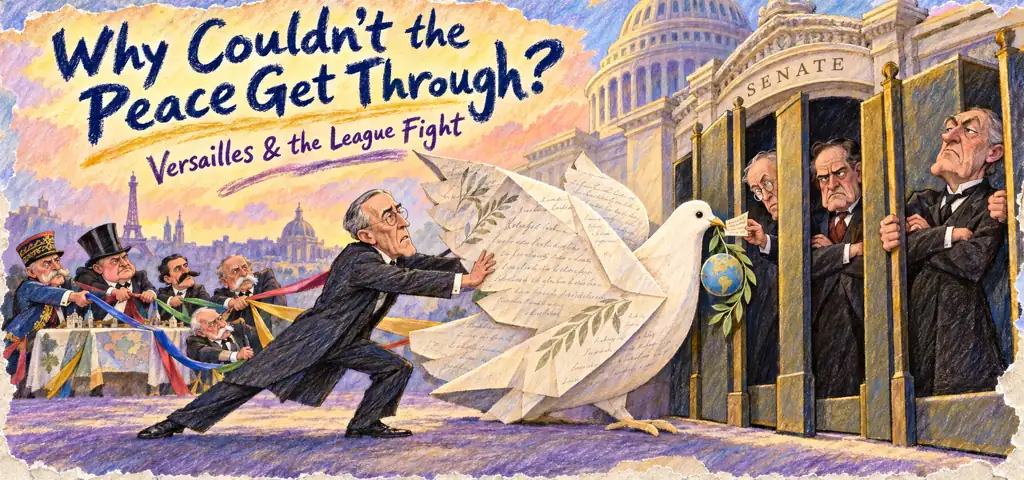
Chapter 7 of the CLEP History of the United States II study guide on Effortless Math covers The Fourteen Points, Versailles, and the League Fight: the key terms, the core ideas, and worked examples showing how this topic is tested on the exam.
CLEP History of the United States II, Chapter 7
Wilson framed a program before victory
In January 1918 Wilson presented the Fourteen Points: open diplomacy, freedom of the seas, fewer economic barriers, arms reduction, impartial adjustment of colonial claims, evacuation or restoration of occupied countries, national adjustments in Europe, and a general association of nations. The program did not demand German confession of war responsibility or a fixed reparations bill. It sought principles for a durable order, although terms such as self-determination were applied selectively and did not promise independence to every colonized people.
Associated power preserved formal independence
The United States fought Germany as an associated power, not a treaty ally of Britain and France. Wilson wanted freedom to advance American peace terms rather than accept every Allied war aim. Military cooperation remained extensive, so the label did not make the war effort separate in practice. It signaled diplomatic independence. The distinction helps explain why Wilson expected his principles to mediate among victors as well as constrain Germany.
Security aims divided the peacemakers
French premier Georges Clemenceau wanted concrete protection against another German invasion: a demilitarized Rhineland, military restrictions, reparations, and enforceable guarantees. Wilson emphasized a League and a settlement not built solely on punishment. British and Italian leaders pursued imperial, naval, and territorial interests of their own. The conference was therefore a negotiation among unequal victors, not the implementation office of the Fourteen Points.
Versailles constrained Germany
The treaty returned Alsace-Lorraine to France, limited the German army to 100,000 volunteers, barred certain weapons, demilitarized the Rhineland, transferred territories, and placed colonies under mandates. The Rhineland was not ceded as sovereign French territory. Germany initially remained outside the League. Reparations were required, but the final sum was set later. These distinctions separate military security, territorial change, institutional status, and financial liability.
Article 231 supplied liability language
Article 231 stated that Germany and its allies accepted responsibility for loss and damage caused by the war imposed through their aggression. It supplied the legal foundation for reparations and became known as the war guilt clause. The article did not itself state the final cash amount. Germans read it as a moral condemnation, while Allied lawyers used it to establish liability. Legal function and political meaning could therefore diverge.
Mandates recast rather than ended empire
Article 22 of the League Covenant described former German colonies and Ottoman territories as peoples not yet able to stand alone. Individual victor states administered mandates while reporting to the League until, in theory, the populations could govern themselves. The language of trusteeship distinguished mandates from outright annexation, but affected peoples had little choice of mandatory power and imperial governments retained control. International supervision modified empire without delivering general self-determination.
Racial equality failed inside the Covenant debate
Japan proposed a declaration of racial equality for the League Covenant. A majority of delegates on the commission supported it, but Wilson, presiding, ruled that the divisive proposal required unanimity. Domestic racial politics and opposition from parts of the British Empire influenced the result. The defeat exposed the gap between universal language and a settlement structured by racial hierarchy. It also affected Japanese views of the new order.
Shandong ignited Chinese protest
The conference transferred Germany's former concessions in China's Shandong province to Japan rather than returning them to China. News of the decision triggered the May Fourth demonstrations in Beijing on May 4, 1919, and the protests expanded into a nationalist and cultural movement. Under that public pressure, China's delegation refused to sign the treaty on June 28. The episode shows that bargains among victorious powers could contradict the territorial integrity and self-determination language associated with Wilsonian diplomacy.
Article X became the Senate focal point
Article X committed League members to respect and preserve the territorial integrity and political independence of other members against external aggression. Supporters argued that collective security could deter war and that constitutional processes still governed American action. Critics feared an open-ended obligation that might weaken Congress's power to decide on war or bind the nation to distant conflicts. The disagreement concerned how an international promise would interact with domestic authority.
The Senate contained more than isolationists
Irreconcilables such as William Borah opposed League membership in principle. Reservationists led by Foreign Relations Committee chair Henry Cabot Lodge were willing to consent with conditions, especially a reservation denying that Article X obligated the United States without congressional authorization. Party rivalry and personal conflict mattered, but the Senate divide included distinct constitutional positions. Treating every opponent as an absolute isolationist hides the possible coalition.
Wilson rejected the reservation path
Wilson took the treaty to the public on a speaking tour in 1919, suffered a severe stroke, and remained unwilling to accept Lodge's reservations. The Senate voted on versions with and without reservations; neither achieved the required two-thirds of senators present and voting. A treaty can receive a numerical majority and still fail. Wilson's refusal to compromise was not the sole source of opposition, but it prevented combining Democratic supporters with enough reservationists.
The United States made a separate peace
The United States never ratified Versailles and did not join the League. A 1921 peace treaty signed at Berlin claimed for the United States the rights and advantages the Allied powers received under Versailles while omitting the League Covenant. This was not a return to formal wartime status. It separated the legal end of war and material treaty rights from membership in Wilson's collective-security institution.
Treaty thresholds apply across cases
The Constitution requires consent by two-thirds of senators present. The Treaty of Paris ending the war with Spain passed in 1899 by one vote above that minimum. Versailles failed two decades later under the same threshold. The comparison teaches procedure, but the treaties belong to different historical problems. A procedural similarity does not transfer the territorial questions of 1898 into the League debate of 1919.
compare program and settlement
A prompt asks whether mandates fulfilled self-determination because they promised eventual self-rule.
The peace fight joined foreign and domestic power
Versailles departed from the Fourteen Points through punishment, imperial bargains, and selective self-determination, yet it incorporated Wilson's League. The Senate debate then moved the question into American constitutional structure: who could commit the nation, under what reservation, and through which threshold? The settlement's failure in the United States resulted from international compromise, partisan conflict, constitutional concern, ideological opposition, and presidential strategy acting together.
Watch the history in motion
This short lesson adds voices, images, and chronology to the ideas you just studied.
Video: APUSH Review: Wilson's Fourteen Points and The Treaty of Versailles, Adam Norris.
Try four CLEP-style questions
- Why did the language of national self-determination at Paris not produce independence for every colonized people?
- Delegations from proposed mandates participated on equal terms but lacked power to enforce conference decisions.
- The principle governed European settlements while mandates received fixed independence timetables elsewhere.
- League oversight transferred political sovereignty to local legislatures while mandatory powers retained economic administration.
- Senate reservations narrowed the principle before the peace conference began its territorial bargaining.
- The victors applied the principle selectively while strategic bargains and imperial claims continued to shape territorial decisions.
- A mandate report repeatedly calls imperial rule a "sacred trust." What evidence would best test whether that language produced movement toward self-government?
- The frequency with which reports repeated trusteeship phrases from the League Covenant
- Military expenditure by the mandatory power without evidence about local political institutions
- The nationality and diplomatic rank of the European official submitting each annual report
- Changes in local authority, petition access, resource control, and a transfer timetable
- Whether the territory previously traded more heavily with Germany than Britain or France
- Versailles incorporates a League but also imposes punitive terms and bargains over territory that depart from Wilson's earlier program. Which interpretation is strongest?
- The settlement mixed Wilsonian influence with negotiated security and imperial aims.
- Accepting a League required every delegation to adopt all Fourteen Points without modification.
- Departure from Wilson's program proves the United States exercised no influence at Paris.
- The United States Senate fixed territorial bargains before the peace delegates met.
- The settlement restored prewar diplomacy without creating a new international institution.
- How did Wilson's refusal to accept reservations affect the Senate arithmetic?
- It converted irreconcilables into treaty supporters.
- It let the Supreme Court approve Article X without Senate action.
- It blocked a potential coalition between treaty Democrats and conditional reservationists.
- It lowered the constitutional threshold to a simple majority.
- It removed the League Covenant before the final votes.
Check your answers and reasoning
Independent preparation. CLEP is a registered trademark of the College Board, which does not endorse this lesson.

Related to This Article
More math articles
- The Best Grade 8 ELA Practice Tests for Texas Students
- The Best Grade 7 ELA Practice Tests for Nevada Students
- Full-Length TABE 11 & 12 Math Practice Test-Answers and Explanations
- Grade 8 Vocabulary and Word Study: Roots, Context Clues, and Academic Language That Sticks
- Top 10 PSAT / NMSQT Prep Books (Our 2023 Favorite Picks)
- How to Do Ratio, Proportion, and Percentages Puzzle -Critical Thinking 8
- Government, Politics, and Power
- 10 Most Common 3rd Grade PARCC Math Questions
- Grade 3 ELA Tests: A Calm Parent Guide (What the Test Measures—and What It Doesn’t)
- Judicial review





















What people say about "Fourteen Points, Versailles, League Fight"?
No one replied yet.