Profit attracts entry
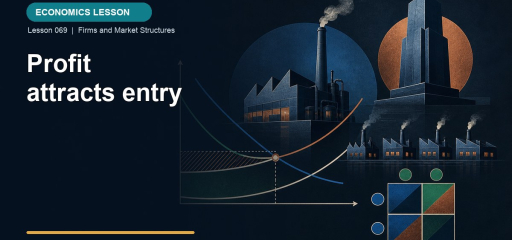
Profit attracts entry: this Effortless Math guide explains the topic in plain language, shows how it works through solved examples, and gives you free practice to try immediately, so the idea sticks instead of staying abstract.
More firms increase market supply and lower price.
Competitive firms are earning positive economic profit. In a constant-cost industry, long-run adjustment will tend to
- reduce the number of firms and raise price
- shift market demand left
- attract entry, increase market supply, and lower price
- shift each firm’s marginal-cost curve upward immediately
- leave price unchanged because firms are price takers
attract entry, increase market supply, and lower price Profit attracts entry. The resulting increase in industry supply lowers market price until economic profit is eliminated.
Competitive firms are incurring losses but covering average variable cost. What is the expected long-run response?
- Entry shifts supply right.
- Firms raise price individually.
- Demand becomes perfectly inelastic.
- Some firms exit, shifting market supply left.
- All firms shut down immediately.
Some firms exit, shifting market supply left. Persistent losses induce exit, reducing market supply and raising price for firms that remain.
In a competitive industry, persistent losses cause exit. Which market change follows?
- Supply shifts left and price rises
- Demand shifts right and price rises
- Supply shifts right and price falls
- Each remaining firm lowers its price independently
- Market quantity necessarily rises
Supply shifts left and price rises Exit removes sellers, shifting market supply left and raising price for firms that remain.
Watch the idea in action
A focused video lesson from Khan Academy.
Suppose demand rises in a competitive industry. In the short run, price rises, each firm expands along MC, and firms may earn profit. Profit signals that resources earn more than their opportunity cost. New firms enter, shifting market supply right. Price and each incumbent’s profit fall until economic profit is zero.
Entry is an industry event. It does not shift market demand or one incumbent’s cost curve in the constant-cost benchmark. It adds entire firm supply schedules at every market price. The lower market price then moves each incumbent to a smaller output along its own MC.
Resources follow economic profit because it is measured after all opportunity costs. A merely positive accounting profit may be no better than the owner’s next alternative and need not attract entry. The relevant signal is an excess return above normal profit.
Loss produces the reverse chain. Firms exit, market supply shifts left, price rises, and the remaining firms’ losses shrink. Exit does not shift one remaining firm’s cost curve in the basic model. It changes the market price the firm faces.
| Initial result | Industry response | Adjustment chain |
|---|---|---|
| Positive economic profit | Entry | Supply right, price down, firm output and profit down |
| Economic loss | Exit | Supply left, price up, survivor output and loss improve |
| Zero economic profit | No entry or exit | Firm count stable under unchanged conditions |
Entry can raise market output while lowering firm output
Demand rises and price increases. An incumbent expands from 50 to 65 units and earns profit. Entry later lowers price, and the incumbent returns to 50 units. Market output remains above its original level because more firms now each produce 50. Firm and industry directions differ during adjustment.
Exit is not the same as every firm reducing output. A price decline first makes existing firms contract along MC. Long-run exit then removes some firm supply curves and partly reverses the price decline. One action changes quantity per firm. The other changes seller count.
The adjustment takes time and need not be instantaneous. Barriers, uncertainty, and construction delays can allow profit to persist temporarily in an otherwise competitive market. Long-run theory describes the endpoint once entry or exit is possible, not a claim that every market reaches it immediately.
If demand conditions change again, the target moves. Exam questions ordinarily hold demand and costs constant during entry or exit so the chain can be isolated. Preserve that ceteris paribus assumption.
State the entry chain completely: profit attracts firms, firm count rises, market supply shifts right, price falls, each incumbent contracts, and profit disappears. “More firms enter” is true but incomplete when the question asks about price or incumbent output.
Entry can raise total market quantity while lowering each incumbent’s quantity. That apparent contradiction disappears once total output is recognized as the sum across a larger number of firms. The market and firm graphs must be read together throughout the long-run adjustment.
If entry bids up a specialized input, the industry is increasing cost and firm cost curves can shift. The basic chain here assumes constant cost. Add the input-market effect only when the stem states it.

Reza is an experienced Math instructor and a test-prep expert who has been tutoring students since 2008. He has helped many students raise their standardized test scores--and attend the colleges of their dreams. He works with students individually and in group settings, he tutors both live and online Math courses and the Math portion of standardized tests. He provides an individualized custom learning plan and the personalized attention that makes a difference in how students view math.
Related to This Article
More math articles
- Top 10 ATI TEAS 7 Prep Books (Our 2023 Favorite Picks)
- Unit Converter (Length, Mass, Volume, Temperature & More)
- 8th Grade STAAR Math FREE Sample Practice Questions
- The Ultimate NES Elementary Education Math Course
- The Best Algebra 1 Book for Oregon Students
- Sterile and Nonsterile Distribution and Transport
- SAT Math-Test Day Tips
- Cartels face an incentive to cheat
- Rates, Fertility, Mortality, and Reader-Friendly Calculations
- Political action committees





















What people say about "Profit Attracts Entry"?
No one replied yet.