From Word Problems to Working Code: Using Python to Make Middle School Math Stick
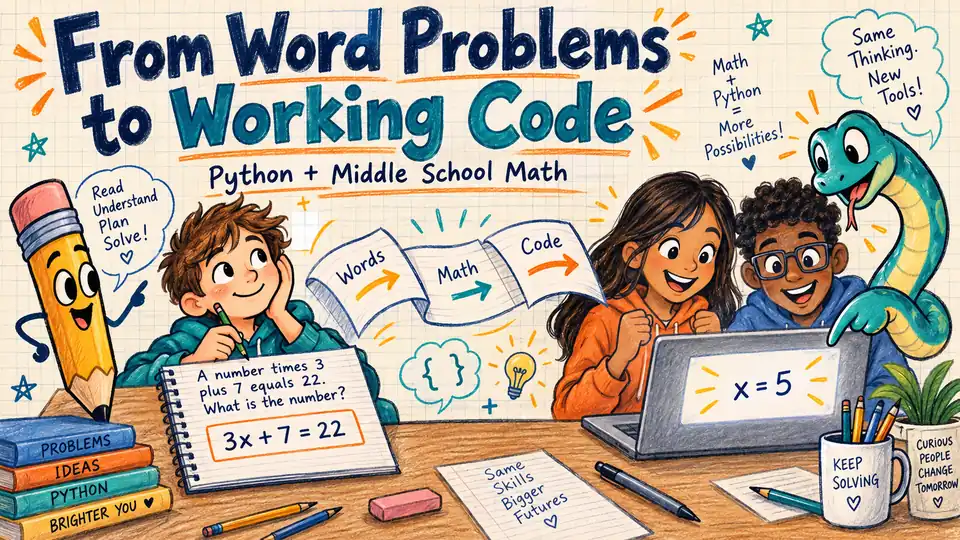
Every math teacher knows the student who can execute a procedure flawlessly and has no idea what it means. Ask them to solve 3x + 7 = 22 and they will get 5. Ask them why they subtracted 7 from both sides and you get silence, or the honest answer: because that is what you do.
Procedural fluency without conceptual understanding is fragile. It survives a unit test and collapses six months later when the same idea shows up wearing different clothes. One of the more practical ways to attack the problem costs nothing, runs in a browser, and happens to be a skill worth having for its own sake. You have the student write the math as code.
Why code exposes what a worksheet hides
A worksheet accepts a right answer produced by a wrong understanding. A program does not. If a student thinks the mean is “add them up and divide by something”, the code will divide by the wrong thing and the output will be visibly absurd. The gap between what the student believes and what is actually true becomes a number on the screen rather than a red mark two days later.
This is not a new observation. Seymour Papert argued decades ago that children learn mathematics best by building things with it, and that a computer’s real value in a classroom is as a medium the child instructs rather than a machine that quizzes them.1 What has changed is that the tooling finally caught up. A middle schooler can write and run useful Python in a free browser editor, with no installation and no setup lesson.
The research is encouraging and specific
It is worth knowing what the evidence actually supports before rearranging a curriculum around it. A meta-analysis of 105 studies on the transfer effects of learning to program found moderate positive transfer to mathematical skills, along with creative thinking, reasoning and metacognition, while transfer to unrelated domains such as literacy was much weaker.2
That pattern is exactly what you would hope for. Programming is not a general brain tonic. It is closely related to mathematics in structure, and the benefit shows up where the structures overlap: variables, functions, order of operations, conditional logic, iteration. Those are not analogies to math concepts. They are the same concepts with different notation.
Five places where the overlap is exact
Variables are the clearest case. In algebra a variable is a placeholder whose value is unknown or varies. In Python it is a name bound to a value. Students who find x mysterious often find total = 0 perfectly obvious, and once they have written a hundred lines using names that hold numbers, the algebraic x loses its menace.
Functions come next. A function in math takes an input and returns exactly one output. In Python you write that definition out literally, give it a name, and call it with different arguments. A student who has written a two-line area function and then called it four times has understood function notation in a way that f(x) on a whiteboard rarely delivers.
Order of operations stops being a mnemonic and starts being a rule with consequences. Type 2 + 3 * 4 and the interpreter returns 14. Add parentheses and it returns 20. The student is not told which is correct, they are shown, and the parentheses now have an obvious job instead of being decoration.
Conditionals map onto inequalities and case analysis. Writing a program that classifies a triangle by its sides, or decides whether a number is prime, is case analysis with immediate feedback on every branch the student forgot.
Iteration is where summation notation quietly becomes intuitive. A loop that accumulates a running total is the sigma symbol unpacked into steps. Students who meet the loop first usually meet the notation later without flinching.
Starting without turning it into a computer science course
The mistake is to teach Python as a subject. Fifty minutes on data types will lose a math class in ten. The approach that works is to keep the mathematics in front and let the syntax arrive only when a problem needs it.
Start with the interpreter as a calculator that writes down what it did. Move to naming values, then to a function that repeats a calculation, then to a loop. Four sessions of twenty minutes covers enough ground to write something genuinely useful. Teachers who want the ground mapped out before they start will find that structured overviews of Python for kids lay out the concept order and the common sticking points, which saves a lot of improvising in front of a class.
Assignments that are math problems first
The best tasks are ones where the code is the shortest path to an answer the student actually wants. Ask for a program that finds every factor of a number, and factorisation becomes a search the student has to define precisely. Ask for a program that computes the mean, median and range of the class’s own test scores, and the definitions have to be exact because the output will be compared out loud.
Other reliable ones: convert between fractions, decimals and percentages, and watch students discover which conversions are lossy. Simulate a thousand dice rolls and compare the result to the theoretical probability, which teaches more about expected value than a chapter does. Generate the first fifty terms of a sequence and let the student see the pattern before anyone writes the formula.
Test preparation benefits too, in a way that surprises people. A student who writes a program to generate their own practice problems, with random values and a printed answer key, has had to encode the problem type precisely. That encoding is the understanding. The worksheet they produce is almost beside the point.
What to watch for
Two failure modes are common. The first is the syntax spiral, where a class spends the period fighting indentation errors and never reaches the mathematics. The fix is to hand out working code and have students modify it rather than write from a blank file. Reading and changing code is a legitimate skill and a gentler entry.
The second is the calculator trap, where the program does the thinking and the student stops. If the assignment is “write code that solves this equation”, a student can paste a library call and learn nothing. If the assignment is “write code that shows every step of solving this equation”, they cannot. Keep the visible reasoning inside the task.
Realistic expectations
Adding Python to a math class will not fix a student who has never understood fractions, and it will not replace practice. What it does is convert a set of remembered procedures into a set of rules the student has had to state precisely enough for a machine to follow, which is a much more demanding standard than a worksheet applies. Students who reach that standard tend to hold onto the material, because they built it rather than memorised it.
References
- Papert, S. (1980) Mindstorms: Children, Computers, and Powerful Ideas. New York: Basic Books.
- Scherer, R., Siddiq, F. and Sanchez Viveros, B. (2019) ‘The cognitive benefits of learning computer programming: A meta-analysis of transfer effects’, Journal of Educational Psychology, 111(5), pp. 764-792.

Related to This Article
More math articles
- Top 10 7th Grade MEAP Math Practice Questions
- Different Question Types on the ACT Math Test
- The Best Grade 8 Math Book for South Carolina Students
- Writing Linear Equations Practice — Slope-Intercept Form (Free)
- North Carolina Algebra 1 Free Worksheets: Printable NC Algebra 1 Practice, Answers Included
- Math Topics You Need to Learn in Medicine
- 3rd Grade IAR Math FREE Sample Practice Questions
- Properties of the Vertical Lines
- Top 10 Tips for Managing Time Effectively on the SAT Math
- Science Facts and Quick Review







What people say about "Python for Middle School Math: From Word Problems to Code"?
No one replied yet.