Math for Programmers: The Practical Topics Every Coder Should Know in 2026

The math that programmers actually need is different from the math that math majors learn. You don’t need calculus to write production code. You do need a working command of discrete math, logic, big-O, modular arithmetic, and a sprinkle of linear algebra and probability.
This guide covers the practical topics, organized by what you’ll encounter on the job, in coding interviews, and in modern AI and data work in 2026. Each section explains the math and shows where it shows up in code.
1. Logic and Boolean Algebra
Every condition in every program is a Boolean expression. Knowing the laws of Boolean algebra makes code shorter and clearer.
The Core Operators
| Operator | Symbol | Truth |
|---|---|---|
| AND | && or ∧ | True only if both are true |
| OR | || or ∨ | True if either is true |
| NOT | ! Or ¬ | Flips true and false |
| XOR | ^ or ⊕ | True if exactly one is true |
De Morgan’s Laws
!(A && B)=!A || !B.!(A || B)=!A && !B.
When you have a complex negation, distribute the NOT and flip the operator. This simplifies code constantly.
Before:
if (!(x > 5 && y < 3)).
After:if (x <= 5 || y >= 3).
The second form is easier to reason about.
2. Big-O Notation
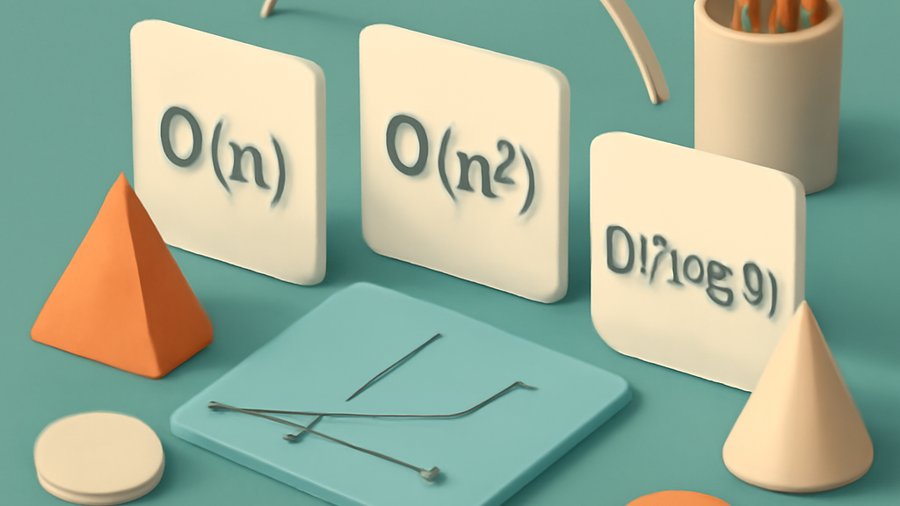
Big-O describes how an algorithm’s running time grows with input size n. It’s the single most common interview topic.
The Hierarchy
| Notation | Name | Example |
|---|---|---|
| O(1) | Constant | Array indexing |
| O(log n) | Logarithmic | Binary search |
| O(n) | Linear | Single-pass loop |
| O(n log n) | Linearithmic | Merge sort, quicksort (avg) |
| O(n²) | Quadratic | Nested loops |
| O(2ⁿ) | Exponential | Naïve recursion (e.g., naïve Fibonacci) |
| O(n!) | Factorial | Permutation generation |
How to Compute Big-O
- Count nested loops. Each loop adds a factor of n (or whatever the loop runs n times).
- Function calls inside a loop multiply the call’s complexity by the loop’s iterations.
- Drop constants: O(2n) becomes O(n).
- Keep the dominant term: O(n + log n) becomes O(n).
For loop inside a for loop over n? O(n²).
Binary search inside a loop over n? O(n log n).
3. Discrete Math
Discrete math covers structures used in programming: sets, graphs, trees, sequences.
Sets and Set Operations
- Union (∪): all elements in either set.
- Intersection (∩): elements in both.
- Difference (∖): elements in A but not B.
In Python: a | b, a & b, a - b.
Functions and Mappings
A function in math is a mapping: each input has exactly one output. A hash map is a function from keys to values, implemented for fast lookup.
Graphs and Trees
Most programming problems involve traversing graph-like structures:
- Trees: hierarchical (file system, DOM, organization chart).
- Graphs: arbitrary connections (social networks, route maps, dependency graphs).
Graph algorithms (BFS, DFS, shortest path) are the backbone of many real-world systems.
4. Modular Arithmetic
Modular arithmetic is the math of remainders. The % operator in most languages computes it.
Practical Uses
- Hashing: bucket assignment uses
key % table_size. - Cycles: a clock has 12 hours; the next hour after 11 is
(11 + 1) % 12 = 0(or 12). - Parity:
n % 2tells you if n is even (0) or odd (1). - Cryptography: RSA and most modern encryption use modular arithmetic.
Key Property
(a + b) mod m = ((a mod m) + (b mod m)) mod m.
This lets you simplify huge numbers before computing.
5. Linear Algebra
If you work on graphics, machine learning, robotics, or game physics, linear algebra is essential.
Vectors
A vector is an ordered list of numbers: (3, 4, 7). In 2D, vectors represent points or directions.
Key operations:
– Addition: (1,2) + (3,4) = (4,6).
– Scalar multiplication: 2 × (3,4) = (6,8).
– Dot product: (1,2) · (3,4) = 1×3 + 2×4 = 11.
– Magnitude: |(3,4)| = √(9 + 16) = 5.
Matrices
A matrix is a 2D grid of numbers. Used everywhere:
- 3D graphics: transformation matrices (translate, rotate, scale).
- Machine learning: weights in a neural network.
- Game physics: rigid-body transforms.
The most common matrix operation is multiplication: combining transformations.
6. Probability
Probability shows up in machine learning, A/B testing, randomized algorithms, and game design.
Key Concepts
- Probability: a number between 0 and 1 indicating likelihood.
- Expected value: the average outcome of a random process. E[X] = Σ x · P(x).
- Conditional probability: P(A | B) = P(A and B) / P(B).
- Bayes’ theorem: P(A | B) = P(B | A) · P(A) / P(B). The backbone of Bayesian inference.
Random Variables in Practice
- Random IDs (
uuid.uuid4()). - Random sampling (testing, simulation).
- A/B test analysis.
- Loot drops in games.
7. Number Theory (For Algorithms)
- Prime numbers: 2, 3, 5, 7, 11, …. Primes drive cryptography.
- GCD (greatest common divisor): largest number dividing both. Computed with Euclid’s algorithm.
- LCM (least common multiple): smallest number divisible by both. LCM(a, b) = a × b / GCD(a, b).
- Prime factorization: every integer is a unique product of primes.
8. Geometry (For Graphics and Games)
- Distance between (x₁, y₁) and (x₂, y₂): √((x₂ − x₁)² + (y₂ − y₁)²).
- Slope of a line: (y₂ − y₁) / (x₂ − x₁).
- Triangle area with vertices: (1/2) |x₁(y₂ − y₃) + x₂(y₃ − y₁) + x₃(y₁ − y₂)|.
- Point in polygon: ray-casting algorithm.
9. Combinatorics
Counting techniques drive performance analysis and probability.

- Permutations: order matters. N! / (n − k)! Ways to arrange k from n.
- Combinations: order doesn’t matter. C(n, k) = n! / (k! (n − k)!).
How many ways to choose 3 students from 10? C(10, 3) = 120.
10. Recursion and Induction
Recursion is a programming technique; induction is the math behind it.
A recursive function calls itself with a smaller input. Mathematical induction proves a claim for all n by showing it holds for n = 1 and that if it holds for n, it holds for n + 1.
Factorial:
f(n) = n * f(n-1), withf(0) = 1. Proven correct by induction.
What You Don’t Need
For most programming jobs, you do not need:
- Calculus (unless you’re doing physics simulation, ML research, or computer graphics).
- Trigonometry beyond basic geometry.
- Differential equations.
- Real analysis or abstract algebra.
The exception: machine learning research and graphics programming, where calculus and linear algebra become essential.
Math for Coding Interviews
The math you’ll see in interviews:
- Big-O: every interview.
- Modular arithmetic: hashing, cycle detection.
- Counting / combinatorics: probability questions, optimization.
- Bit manipulation: XOR tricks, binary representation.
- Basic number theory: primes, GCD.
Practice topics, not algorithms, when prepping. The algorithms vary; the underlying math doesn’t.
How to Strengthen Your Math for Programming
- Read a discrete math book (Rosen or Epp). Three months for the basics.
- Do problems on Project Euler (projecteuler.net). Math + programming.
- Take a linear algebra course. Khan Academy or MIT OCW.
- Take an intro probability course. Required for ML.
- Practice big-O analysis with daily LeetCode problems.
Common Mistakes
- Skipping discrete math. Programming is fundamentally discrete; calculus is rarely needed first.
- Treating big-O as just notation. Big-O is a way of thinking about scalability.
- Memorizing matrix formulas. Understanding what a matrix transformation does matters more than memorizing the matrix multiplication algorithm.
- Avoiding linear algebra for ML. You cannot deeply understand neural networks without linear algebra.
- Forgetting probability. A/B testing, ML, simulation, all rely on probability.
Frequently Asked Questions
Do I need calculus to be a software engineer?
For most jobs, no. For graphics, ML research, and physics simulation, yes.
How much math do data scientists need?
More than software engineers. Statistics, probability, linear algebra, and some calculus.
Is math more important than coding skill?
For most jobs, coding skill matters more. For ML and quant finance, math matters as much.
Where do I start if I’m behind on math?
Khan Academy’s Algebra → Statistics path is the most efficient self-study.
Will AI tools replace programmers’ need for math?
No. They make math fluency more valuable, because you can use AI to scaffold work but still need to verify the math is right.
Closing Thought
Math for programmers is a different curriculum from school math. Discrete math, logic, big-O, and modular arithmetic are the daily tools; linear algebra and probability open the door to ML and graphics; calculus is optional for most. Build the practical foundation first, layer specialty math on top, and your coding will improve along with your math.
For more math foundations, see our blog and our full Math Topics library. When you are ready for structured workbooks, browse our product catalog for algebra, statistics, and discrete math resources.

Related to This Article
More math articles
- Cruel and unusual punishment
- Trigonometric Integrals: A Thorough Guide On Everything You Need To Know
- George H. W. Bush, the Persian Gulf War, and the Post-Cold War Order
- CLEP U.S. History I 029: Military Turning Points and the French Alliance
- Electricity and Simple Circuits
- The Ultimate PSAT Math Course (+FREE Worksheets & Tests)
- Iron triangles
- Gender Socialization and Social Structure
- How to Decode the Mysteries: A Comprehensive Solution Guide for “FTCE Math for Beginners”
- Relationship Between Sides and Angles in a Triangle


What people say about "Math for Programmers: What to Actually Learn"?
No one replied yet.