YOUR GED STUDY COMPANION
10 GED Math Mistakes: Worked Fixes and a Free Review Log
Look for the reason behind a missed answer. Use the examples below to spot a mistake and practice a better approach.
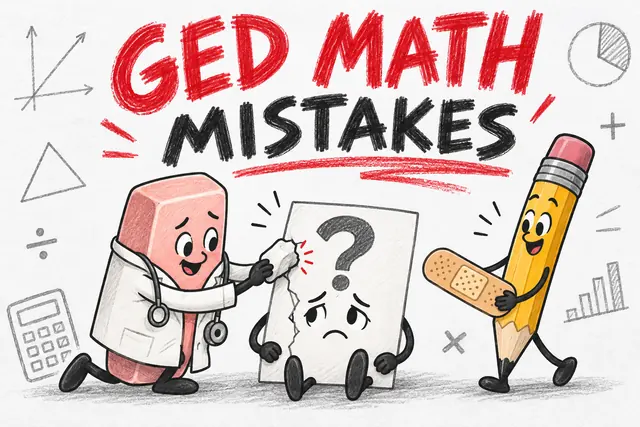
To learn from a missed GED Math practice problem, find the first incorrect step, explain the rule you need, solve the problem again, and check the result. Then try a fresh problem on that skill. The examples below show ten mistakes worth checking in your own work; they are not a measured ranking of mistakes made by GED test-takers.
Ten mistakes, with worked fixes
These are original teaching examples, not questions copied from an official GED exam or a protected book test.
1. Distributing a minus sign to only one term
The mistake: For 9 – (2x + 3), writing 6 + 2x changes the expression.
Worked fix: Subtract both terms: 9 – 2x – 3 = 6 – 2x. At x = 2, the original and corrected expressions both equal 2.
Your next check: Use substitution to check that an equivalent expression really has the same value.
2. Adding fractions by adding denominators
The mistake: 1/2 + 1/3 is not 2/5.
Worked fix: Use sixths: 3/6 + 2/6 = 5/6. The answer should be bigger than 1/2 because you added a positive amount.
Your next check: Find a common denominator and make a rough size check.
3. Treating multiplication as always before division
The mistake: 18 ÷ 3 × 2 is not 18 ÷ 6.
Worked fix: Multiplication and division share priority. Work left to right: 18 ÷ 3 = 6, then 6 × 2 = 12. Addition and subtraction also share priority.
Your next check: Write the next operation before calculating instead of following the letters of PEMDAS mechanically.
4. Finding the discount but reporting it as the sale price
The mistake: A $60 item is reduced by 15%. The discount, $9, is not the price you pay.
Worked fix: 15% of $60 = $9. Subtract: $60 – $9 = $51. A second check is 0.85 × $60 = $51.
Your next check: Circle what the question asks for: the discount, new price, or percent change.
5. Confusing area and perimeter
The mistake: An 8-foot by 5-foot rectangle has area 40 square feet, not perimeter 40 feet.
Worked fix: Area: 8 × 5 = 40 square feet. Perimeter: 2(8 + 5) = 26 feet.
Your next check: Use square units for covering a surface and linear units for distance around an edge.
6. Converting units in the wrong direction
The mistake: 2.5 feet does not equal 2.5 ÷ 12 inches.
Worked fix: There are 12 inches in one foot, so 2.5 × 12 = 30 inches. More smaller units are needed to represent the same length.
Your next check: Write the conversion relationship and check whether the numerical answer should grow or shrink.
7. Changing only one side of an equation
The mistake: From 3x + 7 = 22, removing 7 on the left while leaving 22 on the right changes the equation.
Worked fix: Subtract 7 from both sides: 3x = 15. Divide both sides by 3: x = 5. Check: 3(5) + 7 = 22.
Your next check: Show an operation on both sides and substitute the answer into the original equation.
8. Reading a graph without its scale
The mistake: Three grid intervals do not always mean 3 units.
Worked fix: If the vertical scale increases by 5 per interval, a point three intervals above zero has value 15. Read axis labels before interpreting a point.
Your next check: Record the units and value of one interval on each axis.
9. Using the calculator without grouping the numerator
The mistake: For (8 + 4)/3, entering 8 + 4 ÷ 3 evaluates a different expression.
Worked fix: Group the numerator: (8 + 4) ÷ 3 = 4. Without grouping, 8 + 4 ÷ 3 is 9 1/3.
Your next check: Practise entering fractions, negatives and parentheses; compare the display with the written expression.
10. Choosing a formula without matching its variables
The mistake: For a triangle with base 10 cm and perpendicular height 6 cm, multiplying 10 × 6 misses the one-half factor.
Worked fix: A = (1/2)bh = (1/2)(10)(6) = 30 square centimetres. The perpendicular height is not automatically a sloping side.
Your next check: Sketch the shape, label the given values and identify what each variable means.
A review routine for your next practice session
- Choose one missed problem. Keep the original working so you can locate the first error.
- Name the cause. Was it a missing concept, an arithmetic slip, calculator entry, or misreading the question?
- Correct and check. Explain the changed step. Use an estimate, substitution, or a second method where appropriate.
- Try another problem. Choose the same skill with different numbers. If you still need help, return to the lesson or ask a teacher.
- Review later. Return to the skill in a later session. A correct answer immediately after seeing the solution is useful, but it does not show that you can solve it independently later.
The blank log works with a notebook, a worksheet or your own practice materials. Do not put protected exam questions or personal information in copies you share.
Choose a free resource for the skill you need
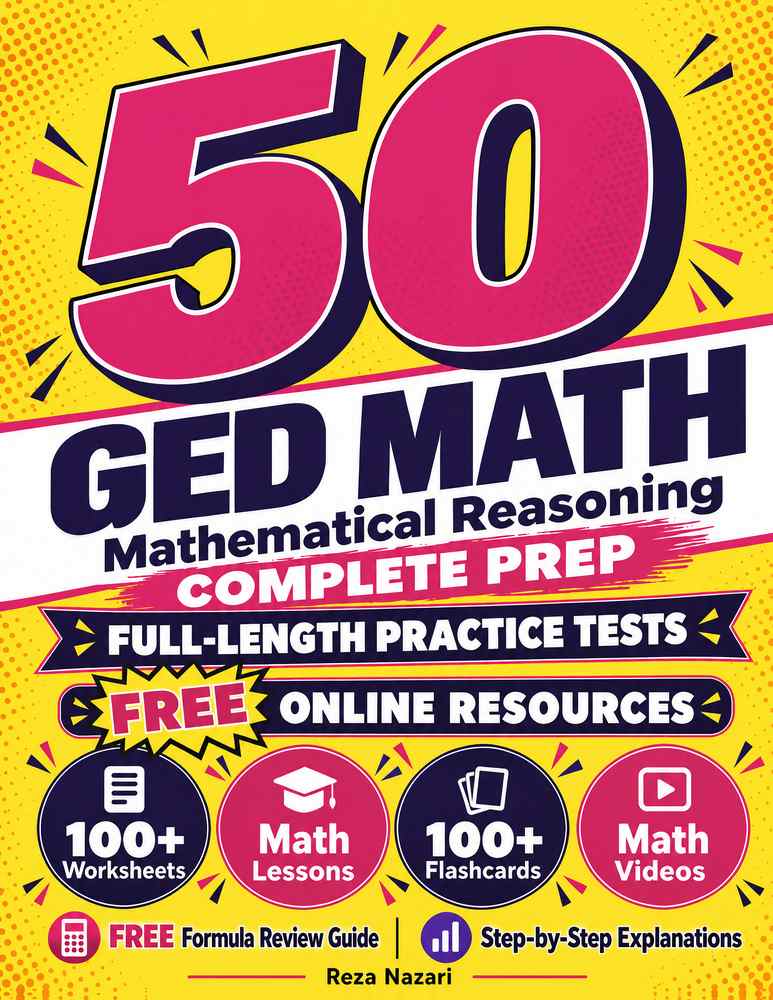
Use the GED Math worksheets for focused practice. The GED Math hub connects worksheets, practice tests, lessons, flashcards and formula review. For a broader plan, read How to Prepare for GED Math.
For adult-education teachers and tutors
Ask learners to bring one completed review log to a discussion. Have each learner explain the first incorrect step and show how they checked the correction. Use the pattern of errors to choose the next lesson; avoid treating a single practice score as a readiness prediction. Find more materials in Teacher Resources.
What to check before test day
GED Testing Service describes a 115-minute Mathematical Reasoning test, with access to the onscreen calculator in Part 2 and a math formula sheet. Practise without a calculator as well as with the permitted tools. Use the official links below for current rules, calculator guidance and reference materials. This independent article does not set test policies or predict your score.
Want a structured digital study option?
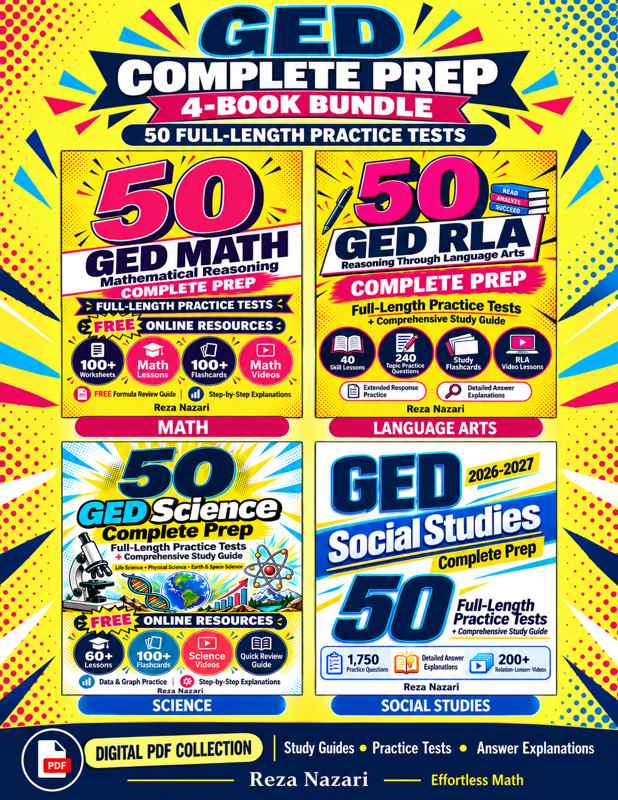
Start with the free resources above. If you want preparation across all four GED subjects, review the GED Complete Prep 4-Book Bundle: four digital books with 50 full-length practice tests per subject. Check the product page for the included materials, previews, delivery details and current price.
Sources and corrections
- GED Testing Service: Mathematical Reasoning — official subject guidance.
- GED Testing Service: test subjects — timing, question formats and permitted tools.
- GED Testing Service: free classroom materials — official reference sheets and classroom resources.
- Carnegie Mellon University Eberly Center: exam wrappers — an approach to reflecting on mistakes and preparation. Our blank log is an original resource; it is not a CMU publication or a GED-specific effectiveness study.
Published by Effortless Math. Examples and source links checked October 8, 2026. Report a correction with this page URL, the section and the step you think needs checking.

Related to This Article
More math articles
- 7 Best Digital Pen Tablets for Online Math Teaching in 2026
- How to Balance the Scales: Inequalities with Addition and Subtraction of Mixed Numbers
- Dark money
- Using Distributive Property to Factor Numerical Expressions
- Bar Graph
- 4th Grade SC Ready Math Worksheets: FREE & Printable
- Policy Mix, Transmission, Rules, and Lags
- The Best Grade 4 Math Book for Colorado Students
- 5 Best Accuplacer Math Study Guides
- Roulette Inside vs. Outside Bets: A Risk-Adjusted Comparison


What people say about "10 Most Common GED Math Mistakes"?
No one replied yet.