CLEP U.S. History I 072: Women’s Rights and Seneca Falls
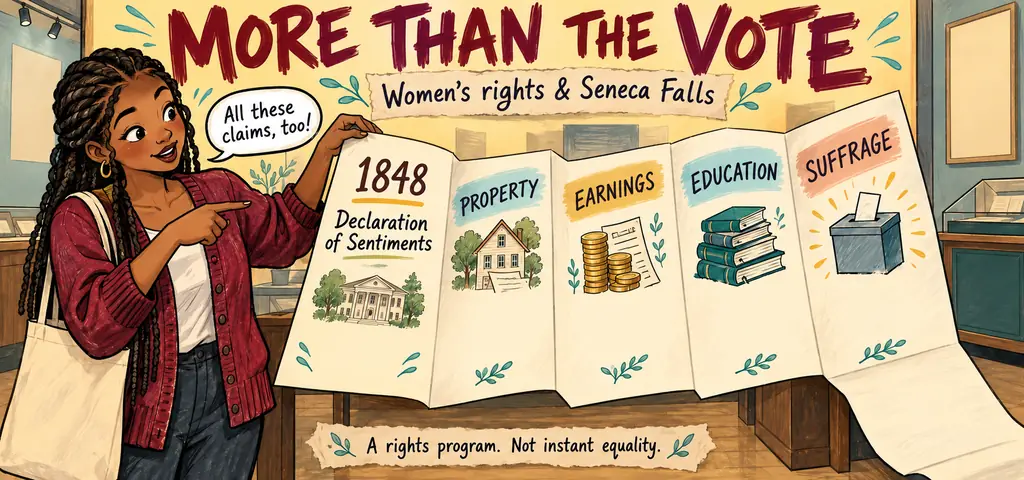
Lesson 13.5 of Chapter 13 of the U.S. History to 1877 study guide on Effortless Math covers CLEP U.S. History I 072: Women’s Rights and Seneca Falls: the key terms, the core ideas, and worked examples showing how this topic is tested on the exam.
U.S. History to 1877 | Chapter 13 | Lesson 13.5
Women’s reform work created skills and exposed inequality. Women organized fairs, raised funds, circulated petitions, wrote for publication, and spoke publicly. When American women delegates faced exclusion from full participation at the 1840 World Anti-Slavery Convention in London, Lucretia Mott and Elizabeth Cady Stanton discussed women’s status. Their concern extended beyond that incident: coverture generally placed a married woman’s legal identity and property under her husband’s control, higher education was restricted, wages could be controlled by husbands, and voting was barred.
Mott, Stanton, Martha Coffin Wright, Mary Ann M’Clintock, and Jane Hunt organized the Seneca Falls Convention in 1848. Its Declaration of Sentiments deliberately echoed the Declaration of Independence while listing legal, educational, religious, and economic grievances. The demand for women’s suffrage was the most controversial resolution and passed after debate, with Frederick Douglass supporting it.
Seneca Falls did not begin women’s resistance or create a unified movement overnight. Indigenous gender systems, Black women’s activism, labor protest, religious dissent, and earlier advocates formed a wider history. Sojourner Truth later challenged movements to confront both race and gender. Some white women’s-rights advocates failed to treat Black women equally. Some abolitionists feared women’s rights would distract from antislavery work.
States gradually enacted married women’s property laws, often first to protect family assets from a husband’s creditors. Such reforms could expand women’s legal control without establishing political equality. The “separate spheres” ideal praised women as moral guardians of the home, especially in middle-class literature. Women used that claim to justify reform activism and it confined them and did not describe enslaved, poor, or many immigrant women’s labor.
Watch the topic in context
Hip Hughes (HipHughes) offers a visual route through this topic. As you watch, compare its explanation with the source limits in the written lesson.
Video: The Seneca Falls Convention Explained: US History Review, Hip Hughes (HipHughes).
Check your understanding
- Which document deliberately adapted the Declaration of Independence’s natural-rights form to women’s civil and political grievances?
- the Grimké sisters’ pastoral letter
- the Lowell Female Labor Reform petition
- the married women’s property act
- the American Anti-Slavery Society constitution
- the Declaration of Sentiments
- Under coverture, marriage most directly limited a woman’s
- independent legal and property identity
- ability to join any voluntary association
- right to worship outside her husband’s denomination
- eligibility to work for wages before marriage
- ability to inherit under every possible will
- Deep Practice: select all that apply. Reform work gave women experience in
- petitioning
- fundraising
- public speaking
- organizing
- presidential voting
- Deep Practice: open response. Explain how separate-spheres language could restrict and equip reformers.
Write a brief response using a named fact from the lesson.
Open the answers and reasoning
Independent preparation. CLEP is a registered trademark of the College Board, which does not endorse this lesson.

Related to This Article
More math articles
- How to Decipher Limits and Function Values
- Free Grade 5 Math Worksheets for Arkansas Fifth Graders: 49 ATLAS-Aligned PDFs with Solutions
- Demographic Transition and the Population-Resource Debate
- 7th Grade PSSA Math FREE Sample Practice Questions
- Metric Units
- Free Printable Grade 5 Math for District of Columbia DC CAPE Students: 49 Single-Skill PDF Worksheets
- Top 10 Tips to Create the CLEP College Algebra Study Plan
- The Best Grade 8 Math Book for Illinois Students
- Collective Behavior, Social Movements, and Social Change
- How to Pass the Praxis Core Math Test (2026 Guide)











What people say about "Women's Rights and the Seneca Falls Convention"?
No one replied yet.