The Art of Numerical Literacy: Helping Children Master Real-World Math
Why Traditional Math Lessons Sometimes Fall Short
For many children, the word “mathematics” conjures up images of dusty chalkboards, endless rows of long division, and abstract formulas that seem to have little connection to the world outside the classroom. While the basics of arithmetic are vital, the way we introduce these concepts often lacks the spark of practical application. When a child asks, “When will I ever use this?”, they aren’t just complaining; they are seeking a reason to engage with the logic of numbers.
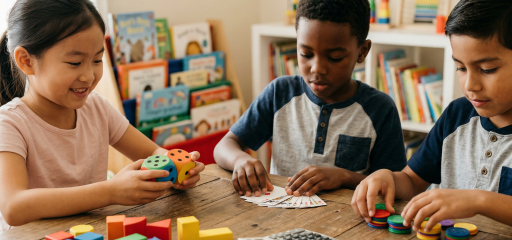
The secret to building a genuine interest in math lies in moving beyond the textbook. To a child, numbers are often just symbols on a page. However, when those numbers represent the health points of a character in a game, the probability of drawing a specific card, or the way a budget is managed, they become tools for empowerment. By focusing on the logic behind the numbers rather than just the rote memorization of tables, we help children develop a “mathematical mindset” that serves them well into adulthood.
The Power of Probability and Chance
One of the most exciting branches of math for children is probability. It is the study of “what might happen,” and it governs almost every aspect of our lives, from weather forecasts to the games we play on the living room floor. Teaching a child about chance helps them manage expectations and make better decisions.
Start with something simple, like flipping a coin. If you flip it ten times, will it be heads exactly five times? Probably not. This leads to a discussion about the law of large numbers. If you flip it a thousand times, the ratio will get closer and closer to 50/50. This isn’t just a fun experiment; it’s the foundation of statistics.
Dice games are another fantastic tool. When playing a game that requires two dice, children can learn that some totals are more likely than others. There is only one way to roll a two (1 and 1), but there are six ways to roll a seven. Visualizing these combinations helps children grasp that the world isn’t purely random; it follows predictable patterns.
Resource Management and Financial Logic
Mathematics is also the primary language of resource management. Whether a child is saving their allowance for a new toy or managing “mana” in a digital strategy game, they are practicing essential economic math.
You can introduce these concepts by creating a “mini-economy” at home. Give them a budget for a weekend outing and let them decide how to spend it. Should they buy one expensive treat now, or save half the money for a smaller treat later? This involves addition, subtraction, and the concept of “opportunity cost”, the idea that choosing one thing means giving up another. This type of logical thinking is what separates a person who simply does math from a person who understands how to use it.
Lessons from the World of Complex Systems
As children get older, they can start to see how these simple rules of probability and management scale up into much larger systems. Many adults find themselves fascinated by the mathematical structures found in high-stakes environments. While these environments are for grown-ups, the math behind them is surprisingly educational for a teenager or an older student.
Take, for instance, the way certain systems are designed to balance risk and reward. In many professional environments, people look for ways to maximize their potential outcomes. Just as a savvy shopper looks for the best value at a grocery store, or a professional gamer looks for the most efficient equipment, individuals who participate in gaming often look for the best casino offers to ensure they are getting the most statistical value for their participation.
This behavior is rooted in “expected value” (EV). In math, EV is a calculation of how much one can expect to win or lose on average over a long period. When we teach kids to look for the “best deal”, whether that’s in a video game shop or a real-world financial decision. We are teaching them to calculate EV. It’s about looking past the shiny surface and analyzing the underlying numbers to see if a choice is logically sound.
Strategic Thinking Through Card Games
Card games are perhaps the most portable math labs in existence. A simple deck of 52 cards offers a masterclass in fractions and percentages. If there are four Aces in a deck and you have already seen two of them, what are the odds that the next card will be an Ace?
This is basic division, but because there is a “win” or a “loss” attached to the result, the child is much more motivated to get the answer right. Strategic games teach children to think several steps ahead. They have to hold a “mental map” of the game’s progress, calculating what their opponents might have based on the cards already played. This builds memory, focus, and logical deduction.
The Role of Games in Building Confidence
Math anxiety is a real phenomenon that affects many students. It often stems from a fear of being wrong or a feeling that math is a rigid, unforgiving subject. Games change that dynamic. In a game, “being wrong” is just part of the play. If you miscalculate and lose a turn, you simply try a different strategy next time.
This trial-and-error process is exactly how scientists and mathematicians work in the real world. No one gets the formula right on the first try. By using games as a medium, we allow children to fail in a safe environment, which builds the resilience needed to tackle more complex algebraic or trigonometric problems later in life.
Real-World Geometry and Measurement
We shouldn’t forget the physical side of math. Geometry and measurement are often much easier for children to grasp when they are tangible. Cooking is a perfect example. Halving or doubling a recipe requires a firm grasp of fractions. Measuring ingredients requires precision. Even the way a pizza is cut provides a visual lesson in geometry, angles, diameters, and the division of a circle into equal parts.
Building projects, such as assembling a birdhouse or even playing with construction blocks, teach spatial reasoning. A child has to calculate how many small blocks will fit into a larger space, or how to balance a structure so that the center of gravity remains stable. These are engineering principles, but at their heart, they are pure mathematics.
Developing a Healthy Relationship with Risk
Part of teaching math to children involves helping them understand the concept of risk. In our modern world, we are constantly presented with choices that involve uncertainty. By teaching children how to quantify risk, we give them a shield against making impulsive decisions.
When a child understands that a “1 in 100” chance is very different from a “1 in 5” chance, they begin to view the world more critically. They start to ask questions: “What are the odds of this working?”, “What is the potential reward?”, and “Is the risk worth it?” This level of critical thinking is the ultimate goal of mathematical education. It’s not about passing a test; it’s about navigating life with a clear, logical mind.
Encouraging Curiosity Over Calculation
To truly help a child succeed in math, we must prioritize curiosity. Encourage them to ask “Why?” and “What if?”
- “What if we changed the rules of this game?”
- “What if the dice had twelve sides instead of six?”
- “Why does the house always have a slight advantage in certain games?”
When a child begins to pull apart the systems around them to see how the numbers work, they have transitioned from being a passive student to an active thinker. The goal is to show them that math isn’t a hurdle they have to jump over to graduate; it’s the hidden code that makes the world work.
Whether they are calculating the trajectory of a ball in a physics-based mobile game, managing their virtual currency, or eventually learning to navigate complex financial markets as adults, the foundation is the same. It is a foundation built on logic, probability, and the confidence to look at a set of numbers and see a story waiting to be told. By integrating these lessons into daily life and play, we ensure that the next generation isn’t just “good at math,” but truly fluent in the language of the world.

Related to This Article
More math articles
- SIFT Math Practice Test Questions
- Top 10 SSAT Middle-Level Math Practice Questions
- Fifth-Grade Math in Connecticut (SBAC): 49 Free Printable Worksheets, One Concept Per Page
- 4th Grade GMAS Math Worksheets: FREE & Printable
- How to Multiply and Divide Integers? (+FREE Worksheet!)
- Homeschool Math Curriculum: How to Build the Perfect Plan
- CLEP U.S. History I 071: Enslaved Resistance and Black Institution Building
- The Best Grade 4 Math Book for Alaska Students
- How to Solve Non-Right Triangles Problems
- How to Compare Fractions?


















What people say about "Helping Children Master Real-World Math"?
No one replied yet.