The Best Grade 7 ELA Practice Tests for Florida Students
Reading in seventh grade asks for judgment. It is not enough to follow a text — a seventh grader has to evaluate it: is the argument sound, is the evidence enough, what is the author really doing? Reading is now real critical work.
In Florida, the Grade 7 reading test reflects that shift. It is a real step up from sixth grade, but it is completely manageable, and the most effective way to prepare is honest practice with real, full-length practice tests. This guide explains what the test covers, the reading and language skills behind it, and the practice-test books that get a Florida seventh grader ready.
What the Florida Grade 7 reading test covers
Florida teaches English Language Arts through the B.E.S.T. Standards, and Grade 7 reading is assessed each spring through FAST, the Florida Assessment of Student Thinking. Your child has sat FAST every year since third grade, so the format is familiar — but the reading is harder and the questions ask for real analysis and judgment.
The test is built around reading. Students read passages — both literature and nonfiction — and answer questions about them, along with questions on vocabulary, language, and writing. The seventh grade passages are longer and more demanding than sixth grade, the questions ask a child to evaluate arguments and cite several pieces of evidence, and the test runs a long time, so reading stamina matters as much as reading skill. That is exactly why full-length practice tests make such a difference.
The reading and language skills the test measures
The Grade 7 reading test is wide, but it rests on a handful of core skills. Here is what your Florida seventh grader needs to be comfortable with, and why each one matters.
Reading literature: stories, drama, and poems
Students read stories, drama, and poems, and answer questions about how the parts of a text interact, how an author develops and contrasts the points of view of different characters, and how form shapes meaning. Seventh grade expects a child to analyze a text, not just summarize it.
Reading informational text: nonfiction
A large share of the reading is nonfiction: articles about science, history, and the world. Students analyze how an author develops ideas, trace and evaluate an argument — judging whether the reasoning is sound and the evidence relevant — and compare how two authors shape their presentations of the same topic. Nonfiction is where many seventh graders need the most practice, because the thinking is genuinely analytical.
Vocabulary and figurative language
The test checks whether a child can work out an unfamiliar word from context, use Greek and Latin roots and affixes, and understand figures of speech, allusions, word relationships, and connotation. Vocabulary quietly lifts every reading score, because a passage full of unknown words cannot truly be analyzed.
Language and grammar conventions
Students answer questions on phrases and clauses, simple, compound, and complex sentences, modifier placement, and precise, concise language. These are the rules of written English, and the test expects a seventh grader to recognize correct usage and spot mistakes.
Writing
Grade 7 reading is paired with writing: building an argument or explanation, supporting it with several pieces of evidence cited accurately from a text, and organizing and revising the result. Seventh grade writing expects a clear claim and well-chosen textual support.
Reading stamina and the test format
Beyond the skills, the test asks a seventh grader to read carefully and stay focused across a long session. Knowing the format in advance — the length, the kinds of questions, the pacing — removes most of the surprise, and surprise is what costs points.
Signs your seventh grader could use reading test practice
Seventh graders rarely say “this reading is getting hard for me.” It shows up in quieter ways. Here is what to watch for:
- Reading a passage fluently but unable to explain whether its argument held up
- Answering questions from memory instead of citing evidence in the text
- Struggling to judge whether an author’s evidence is relevant or enough
- Losing the thread of an idea across a longer, layered text
- Running out of focus partway through a long passage
- Nervous or discouraged whenever a “test” is mentioned
A few of these are completely normal and not a cause for worry. They simply mean a child has not yet had enough practice with this harder kind of reading and this kind of test. Full-length practice tests fix exactly that, by making the real thing familiar long before test day.
The Grade 7 reading practice-test books we recommend for Florida
For a Florida seventh grader getting ready for FAST, we recommend a set of four practice-test books. They contain the same kind of carefully written, standards-aligned practice; the only difference is how many full-length tests each one includes. A family can choose based on how much practice they want, and every book comes with complete answer explanations so a child learns from each test, not just takes it.
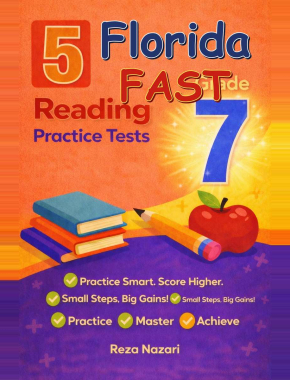
Start with the book of five full-length practice tests — a focused, manageable first round that builds familiarity with the format.
The book of six full-length practice tests adds another round of reading passages and questions for a child who wants a little more repetition.
The book of seven full-length practice tests gives a steady, extended runway of practice across the weeks before the test.
And the book of eight full-length practice tests is the most thorough preparation of all, with the widest range of passages and questions a Florida seventh grader can work through.
The complete Florida Grade 7 ELA bundle
Families who want everything in one place can choose the Florida Grade 7 ELA Preparation Bundle, which brings the 5, 6, 7, and 8 test-prep books together as a single set.
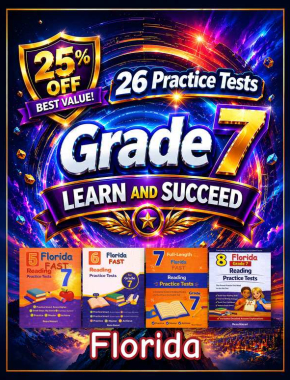
The bundle is the simplest choice for a family that wants a full year of reading practice ready to go, and the best value for getting all four books at once.
A week-by-week reading test-prep plan
Practice tests work best with a plan. Here is a simple four-week cycle a Florida family can repeat in the weeks before FAST.
Week 1 — The first full practice test. Have your child take one complete practice test, untimed, in a quiet space. The goal this week is simply to see the whole thing once and remove the fear of the unknown.
Week 2 — Review and reading focus. Go through the answer explanations together for every question your child missed. Then practice the weakest area — usually evaluating an argument or comparing two texts — with another passage or two.
Week 3 — A test under realistic conditions. Take another full practice test, this time keeping a gentle eye on the clock so your child gets used to pacing. Review the misses again afterward.
Week 4 — A final test and a confidence check. One more complete practice test. By now the format should feel familiar and the score should be climbing. End on a calm, encouraging note.
Then repeat the cycle with the next book if test day is still weeks away. Most seventh graders need three or four full practice tests before the format feels genuinely easy, which is exactly why the books come in sets.
How to use the practice tests
A few habits make the practice-test books far more effective:
- Always review the answer explanations. A practice test only teaches if your child sees why a wrong answer was wrong.
- Teach the habit of citing the passage. The answer to a reading question is almost always in the text.
- Keep sessions calm and positive. Practice tests should lower test anxiety, not add to it.
- Space the tests out. One full test a week beats several crammed into a weekend.
- Track the score across tests so your child can see their own progress.
For the math side of the same spring FAST testing, our companion guide to the best Grade 7 math book for Florida students takes the same steady, practical approach.
Questions Florida families ask
How is Grade 7 reading tested in Florida?
Grade 7 reading is assessed each spring through FAST, built around reading passages with questions on comprehension, vocabulary, language, and writing.
Why does Grade 7 reading feel harder than sixth grade?
Seventh grade is when passages get denser, questions ask a child to evaluate the soundness of an argument, and answers must be supported with several pieces of evidence from the text.
How many practice tests should my child do?
Most seventh graders need three or four full-length practice tests before the format feels easy. The books come in sets of 5, 6, 7, and 8 so you can choose how much practice to give.
Which book should we buy?
If you want a focused round, choose the 5-test book. If you want the most thorough preparation, choose the 8-test book or the bundle, which includes all four.
What is the difference between the four books?
Only the number of full-length practice tests inside. The style, the standards alignment, and the answer explanations are the same in each.
Can my child use these without a tutor?
Yes. Each test comes with complete answer explanations, so a parent and child can review the results together with no special training.
When should we start practicing?
Four to six weeks before FAST is plenty for most families. Starting earlier simply means a more relaxed pace.
My child gets nervous about tests. Will practice help?
It usually helps a great deal. Most test anxiety at this age comes from the unknown, and a practice test turns the unknown into something familiar.
Will this help with FAST specifically?
Yes. The practice tests are built to match the Florida B.E.S.T. Standards and the FAST format, so practicing them is direct preparation for the real test.
The bottom line
Seventh grade is when reading becomes analysis and judgment, and Florida measures it with FAST. None of it is beyond a well-prepared child. A few full-length practice tests turn an unfamiliar exam into a familiar one, and a familiar test is one a seventh grader can walk into calm and ready. Pick the book that fits your family, or take the bundle and have a full year of practice in hand.

Related to This Article
More math articles
- Build surplus from a schedule before using a triangle
- 5th Grade FSA Math FREE Sample Practice Questions
- Free Grade 6 English Worksheets for Colorado Students
- Sentence Solvers: How to Completing Addition and Subtraction Equations
- Estimate Differences for 4th Grade
- 8th Grade STAAR Math Practice Test Questions
- How to Study for a Math Test in 7 Easy Steps
- Berlin, NATO, NSC-68, and Militarized Containment
- Election and succession
- Fifth-Grade Math in Texas (STAAR): 49 Free Printable Worksheets, One Concept Per Page


















What people say about "Florida Grade 7 ELA Practice Tests"?
No one replied yet.