YOUR SAT STUDY COMPANION
SAT vs. ACT Math: Which Test Is Easier in 2026?
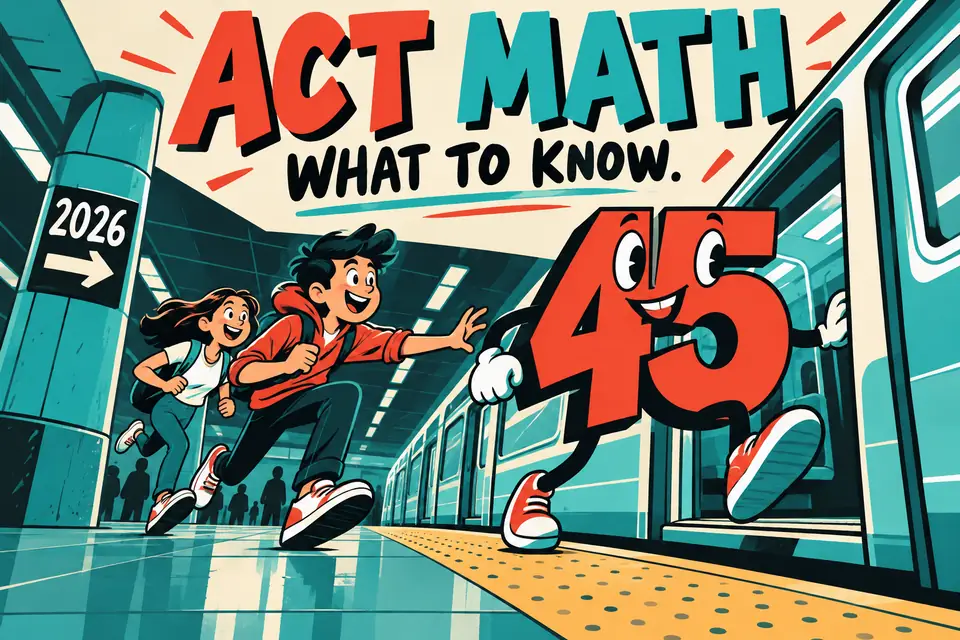
ACT format update, checked October 2, 2026: Enhanced ACT Math has 45 questions, 50 minutes, and four answer choices. Older 60-question practice sets remain useful for skill review, but they do not reproduce the current test format. Historical topic percentages below should not be treated as the current blueprint. See ACT’s current test information .

Both tests get you into the same colleges. Both are accepted by every U.S. Four-year university. But they’re very different math tests, different format, different topics, different timing. The right test for you depends on your strengths.
This guide gives you a clear, honest comparison and helps you decide in under 10 minutes.
The Quick Answer
- Take the SAT if: You prefer fewer, harder questions; you’re a slow but accurate reader; you like having more time per problem; you’re comfortable with the digital format.
- Take the ACT if: You prefer more, easier questions; you’re a fast reader and quick at arithmetic; you don’t mind a tight clock; you want a traditional, predictable format.
Both tests are accepted everywhere. The “easier” test is the one your brain works best on.
SAT Math (Digital, 2026)

Format
- Fully digital as of 2024.
- 2 math modules, each 22 questions, 35 minutes.
- Section-adaptive: Module 2’s difficulty depends on how you did in Module 1.
- Total: 44 questions in 70 minutes.
Topics
- Algebra (35%): linear equations, inequalities, systems.
- Advanced math (35%): quadratics, exponents, functions.
- Problem-solving and data analysis (15%): ratios, percents, statistics.
- Geometry and trig (15%): area, volume, right triangles, circles.
Calculator
- Calculator allowed throughout. Desmos is built into the test interface, and you can also bring your own approved calculator.
Scoring
- Math: 200-800.
- Total SAT (Math + Reading/Writing): 400-1600.
- “Good” score: 600+ math. “Great” score: 700+. “Top”: 750+.
Timing
- ~1:35 per question. More breathing room.
ACT Math
Format
- Paper-based or computer (in some test centers).
- 1 math section, 45 questions, 50 minutes.
- All multiple choice (4 answer choices, not 4).
Topics
- Pre-algebra and elementary algebra (24%): basic operations, percents, exponents.
- Intermediate algebra (18%): quadratics, functions, complex numbers.
- Coordinate geometry (15%): graphs, lines, parabolas.
- Plane geometry (23%): area, volume, circles, triangles.
- Trigonometry (7%): basic trig and identities.
- Statistics (~10%): mean, median, probability.
Calculator
- Calculator allowed throughout. TI-84 is the standard.
Scoring
- Math: 1-36.
- Total ACT (Math + 3 other sections): 1-36 composite.
- “Good” score: 24+. “Great” score: 28+. “Top”: 32+.
Timing
- 1:00 per question. Much tighter.
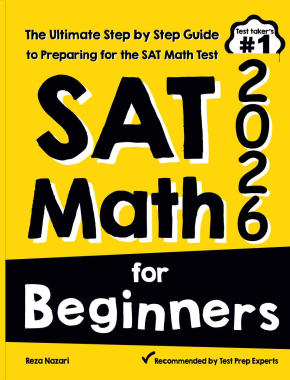
Recommended Practice Resources
Side-by-Side Comparison
| Feature | SAT | ACT |
|---|---|---|
| Format | Digital, adaptive | Paper or computer |
| Questions | 44 in 70 min | 60 in 60 min |
| Time per Q | 1:35 | 1:00 |
| Calculator | Throughout (Desmos built-in) | Throughout |
| Answer choices | 4 | 5 |
| Trig coverage | Light | Heavier |
| Word problems | Lots of multi-step | Mostly straight math |
| Score | 200-800 | 1-36 |
Where the Tests Differ Most
1. Speed vs. Depth
- ACT = race against the clock. You need to move fast.
- SAT = think harder per problem, but you have time.
2. Reading load in math problems
- SAT has more “word problem” style. You read a paragraph, extract the math, solve.
- ACT is more direct: “Solve \(2x + 5 = 17\).”
3. Trigonometry
- SAT: maybe 1-2 basic trig problems.
- ACT: 4-6 trig problems including identities, graphs, and the law of sines/cosines.
4. Digital vs. Paper
- SAT is digital-only as of 2024. Desmos is built in. Bring an approved calculator or use the on-screen one.
- ACT is still primarily paper, though some test centers offer computer-based.
5. Adaptive scoring
- SAT Module 2 difficulty depends on your Module 1 performance. If you do well in Module 1, Module 2 is harder (but each correct answer is worth more).
- ACT is not adaptive.
Which Math Is Easier?
The “easier” test depends on who you are:
SAT feels easier if:
– You’re a careful, methodical thinker.
– You don’t like time pressure.
– You’re strong at algebra and weak at trig.
– You’re comfortable with computers.
ACT feels easier if:
– You work fast and accurately.
– You prefer “do the math” over “interpret the word problem.”
– Trig comes naturally to you.
– You like predictable, traditional test formats.
Most students try one practice test of each to feel the difference. Whichever you score higher on (relative to score percentiles), that’s your test.
How to Decide in One Weekend
- Saturday: Take a free SAT practice test (College Board offers them).
- Sunday: Take a free ACT practice test (ACT.org has free practice).
- Use a score concordance table to compare. A 1300 SAT roughly equals a 27 ACT.
- Pick the test where you scored higher on the percentile chart.
Don’t agonize. The difference is often small. Pick one and commit.
Prep Plan for Either Test
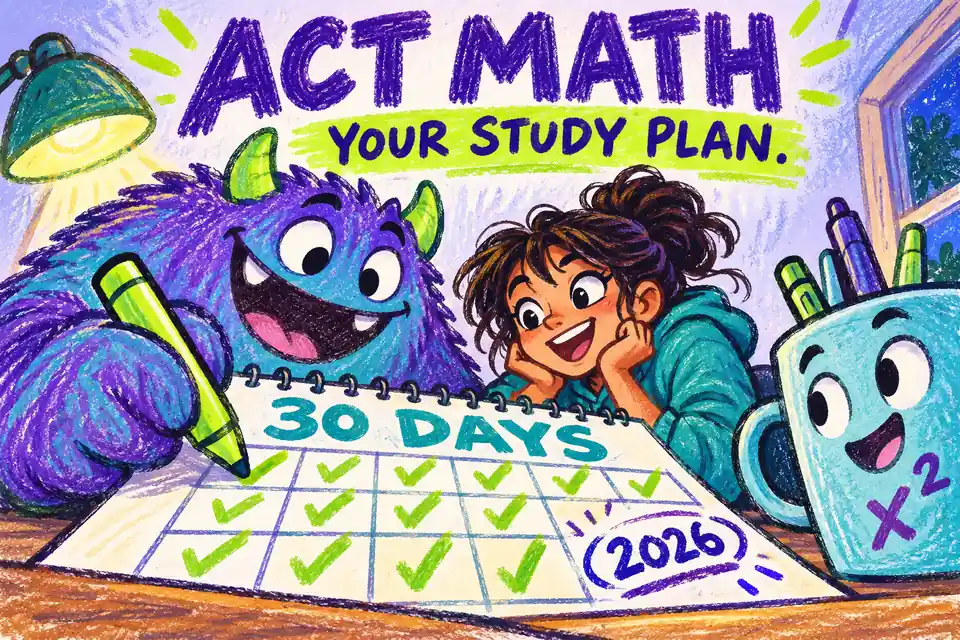
3-month plan (most students)
Month 1, Foundation review
– Algebra, geometry, basic problem-solving.
– 1 hour, 5 days a week.
– 1 practice test at the end of month.
Month 2, Strategy
– Test-specific strategies (process of elimination, plugging in answers, calculator shortcuts).
– 90 minutes, 5 days a week.
– 2 practice tests, timed.
Month 3, Polish and pace
– Focus on weak topics.
– Practice tests every weekend.
– Review every wrong answer.
Topics to drill harder
For SAT:
– Linear equations and systems.
– Word problem setup.
– Function notation and transformations.
– Quadratics.
For ACT:
– Triangle trig (SOH-CAH-TOA, special triangles).
– Probability and combinatorics.
– Logarithms.
– Coordinate geometry (slope, distance, midpoint).
Should You Take Both?
If you have the time and money, taking each test once isn’t a bad idea, submit your better score to colleges. But for most students, picking one and going deep gives a higher score.
A focused 3-month prep on one test beats split focus on both.
Are SAT/ACT Scores Still Required?
Many colleges went test-optional during COVID and remain so. But:
– Some colleges (MIT, Georgetown, Florida public universities) require tests again as of 2024-2026.
– Even at test-optional schools, a strong score strengthens your application.
– Scholarships often require test scores.
Don’t skip the test unless you’re certain every school on your list is permanently test-blind.
Free Resources
Effortless Math has comprehensive prep libraries for both tests:
- Math Blog, guides for both tests.
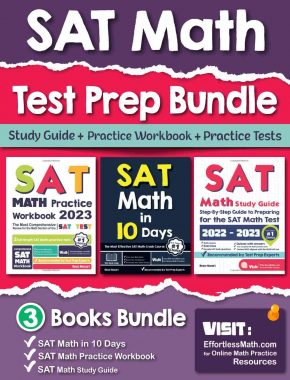
- SAT Math Resources, books, worksheets, practice tests.
- ACT Math Resources, full ACT math prep.
Frequently Asked Questions
Is the SAT easier than the ACT?
Neither is universally easier. The SAT gives more time per question; the ACT gives more questions and less time. Pick based on your strengths.
Does the SAT have trigonometry?
Yes, but only 1-2 light problems. The ACT has significantly more.
What’s a “good” SAT math score?
600+ is solid. 700+ is competitive for selective schools. 750+ for elites.
What’s a “good” ACT math score?
24+ is solid. 28+ is competitive. 32+ for elite schools.
Can I use a calculator on both tests?
Yes, on every math question, on both tests. The SAT has Desmos built in.
Should I take the SAT now that it’s digital?
The digital SAT is shorter, has more time per question, and feels more student-friendly. Most current students prefer it.
Pick the Test, Then Get to Work
The test you choose matters less than how hard you prep for it. A student who commits 90 days to ACT prep will out-score a student who half-heartedly takes both. Pick the test that fits your brain, build a daily study habit, and the score will follow.
Keep Practicing With the Right Resources

Related to This Article
More math articles
- Full-Length SSAT Upper Level Math Practice Test
- How to Use Models to Compare Fractions?
- Single-Skill Grade 5 Math for New Jersey (NJSLA): 49 Free Practice PDFs, No Signup
- Geometry Puzzle – Challenge 74
- Polynomial Identity
- SHSAT Math Formulas
- Grade 3 Math: Word Problems: Addition and Subtraction
- Algebra Puzzle – Challenge 32
- How Evolution Shapes Animal Behavior and Survival
- 8th Grade NYSE Math FREE Sample Practice Questions






What people say about "SAT vs ACT Math: Which Test Is Easier?"?
No one replied yet.