How to Master ACT Math in 30 Days: 2026 Study Plan

If your ACT is a month away, here is the honest news: you can absolutely move your math score in 30 days. Maybe by a few points, maybe by a lot, depending on where you are starting. The math section is the most “study-able” part of the ACT, the content is finite, the question types repeat, and the rewards for focused practice are big.
This is a real, day-by-day plan written for a real student with school, sports, and a social life. No fluff. Just what to do, when to do it, and why.
What the ACT Math Section Looks Like
The ACT Math section contains 60 multiple-choice questions in 60 minutes. That is exactly one minute per question, pacing is half the battle.
The questions roughly break down as:
- Pre-Algebra (~20%): integers, fractions, decimals, percents, mean/median/mode, basic probability.
- Elementary Algebra (~17%): linear equations, inequalities, expressions.
- Intermediate Algebra (~15%): quadratics, systems, functions.
- Coordinate Geometry (~15%): slope, distance, midpoint, equations of lines and circles.
- Plane Geometry (~23%): triangles, polygons, circles, angles, area, volume.
- Trigonometry (~10%): SOH-CAH-TOA, trig identities, basic graphs.
Question difficulty increases as you go. The first 20 are easy. The last 20 are hard. The middle 20 are mixed.
ACT Math Scoring
ACT math is scored from 1 to 36, matching the other sections. The composite ACT score is the average of all four sections (math, reading, English, science). The 2025 national average for math is about 19. A 24+ is competitive for many state universities. A 30+ is competitive for selective schools.

You do not get penalized for wrong answers. Never leave a question blank, even a random guess has a 20% chance of being right.
The 4 Levers That Move Your Score the Most
Lever 1: Speed on the easy 30 questions
Questions 1 to 30 are mostly arithmetic, percents, simple algebra, and basic geometry. If you can finish these in 25 minutes instead of 35, you free up 10 minutes for the harder back half. Most score gains come from this single shift.
Lever 2: Knowing the formulas the ACT does not give you
Unlike the SAT, the ACT does not provide a formula sheet. You must walk in knowing key formulas cold. The ones tested most:
- Slope: \(m = \dfrac{y_2 – y_1}{x_2 – x_1}\)
- Slope-intercept form: \(y = mx + b\)
- Distance: \(d = \sqrt{(x_2 – x_1)^2 + (y_2 – y_1)^2}\)
- Midpoint: \(\left(\dfrac{x_1 + x_2}{2}, \dfrac{y_1 + y_2}{2}\right)\)
- Area of triangle: \(\tfrac{1}{2} bh\)
- Area of circle: \(\pi r^2\); circumference: \(2\pi r\)
- Pythagorean theorem: \(a^2 + b^2 = c^2\)
- Quadratic formula: \(x = \dfrac{-b \pm \sqrt{b^2 – 4ac}}{2a}\)
- SOH-CAH-TOA
- Equation of a circle: \((x – h)^2 + (y – k)^2 = r^2\)
Lever 3: Calculator strategy
The ACT allows most graphing calculators (TI-84 Plus, TI-Nspire CX non-CAS, Casio fx-CG50). It bans calculators with CAS (Computer Algebra System), which can solve equations symbolically. Check your model on the ACT’s calculator policy page before test day.
Smart use of a TI-84:
– Graph functions to read solutions and intersections.
– Use the table feature to test answer choices.
– Use the regression feature for scatter-plot questions.
– Store \(\pi\) as a variable to save keystrokes.
Lever 4: Backsolving and plugging in
For algebra multiple-choice questions, often the fastest path is to test each answer choice in the original equation, starting with choice C (middle value). If the equation works, you have your answer in 30 seconds instead of 2 minutes.
Recommended Practice Resources
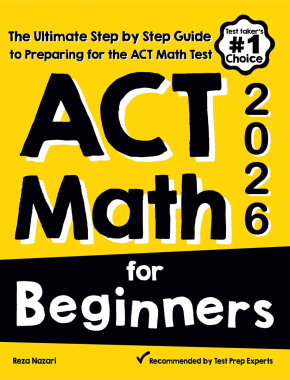
A Day-by-Day 30-Day Plan
This plan assumes 60 to 75 minutes a day, 6 days a week.
Week 1, Foundations and diagnostic
- Day 1: Full-length untimed ACT math practice section. Score it. Identify the topics you missed.
- Day 2 to 3: Pre-algebra deep dive, fractions, decimals, percents.
- Day 4 to 5: Elementary algebra, linear equations and inequalities.
- Day 6: Mixed-topic 20-question drill, untimed.
- Day 7: Rest or light review of error log.
Week 2, Algebra and coordinate geometry
- Day 8 to 9: Quadratics, factoring, vertex, quadratic formula.
- Day 10 to 11: Systems of equations and functions.
- Day 12 to 13: Coordinate geometry, slope, distance, midpoint, equations of lines and circles.
- Day 14: Mixed 30-question drill, untimed.
Week 3, Geometry, trig, and timing
- Day 15 to 16: Plane geometry, triangles, polygons, area, volume.
- Day 17 to 18: Circles, angles, and arcs.
- Day 19 to 20: Trigonometry, SOH-CAH-TOA, identities, basic graphs.
- Day 21: First timed full-length ACT math section. Score and review.
Week 4, Simulation and refinement
- Day 22 to 23: Spend two days on whatever the timed test exposed as weakest.
- Day 24: Second timed full-length practice section.
- Day 25 to 26: Drill your top three weak topics from the error log.
- Day 27: Third (final) timed full-length practice section.
- Day 28: Light review only, formulas, error log, mental math.
- Day 29: Off. Sleep. Hydrate.
- Day 30: Test day. Eat a real breakfast. Bring two calculators (you can have a backup), two pencils, and your ID.
Test-Day Strategy

- Answer every question. No penalty for wrong answers. Even a random guess earns ~20% expected value.
- Tier your time. Spend ~30 seconds each on questions 1 to 20; ~60 seconds on 21 to 40; ~90 seconds on 41 to 60. If you blow the budget on a hard one, mark and move on.
- Watch your calculator. Many ACT mistakes come from miskeyed parentheses. Use them liberally for negatives and fractions.
- Use the test booklet. Write all over it. Draw diagrams. Cross out wrong answers. Show work.
- Skip the trap-bait choices. When an answer feels suspiciously easy on a question 50, it is usually the wrong choice. ACT loves placing “tempting” wrong answers.
- Bubble carefully. A row-shift bubbling mistake can wreck your section. Bubble every 5 questions instead of one at a time.
Common ACT Math Mistakes
- Forgetting the formula on the test. Memorize them now.
- Working too hard on easy questions. A 60-second pre-algebra question is a sign you are over-complicating it.
- Confusing radius and diameter. Circle questions trap you here constantly.
- Trig units. ACT uses degrees unless told otherwise. Keep your calculator in degree mode.
- Letting one question ruin a section. Move on. Survive. Score what you can.
- Skipping the final 10 questions. They are hard, but a guess is still better than a blank.
Free Resources
Effortless Math has built a full free ACT math system:
- ACT Math Worksheets, topic-organized printable practice with answer keys.
- ACT Math eBooks, full prep books with timed practice tests.
- Math Topics Library, every ACT-relevant skill, explained, with a free worksheet.
Frequently Asked Questions
Can I really improve my ACT math score in 30 days?
Yes, and the average gain for a focused student in 30 days is 2 to 4 composite-math points. Bigger gains are possible for students starting below 22.
Is the ACT math harder than the SAT math?
Different, not necessarily harder. ACT math is broader (includes trig and matrices) and faster-paced (1 minute per question). SAT math is deeper on algebra. Choose the test that plays to your strengths.
Do I have to memorize trig identities for the ACT?
A small handful, yes. Most trig on the ACT is SOH-CAH-TOA and reading basic graphs. The Pythagorean identity \(\sin^2\theta + \cos^2\theta = 1\) shows up.
Can I use a TI-84 Plus on the ACT?
Yes, the TI-84 Plus, TI-Nspire CX (non-CAS), and Casio fx-CG50 are all approved. The TI-Nspire CAS and TI-89 are not.
What is a “good” ACT math score?
Depends on where you are applying. State flagships often want 23 to 27. Selective schools want 30+. Top-10 schools want 32+. Set your target based on your school list, not the national average.
Should I retake the ACT if I don’t hit my target?
Most students take it 2 to 3 times. Score gains on a second sitting are common and well-documented.
You Have a Month, Make It Count
Thirty days is short, but it is enough. Today is day 1. Pick up a practice section, score it, log every miss, and start the week-1 plan. Twenty-nine days from now, you will know your ACT math better than 90% of the students sitting next to you. That is the whole goal.
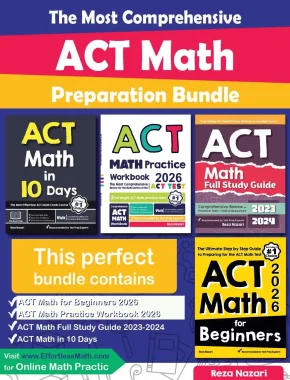
Keep Practicing With the Right Resources

Related to This Article
More math articles
- AI Homework Helpers vs. Real Math Practice: What Actually Works in 2026
- How to Teach the GED Math Effectively: A Complete Guide!
- Plate Boundaries: Pull Apart, Meet, or Slide Past
- How to Write a Formula for a Recursive Sequence
- Top 10 8th Grade NYSE Math Practice Questions
- Solutions and Concentration: Molarity, Dilution, and Solubility
- CLEP U.S. History I 057: Commercial Farming and Regional Specialization
- Campaign contributions
- The Best Grade 7 Math Book for Washington Students
- Other Topics Puzzle – Challenge 96













What people say about "How to Master ACT Math in 30 Days"?
No one replied yet.