How to Improve Your SAT Math Score by 100+ Points (2026)

You can move your SAT math score by 100 points. Maybe more. The students who do are not necessarily the ones who already love math. They are the ones who train the specific skills the test rewards. This guide is the playbook.
The SAT has changed since 2024: it is now fully digital, shorter, and adaptive. The strategies that worked on the old paper test do not all transfer. Below is what works on the Digital SAT in 2026, written for real students with real schedules.
What the Digital SAT Math Section Looks Like in 2026
The Digital SAT is delivered through College Board’s Bluebook app on a tablet or laptop. The math portion has:
- Two modules, 35 minutes each (70 minutes total).
- 22 questions per module (44 questions total).
- Adaptive between modules. Module 2 is harder or easier based on how you do in Module 1.
- Mix of multiple choice and student-produced response (“grid-in”).
- Built-in Desmos graphing calculator on every question.
- Built-in formula reference sheet on every question.
You will see four content domains:
- Algebra (~35%), linear equations, inequalities, systems, and linear functions.
- Advanced Math (~35%), quadratics, exponential functions, polynomials, nonlinear equations.
- Problem-Solving and Data Analysis (~15%), ratios, rates, percentages, statistics, scatter plots.
- Geometry and Trigonometry (~15%), area, volume, similarity, right triangles, circles, basic trig.
How SAT Math Scoring Works
The SAT math section is scored from 200 to 800. The average math score for college-bound seniors in 2025 was around 520. A 600+ opens most public flagship universities. A 700+ is competitive for selective schools. An 800 is achievable for students who train deliberately.

Because the test is adaptive, how well you do on Module 1 caps your maximum score. Strong performance in Module 1 routes you to a harder Module 2 with higher possible scores. Weaker performance routes you to an easier Module 2 with a lower ceiling (typically around 600).
The strategic implication: fight hardest in Module 1.
Where the 100 Points Actually Come From
Most students who gain 100+ SAT math points do not learn new math. They stop losing points to avoidable mistakes. The big four:
- Misreading the question. “Which expression is equivalent to…” vs. “Which value satisfies…”, different prompts, different answers.
- Arithmetic slips. Sign errors, distributing wrong, miscopying numbers.
- Not using Desmos. The built-in graphing calculator can solve, graph, and verify nearly every algebra problem in seconds. Most students under-use it.
- Running out of time. Spending 4 minutes on a single problem you cannot solve while skipping 3 easier ones at the end is the most common time mistake.
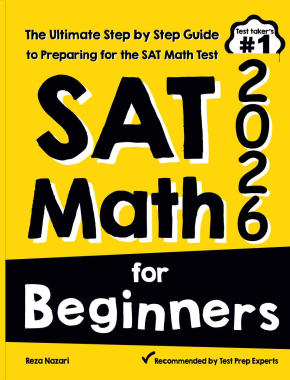
Recommended Practice Resources
The High-Yield Topics That Move Your Score
After analyzing thousands of practice questions, these clusters cover the majority of points.
1. Linear equations and systems
Two equations, two unknowns, in a real-world context. Master substitution and elimination. Then learn the Desmos trick: type both equations into Desmos and read the intersection point off the graph.
2. Quadratic functions
Factoring, vertex form, the quadratic formula, and recognizing when a parabola’s coefficient is positive or negative. Memorize: vertex of \(ax^2 + bx + c\) is at \(x = -\dfrac{b}{2a}\).
3. Exponential growth and decay
\(y = a \cdot b^x\). Recognize doubling, halving, percent increase, percent decrease.
4. Ratios, rates, and percentages
Percent change, percent of, simple ratios in tables, and unit conversion word problems.
5. Statistics and data
Mean, median, mode; understanding scatter plots; recognizing what “the data are skewed” actually means.
6. Right-triangle trig and circles
SOH-CAH-TOA, the 30-60-90 and 45-45-90 triangles, equation of a circle \((x – h)^2 + (y – k)^2 = r^2\).
Lock these six down and you have already cleared 80% of the test.
The Desmos Calculator Is Your Secret Weapon
The Digital SAT gives you Desmos on every question. It is the same Desmos millions of students use online, fully featured, with graphing, tables, and equation-solving.
What Desmos can do for you:
- Solve any single-variable equation. Type
x^2 - 5x + 6 = 0and Desmos shows you the solutions. - Solve any system of equations. Type both equations. Look at the intersection.
- Graph and read. “What is the value of \(f(3)\)?”, graph \(f(x)\), click \(x = 3\).
- Compute statistics. Type a list and use
mean(L),median(L),stdev(L). - Verify answers. Plug in the multiple-choice options and see which one makes the equation true.
Spend 2 hours in Desmos before test day. Those 2 hours are worth 50 to 80 points by themselves.
A 12-Week SAT Math Study Plan
Strong gains happen over 8 to 12 weeks. Here is a 12-week plan assuming 60 to 90 minutes a day, 5 days a week.

Weeks 1 to 2: Foundations
- Take a full-length official Bluebook practice test.
- Review every miss; classify as “didn’t know” vs. “careless.”
- Drill fundamentals: fractions, exponents, basic algebra.
- Learn Desmos basics: graphing, intersections, solving.
Weeks 3 to 4: Linear algebra
- Equations, inequalities, systems.
- Linear functions in tables, graphs, and word problems.
- Slope and intercepts.
Weeks 5 to 6: Advanced math
- Quadratics: factoring, the quadratic formula, vertex form.
- Polynomial behavior at infinity.
- Exponential functions and growth/decay.
Weeks 7 to 8: Problem-solving and data
- Percent change and ratios.
- Statistics: center, spread, distribution shape.
- Scatter plots and best-fit lines.
Weeks 9 to 10: Geometry and trigonometry
- Area, perimeter, volume.
- Right-triangle trig and special right triangles.
- Circles, arcs, sectors, equations of circles.
Weeks 11 to 12: Test simulation
- Two full-length timed practice tests per week.
- After each, build a “missed-questions list” and drill those topics.
- Last week: light practice, hydration, sleep.
The single most important habit across all 12 weeks: keep an error log. Every wrong answer goes into a notebook with the topic, the type of mistake (careless vs. Content), and the correct approach. Your error log becomes your custom textbook.
Test-Day Strategy
- Module 1 matters more. Slow down on the first 8 to 10 questions. Building the lead pays off.
- Use Desmos by default. If a problem can be graphed or solved, graph or solve it.
- Mark and return. The Digital SAT has a “mark for review” flag and a question navigator. Use them.
- Read the actual question last. Many SAT math prompts include extra context. Skim the context, then jump to the question to know what you are looking for, then go back.
- Watch the clock, not the timer. Look at it every 5 questions. Adjust pace if needed.
- Eat carbs the morning of. Your brain runs on glucose. Don’t show up empty.
Common Mistakes That Cost the 100 Points
- Solving for the wrong variable. “Find the value of \(x + 2\)”, don’t stop at \(x\).
- Forgetting the negative root. Quadratics often have two solutions. Check both.
- Misreading “must be true” vs. “could be true.” “Must” is universal; “could” is one-example-enough.
- Ignoring the units. “How many minutes?” but you computed in hours.
- Not using the formula sheet. It is in the test app. Look at it.
- Skipping the mark-and-return system. Hard questions early cost easy questions later.
Free Resources
Effortless Math offers a complete free SAT math system:
- SAT Math Worksheets, topic-organized printable practice with answer keys.
- SAT Math eBooks, full prep books, including full-length practice tests.
- Math Topics Library, explanations for every SAT-relevant skill, each with a free worksheet.
Frequently Asked Questions
How long does it take to improve my SAT math score by 100 points?
For most motivated students, 8 to 12 weeks of consistent study, 4 to 6 hours per week. Faster gains are possible if you start from a low baseline and focus on careless errors. Smaller, slower gains are normal if you are already in the 700s.
Is the Digital SAT easier than the old paper SAT?
It is shorter, faster, and adaptive, but the math content is the same. Many students score similarly. The students who train Desmos and the new timing tend to score higher.
How many times should I take the SAT?
Most students take it 2 to 3 times. Take it once early in junior year, again in late junior year, and possibly once more in early senior year if needed.
Do I need to know calculus or pre-calculus for the SAT?
No. The SAT math content goes through Algebra II and a touch of trig. No calculus.
Is Khan Academy enough to prep for the SAT?
Khan Academy is excellent but generic. Pair it with printable worksheets and an error log for the biggest gains.
Should I aim for an 800?
Aim for the score that opens the schools you want. For most students, 700+ is more than enough. The marginal value of 750 → 800 is small unless you are targeting the very top schools.
You Can Get the 100 Points
Score gains happen one error-logged mistake at a time. Open Bluebook. Take one official practice section. Log every miss. Drill those topics this week. The plan is not glamorous. It is just real. And it works.
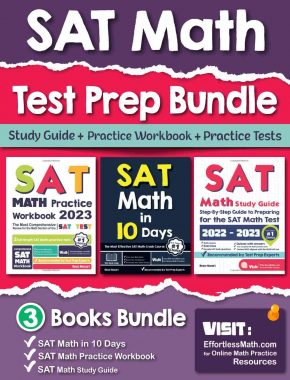
Keep Practicing With the Right Resources

Related to This Article
More math articles
- Alabama ACAP Grade 4 Math Free Worksheets: 72 Printable PDFs with Step-by-Step Answer Keys
- Full-Length 8th Grade FSA Math Practice Test
- Power Series Integration: Fundamentals, Step-by-Step Methods, and Applications
- 6th Grade LEAP Math Worksheets: FREE & Printable
- How to Build Vocabulary You Can Actually Use
- Best Calculators for CA Exams
- How To Solve Word Problems for Explaining Fractions as Division
- Full-Length GED Math Practice Test
- How to Study for a Math Test in 1 Week (Day-by-Day Plan)
- How to Graph Inverse Trigonometric Functions?













What people say about "How to Improve Your SAT Math Score by 100 Points"?
No one replied yet.