YOUR SAT STUDY COMPANION
Digital SAT Math May 2026: What Changed and How to Prep for the Next Test
If you walked out of the May 2026 Digital SAT thinking "that math section felt different," you're not imagining it. I've taught SAT math for nine years, and I've spent the last two weeks listening to students compare notes about what they saw. Something shifted. Not the format, the questions themselves.
If you walked out of the May 2026 Digital SAT thinking “that math section felt different,” you’re not imagining it. I’ve taught SAT math for nine years, and I’ve spent the last two weeks listening to students compare notes about what they saw. Something shifted. Not the format, the questions themselves.
This post is for two kinds of readers. If you took the May 2026 test and you’re trying to figure out what just happened to you, I’ll explain. If you’re prepping for the August or October test and you want to know what to actually study, I’ll get specific about that too.
Let me start with the format you already know, then dig into what really changed.
The Format (No Format Changes, Just Reminders)
The Digital SAT is still:
- 2 hours, 14 minutes total. Math section is 70 minutes, split into two 35-minute modules.
- 44 math questions total (22 per module).
- Adaptive between modules. Your performance on Module 1 decides whether Module 2 is the harder track (and unlocks the top score range) or the easier track (caps your score).
- Desmos calculator built in. You can use it on every question.
- About 75% multiple choice, 25% student-produced response (the fill-in-the-blank ones).
- Scored 200 to 800 on math.
None of that changed between March and May 2026. But the questions did.
What Actually Changed in May
Based on what students reported and what my own tutoring sessions are turning up in post-test reviews, the May 2026 test made three real shifts:
1. Module 2 (hard track) felt harder than March. The questions that came after a strong Module 1 performance were trickier than the equivalent track in March. More multi-step problems. More problems where you needed to set up the equation yourself instead of being handed it.
2. The “Desmos doesn’t help” questions multiplied. This is the big one. When the Digital SAT first launched, you could solve maybe 70% of math questions by typing them into Desmos. The May 2026 test pushed back hard against that. Several questions were structured specifically so that:
- Typing them into Desmos produces a graph you can’t easily read
- Or it gives you a decimal that’s hard to convert back to the answer choices
- Or the equation has multiple variables and Desmos can’t solve it without sliders that take longer than just doing the algebra
If your prep was “I’ll just use Desmos for everything,” May 2026 was a wake-up call.
3. Word-problem density went up in the easier track. The non-adaptive easier track wasn’t easier in terms of reading load. Students who tested into Module 2 (easier) reported a lot of contextual problems, finance, science, real-world ratios, that took time to parse even when the math was straightforward.
A Worked Example That Shows the “Desmos Trap”
Here’s a question style that’s been showing up more often. I’ll show you the lazy Desmos approach versus the smart approach.
The problem: A function f is defined by f(x) = (x² + 5x − 14) / (x − 2). What is the value of f(x) when x = 5?
The lazy Desmos approach: Type `f(x) = (x^2 + 5x – 14)/(x – 2)` into Desmos. Click on the graph near x = 5. Read the y-value. Total time: about 30 seconds, if you don’t fat-finger the typing.
The smart approach: Notice that x² + 5x − 14 factors. You’re looking for two numbers that multiply to −14 and add to 5. Those are 7 and −2. So:
So f(5) = 5 + 7 = 12. Total time: about 15 seconds. No tool needed.
The May 2026 test is full of these. The trap isn’t that Desmos gets it wrong. The trap is that Desmos gets it slowly. And on a 35-minute module, slow adds up.
The Real Math Content Breakdown
Here’s the official content breakdown, with my honest take on what’s heavily tested:
Algebra (~35%) Linear equations and inequalities, systems of linear equations, linear functions. This is the largest single category. Students who skip linear-equation fundamentals to “study the hard stuff” almost always score lower than students who lock down the algebra first.
Advanced Math (~35%) Quadratics (factoring, vertex form, discriminant), exponential functions, polynomials, rational expressions, functions and function notation. This is where score separation happens. If you want to score 700+, this is the section you have to master.
Problem-Solving and Data Analysis (~15%) Ratios, percents, units, probability, statistics, scatterplots, two-way tables. The math here is usually friendly. The reading is what slows students down.
Geometry and Trigonometry (~15%) Lines, angles, triangles, circles, right-triangle trig, the unit circle. Often heavy on coordinate geometry, equations of circles, parabolas in the plane.
The “First Module Matters Most” Strategy
This is the single most important piece of strategy for the Digital SAT, and most students still don’t fully grasp it.
Module 1 of math determines Module 2’s difficulty track. Module 2 determines the upper bound of your score. If you don’t perform strongly on Module 1, you can answer every Module 2 question correctly and still be capped at around a 600.
What this means in practice:
- Do not rush Module 1 to “save time for Module 2.” That logic doesn’t apply here. Module 1 is the bigger lever.
- Spend extra care on the easier questions in Module 1. A careless error on a question you knew how to do costs you the same as a hard miss.
- Use your Desmos sparingly in Module 1. The questions are calibrated to be solvable by hand or with quick mental math. Reaching for Desmos every time is the wrong reflex.
The Six Desmos Moves That Still Work
I’m not anti-Desmos. I’m anti-using-Desmos-on-everything. There are six specific moves where Desmos remains the fastest tool:
1. Finding intersections of two graphs. Type both equations, click the intersection point. Faster than solving by substitution most of the time.
2. Finding zeros and vertices of complicated quadratics. If the quadratic doesn’t factor nicely, type it in. Desmos labels the roots and the vertex automatically.
3. Solving systems of nonlinear equations. Especially when one equation is a parabola and the other is a line. Just graph both, find the intersections.
4. Using sliders for “for what value of k…” problems. Type the equation with k as a slider, then drag k until the graph matches the condition described. Watch the slider value.
5. Quick regressions on data sets. The SAT loves giving you a table of values and asking which model fits. Type the table into Desmos, run a regression, compare to the answer choices.
6. Spot-checking answer choices. If you got a numerical answer and you’re not sure, plug your answer back into the original equation in Desmos. Verify it produces the expected output.
That’s it. Six uses. If you’re typing Desmos for every problem, you’re using it wrong.
How the Adaptive Algorithm Actually Works (Without Drama)
There’s a lot of confused folklore about the adaptive algorithm. Here’s what’s actually known and what matters for you:
- After Module 1, the test sorts you into the upper module (“harder”) or lower module (“easier”) based on raw correct count and possibly which specific questions you got right (the test does seem to weight harder questions in Module 1 more heavily, though College Board hasn’t fully detailed the algorithm).
- The threshold for the upper module appears to sit around 14 to 15 correct out of 22 in Module 1.
- Performance in Module 2 then determines your final scaled score within that module’s range.
- Upper module max: ~800. Lower module max: ~600. The exact cutoffs aren’t published.
What this means: focus relentlessly on Module 1. The most valuable single hour of your prep is the one where you take a timed 22-question module and review every mistake carefully.
A Realistic Study Plan for the August Test
If you’re testing in August 2026, here’s what I’d actually have you do, week by week. This isn’t a generic plan. It’s the one I’ve been giving my own students who’ve seen the May test.
Weeks 1 to 2: Diagnose with the new question types. The Khan Academy / Bluebook adaptive practice tests have been updated to reflect post-May trends. Take two full math sections (Modules 1 and 2). Score them. Categorize wrong answers as: “I didn’t know it,” “I made an error,” or “I ran out of time.”
Weeks 3 to 4: Fix the largest concept gap first. Look at your wrong-answer categorization. If “advanced math” was 70% of your misses, that’s where you live for the next two weeks. Don’t try to spread thin. Pick the biggest hole and fill it.
Week 5: Desmos discipline drills. Three sessions of 22 questions each, with this rule: only open Desmos when you can articulate, in advance, exactly what you’ll type and why. Time yourself. You’ll see how often Desmos was costing you 15 seconds you didn’t need to spend.
Week 6: Module 1 focus. Six 35-minute Module 1 sessions, one per day. Goal: 19+ correct out of 22 every time. This is the lever that opens the top score band.
Week 7: Full-length sections, then rest. Two full math sections (both modules, untimed scoring), then taper. Sleep the last 48 hours. Don’t take a practice test the day before.
What If You Took the May Test and the Score Wasn’t What You Wanted
First, breathe. A score below your target is information, not a verdict.
Pull up the score breakdown. Look at the question-level data, which content areas were green, which were red. That breakdown is more useful than the final number. If you scored 640 with green on algebra but red on advanced math, you have a clear study target.
You can retake in August. Most students who retake see a 30 to 60 point bump on math, especially if the May test was their first real adaptive experience. The shock of the format is real. The second time, you know what to expect.
If you’re aiming for a score in the 700s, two retakes between now and the end of the year is reasonable. More than that and you’re probably burning yourself out without proportional gains.
A Word on Test Anxiety (Especially After a Hard Test)
I’ve watched students walk out of a tough SAT and decide they’re “bad at math” within 24 hours. They’re not. A hard test is a hard test. The students who recover and improve are the ones who treat the hard test as data, not as a referendum on their ability.
If May was rough, here’s what I’d do tonight:
- Write down three specific concepts that gave you trouble.
- Spend 20 minutes reviewing one of them, not all three.
- Sleep.
Tomorrow, do the same. By the end of a week of small, focused reviews, the test will look smaller than it did walking out of the testing center.
Recommended Prep Materials
For free practice, the College Board’s Bluebook app is the only “official” source and it’s been updated. Use it.
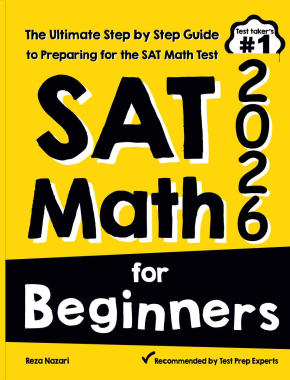
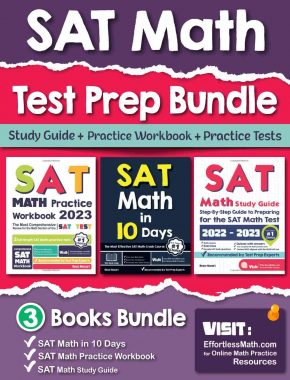
For supplementary work, we’ve built SAT math prep books at EffortlessMath that mirror the May 2026 question style, including the Desmos-trap problems and the multi-step Module 2 patterns. The full-length tests inside have been calibrated against student feedback from March and May 2026.
If you want a single book recommendation, get a topic-by-topic workbook (not just full-length practice tests) for the area where you scored lowest. Targeted practice on your weakest concept beats four more full-length tests, hands down.
The Bottom Line
The May 2026 Digital SAT wasn’t a redesign. It was a refinement. The College Board tested the limits of what Desmos can and can’t do, and they pushed back on the “calculator solves everything” trend that was emerging.
Smart prep for the rest of 2026 looks like this:
- Lock down algebra fundamentals (the biggest single content bucket)
- Build deep mastery in advanced math (the biggest score lever)
- Use Desmos as a scalpel, not a hammer
- Treat Module 1 like it’s the whole test
- Practice with materials that reflect May 2026 patterns, not 2023’s
The format hasn’t changed. The questions have evolved. Your prep should too.
You’ve got this. The next test is just a chance to apply what you’ve already learned about how this thing actually works.
Looking for SAT math practice that reflects the May 2026 question style? Our Digital SAT prep books at EffortlessMath are organized by content area with full-length practice tests in the new format.

Related to This Article
More math articles
- Barriers protect the single seller
- How to Graph Quadratic Inequalities? (+FREE Worksheet!)
- Unit Conversion Practice — Length, Mass, Volume & Time (Free)
- Unlocking Trigonometric Secrets: A Comprehensive Guide to Double-Angle and Half-Angle Formulas
- How to Be A Great SAT/ACT Math Tutor?
- Free Grade 3 English Worksheets for New Mexico Students
- GED Math – Test Day Tips
- Nutrients and Digestion
- Best Calculators for CA Exams
- Liters and Milliliters for 4th Grade












What people say about "Digital SAT Math 2026: What Changed"?
No one replied yet.