CLEP U.S. History I 071: Enslaved Resistance and Black Institution Building
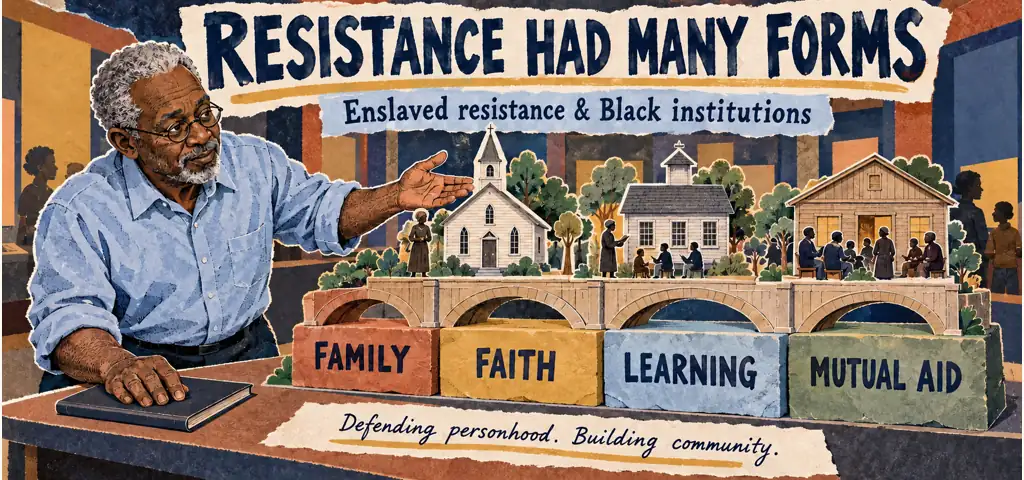
Lesson 13.4 of Chapter 13 of the U.S. History to 1877 study guide on Effortless Math covers CLEP U.S. History I 071: Enslaved Resistance and Black Institution Building: the key terms, the core ideas, and worked examples showing how this topic is tested on the exam.
U.S. History to 1877 | Chapter 13 | Lesson 13.4
Enslaved people resisted through actions ranging from daily negotiation to open rebellion. They slowed work, feigned illness, broke tools, preserved religious and cultural practices, visited family, learned secretly, stole provisions understood as owed, fled temporarily or permanently, and sometimes fought. Owners’ advertisements, punishment records, and patrol laws reveal resistance even when enslaved voices are absent, but such sources must be read against the interests of their authors.
Gabriel’s planned rebellion in 1800 and Denmark Vesey’s alleged conspiracy in 1822 led to executions and harsher control. Nat Turner’s 1831 rebellion in Virginia killed about sixty white people. Militia and mobs killed many Black people in retaliation, including people uninvolved. Southern legislatures restricted preaching, assembly, education, and movement. Revolt was rare because surveillance and punishment were severe, not because enslavement was accepted.
Escape created another geography of resistance. Free Black people, sympathetic whites, churches, and vigilance committees formed routes later called the Underground Railroad. Harriet Tubman repeatedly returned south after her own escape to guide others. Networks were decentralized and dangerous, not a single organization with stations marked on a national map. Most enslaved people could not reach northern freedom, and fugitives remained vulnerable to capture and kidnapping.
Free Black communities founded churches, schools, newspapers, mutual-aid societies, literary societies, and conventions. Richard Allen helped establish the African Methodist Episcopal Church after discriminatory treatment in a white congregation. Institutions offered worship, burial funds, education, political organization, and leadership. They operated under segregation, job exclusion, voting restrictions, and mob violence.
Resistance should not be measured only by whether slavery ended immediately. Protecting family, asserting faith, acquiring knowledge, escaping, and creating organizations defended personhood under coercion. Yet celebration must not romanticize the danger or shift responsibility from enslavers to the enslaved.
Watch, then test the claim
Use this lesson from Study Hall to review the period and its central historical problem. Pause when the video reaches the turning point named above.
Video: Slavery, Freedom, Resistance | US History to 1865 | Study Hall, Study Hall.
Check your understanding
- Southern legislative reaction to Nat Turner’s revolt most directly included
- stronger statutory protection for independent Black schools
- gradual emancipation paired with compensation
- restored suffrage for free Black men
- restrictions on Black preaching, schooling, and assembly
- narrower slave-patrol powers around churches
- Richard Allen’s work best illustrates which form of antebellum Black institution building?
- national political-party leadership
- integrated control of white denominations
- creation of the independent AME Church
- federal administration of mutual-aid funds
- state sponsorship of Black schools
- Deep Practice: select all that apply. Resistance included
- flight
- work slowdowns
- secret literacy
- family protection
- consent inferred from low revolt frequency
- Deep Practice: open response. How can an enslaver’s advertisement provide evidence of enslaved agency?
Write a brief response using a named fact from the lesson.
Open the answers and reasoning
Independent preparation. CLEP is a registered trademark of the College Board, which does not endorse this lesson.

Related to This Article
More math articles
- Wrapping, Closures, and External Indicators
- Grade 4 Informational Reading: Main Idea, Supporting Details, and Text Structure Strategies
- 8th Grade GMAS Math Worksheets: FREE & Printable
- Selective exposure
- Chapter 34: American Political Culture
- Hardy-Weinberg Calculations: Equations and Worked Examples
- Free Grade 8 English Worksheets for Texas Students
- Natural rights and social-contract theory
- Fiscal federalism
- Best Laptops for Teachers


















What people say about "Enslaved Resistance and Black Institution Building"?
No one replied yet.