LSAT Necessary vs. Sufficient Assumptions: Identify the Task (2027 Prep)
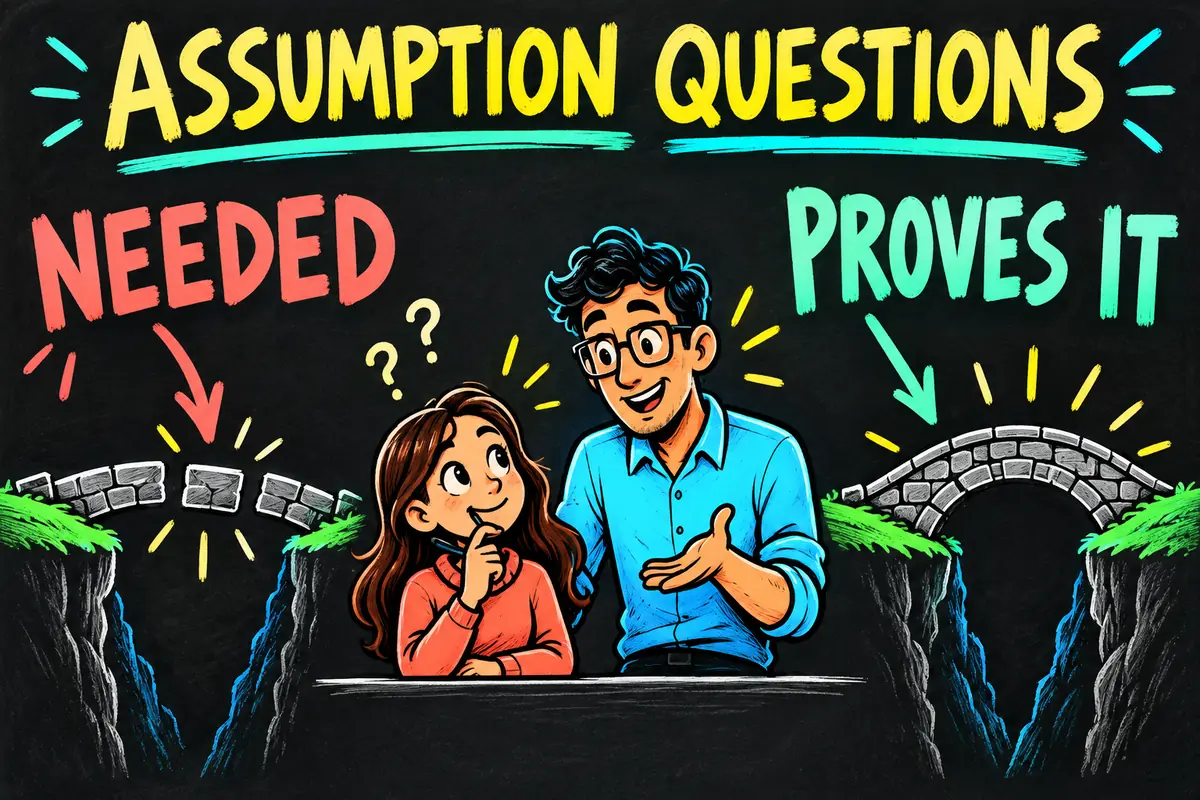
One assumption has to be there for an argument to work. Another would make the conclusion follow. Read the question stem first, then test the answer for the job it must do.
You see the word assumption and reach for the same tool every time. Pause at the question stem. Is the test asking what the argument needs, or what would be enough to prove its conclusion? Those are different jobs.
Here is the quick distinction: a necessary assumption is something the argument depends on. A sufficient assumption, added to the premises, makes the conclusion follow. They can address the same gap. The second task asks for a stronger bridge.
Read the task before you read the answers
LSAC describes Logical Reasoning as short arguments followed by questions about the reasoning. Its listed skills include detecting assumptions made by an argument. Its official sample items use task language such as asking what an argument requires. In your own practice, sort the stem by the work it requests before you predict an answer.
| If the stem asks… | The task is… | Your check |
|---|---|---|
| What the argument depends on, requires, or assumes | Necessary assumption | Negate a candidate. Would the reasoning break? |
| What would let the conclusion follow or justify it | Sufficient assumption | Add a candidate to the premises. Is the conclusion now forced? |
| What would strengthen the argument | Strengthen, which is a different task | Ask how much support the question requests. A helpful fact may improve the case without proving it. |
Stem wording is a clue, not a password. Read the whole question. A single word can appear in more than one kind of task, and answer choices cannot tell you which test to apply until you know what the stem asks.
Necessary means the argument cannot do without it
Suppose a town argues that moving the library’s teen program to a later hour will increase attendance. The argument depends on something about the teens who might attend. If every likely participant has left town for the summer, the proposed time change cannot produce the predicted increase.
On a necessary-assumption question, try the Negation Test. State the candidate’s logical opposite in plain language, then put that opposite back beside the premises and conclusion. If the argument loses a support it needs, the candidate is necessary. If the argument still works, it was not required.
Keep the negation honest. For “some students can attend after 4,” the opposite is “no students can attend after 4.” Do not turn “some” into “all,” or change the subject while negating. A sloppy reversal can make a sound answer look wrong.
A necessary assumption can be modest. It may keep one step of the reasoning alive without proving the conclusion by itself. If the choice sounds like a grand guarantee, ask whether the argument truly needs that much.
Sufficient means enough to make the conclusion follow
Now use the same library argument. A sufficient assumption would close the full gap. For instance, imagine the answer says that every teen who can attend the later program will attend, and that enough such teens can attend to raise the program’s attendance above its current level. Add that to the premises. Does the prediction follow? Yes. That closes the gap.
On a sufficient-assumption question, do not settle for an answer that merely makes the conclusion sound more plausible. Add it to what the argument already gives you. Then look for any remaining way the conclusion could be false. If a sensible counterexample survives, the choice has not done enough.
These two checks ask different questions. Negation asks, “Can the argument live without this?” Addition asks, “Does this guarantee the conclusion?” Keep those tests separate.
One simple rule shows the difference
Consider a made-up event rule: only people on the reservation list may receive a ticket. Being on the list is necessary for receiving a ticket. It does not guarantee one. A person on the list might still miss out.
Add a second rule: every person on the reservation list will receive a ticket. Now being on the list is sufficient for receiving a ticket. If the question asks what must be true, the first rule has the needed direction. If it asks what would guarantee the result, the second rule completes the job.
In conditional notation, if receiving a ticket requires being listed, write ticket → listed. If being listed guarantees a ticket, write listed → ticket. The arrows point in opposite directions. That small flip causes a lot of missed questions.
| Concept | Plain-language test | Ticket example | What it does not promise |
|---|---|---|---|
| Necessary | The result cannot happen without this condition. | Ticket → on the list | List membership alone may not produce a ticket. |
| Sufficient | This condition is enough to produce the result. | On the list → ticket | It need not be the only way to get a ticket. |
A statement can be both necessary and sufficient when each direction is true. Do not assume the categories make two mutually exclusive boxes. The question still determines which proof you must show.
Use this four-step routine on a practice question
- Mark the conclusion. Find what the speaker wants you to accept. Circle the word that signals the claim if that helps.
- List the support. Write the facts the argument actually gives you. Leave your own assumptions out for a moment.
- Name the task. Underline the stem’s job: required, or enough to make the conclusion follow? Avoid deciding from one keyword alone.
- Test the tempting choice. Negate it for a necessary task. Add it to the premises for a sufficient task. Explain why it works before you move on.
Keep a small error log with three columns: stem task, gap you predicted, and why your chosen answer failed. If you confused “helps” with “proves,” mark that. If the reversed arrow got you, write both directions once. The note should tell you what to check on the next question.
A short practice check
Rule: A volunteer can lead the museum tour only after completing the safety briefing. Noor has completed the briefing. What can you conclude?
The rule makes the briefing necessary for leading a tour: lead → briefing. It does not say that everyone who completes the briefing will lead. Noor may be eligible, but the rule alone does not prove that Noor will lead. To make that conclusion follow, you would need additional information in the sufficient direction, such as a rule that everyone who completes the briefing is assigned to lead.
Now reverse the question. If the conclusion were that Noor could lead, what must hold under the rule? Noor must have completed the briefing. Negate that condition: Noor did not complete it. The rule blocks the conclusion. That is a necessary condition doing its job.
When the options look almost alike
Options can differ in strength or direction. The necessary one may be a small condition the speaker quietly relies on. A sufficient one can be broader because it must seal the gap. Strength is a clue. Read the whole choice beside the stem and ask whether the conclusion follows or merely feels easier to believe.
Watch for three familiar misses:
- Helpful but insufficient: the choice supports the conclusion, yet leaves a way for it to fail.
- Strong but unnecessary: the choice would prove the conclusion, but the argument does not need every part of it.
- Reverse arrow: the answer gives a condition that follows from the result when the argument needs a condition that produces it, or the other way around.
LSAC advises readers to judge an answer by whether it responds to the question, not simply by whether it sounds true. That reminder is especially useful here. A true statement can still be the wrong kind of assumption.
Check the source and practice the skill
LSAC’s Logical Reasoning overview identifies assumption detection as part of the section and explains the format of its short arguments. Its sample questions let you see official wording and explanations. Use those materials for scored practice. The original teaching examples on this page are independent study aids.
For a broader plan, visit the LSAT Practice Center. Keep a few lines in your review notes for the direction of the arrow and the job of the stem. That is enough to make your next assumption question more deliberate.
Sources
- LSAC: Logical Reasoning
- LSAC: Logical Reasoning Sample Questions
- LSAC: Suggested Approach for Logical Reasoning
- Khan Academy: Sufficient Assumptions quick guide
This independent study article is not affiliated with or endorsed by LSAC. The examples are original and are not official LSAT questions. Check LSAC materials for current test information and official practice.
Independent LSAT study resource. Not affiliated with or endorsed by LSAC. Examples on this page are original and are not official LSAT questions.

Related to This Article
More math articles
- 10 Most Common FTCE Math Questions
- Function Testing, Damage, and Lubrication
- Can the CBEST Test be Waived?
- FREE 7th Grade OST Math Practice Test
- The Gini coefficient summarizes the area gap
- How to Define Elapsed Time
- Using Strip Models to Explain Percent
- Praxis Elementary Education Math Flashcards
- ASVAB Math Flashcards (Free Online: Formulas, Terms & Concepts)
- Nervous and Endocrine Control of Movement




















What people say about "LSAT Necessary vs. Sufficient Assumptions: Identify the Task (2027 Prep) - Effortless Math"?
No one replied yet.