Free Grade 6 English Worksheets for New Jersey Students
The 7:42 NJ Transit train out of Metuchen is loud in the way only a weekday commuter train can be, phones, coffee lids, the conductor’s announcement system, three different conversations about quarterly numbers. Somewhere in the third car, a sixth grader is sitting with a paperback open on their knees, because their parent’s office let them tag along on a Saturday for a school field trip into the city. The kid has been on this train fifty times. They have never actually read on it before. Today, for whatever reason, the book holds. They look up at New Brunswick, glance at the seat across the aisle, and go back in. By Newark Penn they have read forty pages.
That moment, a sixth grader noticing they can read through noise, is what the NJSLA ELA is, in its own dry, structured way, designed to measure. The test asks a student to sit with a multi-paragraph passage on a screen, hold attention long enough to answer evidence-based selected-response items, and then write a Literary Analysis Task that requires moving back and forth between two texts. None of that works without the underlying habit of sustained, focused reading. The PARCC-style architecture New Jersey kept and renamed assumes a sixth grader who can stay with a text long enough to do real work inside it.
The forty-six free PDFs on this page are built for that kind of attention. One standard at a time, twenty-five focused minutes, an answer key written in plain student-facing language.
What’s on this page
Every worksheet below targets a single Grade 6 ELA standard from the New Jersey Student Learning Standards for English Language Arts. Each PDF opens with a Quick Review the student can read alone, runs through grade-appropriate practice items, and ends with an answer key that explains why each correct answer is correct.
No accounts. No paywalls. Print, work, check.
Reading: Literature
- Citing Textual Evidence and Drawing Inferences, [RL.6.1] name the conclusion, then quote the line that proves it
- Theme and Objective Summary, [RL.6.2] the whole story’s lesson, in one sentence
- Plot, Episodes, and Character Change, [RL.6.3] short scenes that quietly turn a character
- Figurative Language, Connotation, and Tone, [RL.6.4] the feeling a word carries past its definition
- Structure: How a Scene or Stanza Builds the Whole, [RL.6.5] every piece has a job for the larger work
- Developing the Narrator’s Point of View, [RL.6.6] how a writer makes a reader see through one character’s eyes
- Reading vs. Watching: Comparing Versions, [RL.6.7] what the page does that the screen cannot
- Comparing Stories Across Forms and Genres, [RL.6.9] same theme, different vessel
Reading: Informational Text
- Citing Evidence and Drawing Inferences in Nonfiction, [RI.6.1] pull the line that clinches the conclusion
- Central Idea and Objective Summary in Nonfiction, [RI.6.2] the article’s main point with the filler stripped off
- How Ideas and Events Are Developed, [RI.6.3] introduce a point, elaborate, extend, connect
- Word Meaning in Nonfiction: Figurative, Connotative, Technical, [RI.6.4] three jobs a single word can do at once
- Text Structure: How Sections Fit Together, [RI.6.5] cause and effect, problem and solution, sequence and compare
- Author’s Point of View and Purpose, [RI.6.6] the writer’s angle and the reason for the writing
- Integrating Information from Text, Visuals, and Data, [RI.6.7] read the prose, the chart, and the photo as one source
- Evaluating Arguments and Claims, [RI.6.8] separate claim from support, then weigh the support
- Comparing Two Authors on the Same Topic, [RI.6.9] same topic, different facts, different angle
Working on Math Too? Try the New Jersey NJSLA Grade 6 Math Bundle
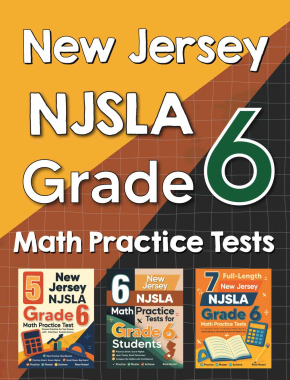
Many third graders are getting ready for the NJSLA in both subjects. If your child also needs math practice that matches the same standards, this companion bundle is the shortest path, workbook, study guide, and full practice tests in one download.
Writing
- Argument Writing: Claim, Reasons, Evidence, [W.6.1] defend a position with reasons and quoted proof
- Informative and Explanatory Writing, [W.6.2] teach a reader cleanly and in order
- Narrative Writing, [W.6.3] hook, pacing, dialogue, sensory detail, real ending
- Clear Writing for Task, Purpose, and Audience, [W.6.4] match writing to its actual reader
- Planning, Revising, and Editing, [W.6.5] drafts in passes, not single shots
- Short Research Projects, [W.6.7] focused question, several sources, tidy write-up
- Gathering, Evaluating, and Citing Sources, [W.6.8] which sources to trust and how to credit them
Speaking & Listening
- Collaborative Discussions, [SL.6.1] come prepared, listen, build on what was said
- Interpreting Diverse Media, [SL.6.2] what each format does well and what it leaves out
- Analyzing a Speaker’s Argument, [SL.6.3] claim, reasons, soft spots
- Presenting Claims and Findings, [SL.6.4] open with the point, walk the evidence, end clean
- Adapting Speech to Context, [SL.6.6] friend, classmate, teacher, principal, different talk for each
Grammar
- Pronoun Case: Subjective, Objective, and Possessive, [L.6.1a] I, me, my, and which one belongs where
- Intensive Pronouns, [L.6.1b] myself, themselves, and the emphasis they bring
- Avoiding Shifts in Pronoun Number and Person, [L.6.1c] one person, one number, hold it
- Vague Pronouns and Unclear Antecedents, [L.6.1d] every pronoun needs a clear noun the reader can point at
- Recognizing and Improving Non-Standard English, [L.6.1e] when to keep your voice, when to switch into school English
Conventions: Punctuation, Spelling
- Punctuation: Commas, Parentheses, and Dashes, [L.6.2a] three ways to fold extra information into a sentence
- Spelling Grade-Appropriate Words, [L.6.2b] homophones and the trouble words sixth graders miss most
Knowledge of Language and Style
- Varying Sentence Patterns for Style, [L.6.3a] combine, expand, rearrange, anything but flat
- Consistency in Style and Tone, [L.6.3b] pick a register and hold it through the whole piece
Vocabulary and Word Study
- Using Context Clues, [L.6.4a] slow down at the strange word and read what surrounds it
- Greek and Latin Roots and Affixes, [L.6.4b] port, dict, tele, photo, and the doors they open
- Using Dictionaries and Thesauruses Effectively, [L.6.4c] match the tool to the question
- Verifying Word Meaning, [L.6.4d] check the guess instead of trusting it
- Figurative Language: Personification and More, [L.6.5a] the moves that make writing breathe
- Word Relationships: Cause-Effect, Part-Whole, Category, [L.6.5b] patterns that link words together
- Connotation: Shades of Meaning, [L.6.5c] slim, slender, scrawny, same idea, different feel
- Academic and Domain-Specific Vocabulary, [L.6.6] cross-subject words and field-specific words
How to use these worksheets at home
NJSLA’s evidence-based selected-response items reward one specific habit above all others: underline-the-line. When your sixth grader is working through any reading PDF on this page, require them to mark the sentence in the passage that proves the answer before they fill in the bubble. The same physical motion, find the line, mark it, then commit, is what the on-screen test rewards through its highlight tool. Build it now, and it transfers in April without your kid noticing the shift.
For the Literary Analysis Task, slow your writing practice down. The Argument Writing and Informative Writing PDFs on this page each look like a single page, but a strong sixth grader should spread one across two or three sittings. Plan on a Wednesday. Draft on a Thursday. Revise on a Saturday with the answer key open beside the draft. The habit of returning to a piece across days is exactly what the on-screen Literary Analysis Task rewards, sixth graders who try to compose start-to-finish on the test almost always run out of structure halfway through.
Once a month, pull the Comparing Two Authors PDF and the Comparing Stories Across Forms and Genres PDF together. Run them in a single afternoon. NJSLA leans heavily on cross-text work at Grade 6, and the kid who is comfortable holding two passages in their head at once has a significant advantage over the kid who has only ever practiced one passage at a time.
A note about NJSLA ELA
The New Jersey Student Learning Assessment in English Language Arts, NJSLA ELA, is administered in the spring at Grade 6 and is built on the New Jersey Student Learning Standards for English Language Arts. The assessment retains the PARCC-style architecture New Jersey originally adopted: evidence-based selected-response (EBSR) items that pair a comprehension question with a second part asking for the textual evidence that supports the answer, technology-sharper items, and a Literary Analysis Task that requires extended writing across two literary texts.
The EBSR design is worth naming explicitly to your sixth grader. On any reading item, there is a real chance that getting the first part right is not enough, the second part asks which sentence or sentences from the passage best support the first answer, and the two parts are often scored together. That is exactly the work the reading PDFs on this page train: pull the conclusion, then prove it from the text. The Literary Analysis Task layers a second skill on top, sustained writing that integrates evidence from two passages, and that is what the writing PDFs and the cross-text comparison PDFs are built to develop across the school year.
Want everything in one bundle?
For families who would rather work from one consolidated resource than navigate forty-six separate links, the Grade 6 ELA Preparation Bundle gathers full-length practice tests and complete answer keys into a single package. It is most useful in the weeks before the spring administration, when sixth graders benefit from rehearsing the full shape of an NJSLA sitting, multiple passages, EBSR pairs, and a Literary Analysis Task, in one block.
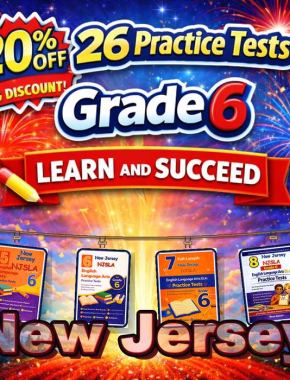
New Jersey Grade 6 ELA Preparation Bundle, four practice-test books, 26 unique full-length tests, complete answer keys with explanations.
A short closing
The kid on the 7:42 did not plan to read forty pages. They opened a book on a noisy train and looked up forty minutes later in a different city. The PDFs on this page work the same way. Print one, sit down, set a timer for twenty minutes, and see where your sixth grader is when the timer ends. Most weeks, they will be further than they expected. That is the only thing NJSLA is really asking for in April.
Best Bundle to Ace the New Jersey NJSLA Grade 6 ELA
Looking for the best resource to help your kid ace the New Jersey NJSLA? Try this bundle, four full practice-test books (5 + 6 + 7 + 8 tests) covering the same Grade 6 reading, writing, and language skills your child is already learning. Instant PDF download, answer keys included.

Related to This Article
More math articles
- The Best Grade 4 ELA Practice Tests for Utah Students
- Free Grade 4 English Worksheets for Oregon Students
- 8th Grade MAP Math FREE Sample Practice Questions
- Scientific Calculator (Evaluate Expressions Step by Step)
- Intelligent Math Puzzle – Challenge 80
- How to Graph Absolute Value Function?
- Full-Length 6th Grade STAAR Math Practice Test-Answers and Explanations
- Due Process Clause
- Exit polls
- Building with Blocks: How to Multiply Decimals by 1-digit Whole Numbers







What people say about "Free Grade 6 English Worksheets for New Jersey"?
No one replied yet.