How to Divide Fractions: The Keep-Change-Flip Method Explained
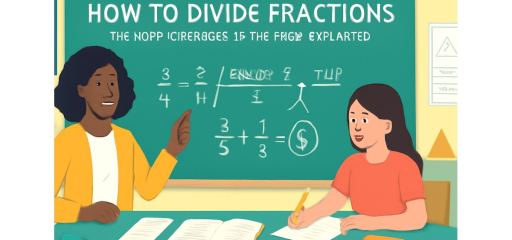
TL;DR: Dividing fractions has a phrase students never forget: keep-change-flip. Keep the first fraction the way it is, change the division sign to multiplication, and flip the second fraction upside down. Now multiply straight across and simplify. So two-thirds divided by four-fifths becomes two-thirds times five-fourths, which equals ten-twelfths, which simplifies to five-sixths. Three little steps and you are done, and once the rhythm is in your hands, you stop second-guessing it.
Key takeaways:
- Keep-change-flip (KCF): keep first fraction, change sign to times, flip second fraction.
- Then multiply across: top times top, bottom times bottom.
- Simplify the final answer (or simplify cross-wise before multiplying for cleaner work).
- Whole number divided by fraction: write the whole number as \(N/1\), then KCF.
- Dividing by a fraction always gives a bigger result than the original (when fractions are less than 1).
Dividing fractions sounds tricky until someone says the magic phrase: Keep, Change, Flip. Once you’ve seen the trick, you’ll wonder why anyone ever calls fraction division hard.
In this guide, you’ll learn the KCF rule, why it works, how to apply it to whole numbers and mixed numbers, and how to spot fraction division hiding inside word problems. We’ll close with a practice section so you can lock in the skill.
The Keep-Change-Flip method
To divide one fraction by another:
- Keep the first fraction the way it is.
- Change the division sign to multiplication.
- Flip the second fraction (use its reciprocal).
Then multiply like usual.
Example: \(\tfrac{3}{4} \div \tfrac{2}{5}\).
- Keep \(\tfrac{3}{4}\).
- Change ÷ to ×.
- Flip \(\tfrac{2}{5}\) to \(\tfrac{5}{2}\).
Now: \(\tfrac{3}{4} \times \tfrac{5}{2} = \tfrac{15}{8} = 1\tfrac{7}{8}\).
Another example. \(\tfrac{5}{6} \div \tfrac{10}{9}\).
- Keep, Change, Flip → \(\tfrac{5}{6} \times \tfrac{9}{10}\).
- Cross-cancel: \(5/10 \to \tfrac{1}{2}\); \(9/6 \to \tfrac{3}{2}\).
- Result: \(\tfrac{1 \cdot 3}{2 \cdot 2} = \tfrac{3}{4}\).
Dividing by a whole number
Treat the whole number as itself over 1.
\(\tfrac{2}{3} \div 4 = \tfrac{2}{3} \div \tfrac{4}{1} = \tfrac{2}{3} \times \tfrac{1}{4} = \tfrac{2}{12} = \tfrac{1}{6}\).
Dividing a whole number by a fraction
This is the case where the answer often grows.
\(8 \div \tfrac{1}{4} = \tfrac{8}{1} \times \tfrac{4}{1} = 32\).
Translation: how many quarter-cups fit into 8 cups? Thirty-two.
Dividing mixed numbers
Convert mixed numbers to improper fractions first, then apply KCF.
\(2\tfrac{1}{3} \div 1\tfrac{1}{2} = \tfrac{7}{3} \div \tfrac{3}{2} = \tfrac{7}{3} \times \tfrac{2}{3} = \tfrac{14}{9} = 1\tfrac{5}{9}\).
Why does Keep-Change-Flip work?
Because dividing by a number is the same as multiplying by its reciprocal. \(\div \tfrac{2}{5}\) and \(\times \tfrac{5}{2}\) produce the same answer. KCF is just a clean way to remember it.
A deeper look. Mathematically, \(\tfrac{a}{b} \div \tfrac{c}{d} = \tfrac{a}{b} \cdot \tfrac{d}{c}\). To see why, multiply top and bottom of the original complex fraction by \(\tfrac{d}{c}\), the bottom becomes 1, and the top becomes \(\tfrac{ad}{bc}\). That’s KCF in disguise.
A real-world example
You have \(\tfrac{3}{4}\) of a pizza. Each serving is \(\tfrac{1}{8}\) of a pizza. How many servings?
\(\tfrac{3}{4} \div \tfrac{1}{8} = \tfrac{3}{4} \times \tfrac{8}{1} = \tfrac{24}{4} = 6\).
Six servings. Makes sense, pretty good party.
Another real-world example. A ribbon is \(\tfrac{5}{6}\) of a yard long. You want to cut it into pieces of \(\tfrac{1}{12}\) yard each. How many pieces?
\(\tfrac{5}{6} \div \tfrac{1}{12} = \tfrac{5}{6} \times \tfrac{12}{1} = 10\) pieces.
Common mistakes
- Flipping the first fraction instead of the second. (Always flip the divisor.)
- Forgetting to convert mixed numbers first.
- Not simplifying the final answer.
- Confusing the operation: \(\tfrac{1}{2} \div 3\) is not the same as \(3 \div \tfrac{1}{2}\).
- Skipping the Change step and trying to divide multiplied fractions directly.
Quick practice
- \(\tfrac{4}{9} \div \tfrac{2}{3}\). Answer: \(\tfrac{4}{9} \times \tfrac{3}{2} = \tfrac{12}{18} = \tfrac{2}{3}\).
- \(\tfrac{1}{2} \div 6\). Answer: \(\tfrac{1}{12}\).
- \(5 \div \tfrac{2}{3}\). Answer: \(\tfrac{15}{2} = 7\tfrac{1}{2}\).
- \(3\tfrac{1}{4} \div 1\tfrac{1}{2}\). Answer: \(\tfrac{13}{4} \div \tfrac{3}{2} = \tfrac{13}{4} \times \tfrac{2}{3} = \tfrac{26}{12} = \tfrac{13}{6} = 2\tfrac{1}{6}\).
- A bag holds \(\tfrac{9}{10}\) kg of rice. Each meal uses \(\tfrac{3}{20}\) kg. How many meals? Answer: 6.
- \(\tfrac{7}{8} \div \tfrac{14}{16}\). Answer: \(\tfrac{7}{8} \times \tfrac{16}{14} = 1\).
- A board is 4 ft long. You want pieces \(\tfrac{2}{3}\) ft each. How many pieces? Answer: 6.
- \(4\tfrac{1}{2} \div \tfrac{3}{4}\). Answer: \(\tfrac{9}{2} \times \tfrac{4}{3} = 6\).
A deeper visual: dividing fractions with a diagram
Let’s revisit \(\tfrac{3}{4} \div \tfrac{1}{8} = 6\) with a picture. Draw a rectangle representing one whole. Shade \(\tfrac{3}{4}\) of it. Now divide the whole rectangle into eighths, your shaded region contains 6 eighth-pieces. That’s why the answer is 6: you’re asking how many eighths fit inside three-fourths.
This interpretation, “how many of the second fits into the first”, is what division of fractions really means.
Division word-problem signals
Look for these phrases in word problems. They signal division of fractions, not multiplication:
- “How many X fit into Y?”
- “How many pieces?”
- “How many servings?”
- “Divide into equal groups.”
- “Per” (sometimes, context matters).
When you spot one of these, set up the larger quantity divided by the smaller chunk, and KCF.
Complex fractions (fractions inside fractions)
A complex fraction looks like \(\dfrac{\tfrac{3}{4}}{\tfrac{2}{5}}\), a fraction whose numerator and/or denominator is itself a fraction. To simplify it, treat it as division:
\[\dfrac{\tfrac{3}{4}}{\tfrac{2}{5}} = \tfrac{3}{4} \div \tfrac{2}{5} = \tfrac{3}{4} \times \tfrac{5}{2} = \tfrac{15}{8} = 1\tfrac{7}{8}.\]
This is one of the most-tested ideas on Algebra 1 finals and the SAT.
Negative fraction division
Same rule. Track the signs:
- \(-\tfrac{4}{5} \div \tfrac{2}{3} = -\tfrac{4}{5} \times \tfrac{3}{2} = -\tfrac{12}{10} = -\tfrac{6}{5}\).
- \(-\tfrac{1}{2} \div -\tfrac{1}{3} = \tfrac{3}{2}\). (Negative ÷ negative = positive.)
Why this skill keeps mattering
Fraction division underpins:
- Rates and unit conversions (miles per hour, dollars per pound).
- Probability (conditional probability is a ratio of fractions).
- Algebra (rational expressions are essentially fractions with variables, same rules).
- Cooking, construction, finance, anywhere measurement matters.
FAQ
What is “Keep, Change, Flip”?
A friendly nickname for the rule that dividing fractions equals multiplying by the reciprocal.
Do I flip the first or second fraction?
Always the second one, the divisor.
Why does the answer often get bigger when dividing by a fraction?
Because dividing by a number less than 1 acts like multiplying by a number bigger than 1.
How do I divide a fraction by a whole number?
Rewrite the whole number as itself over 1, then KCF.
Can I use this method on mixed numbers?
Yes, but convert them to improper fractions first.
What’s the reciprocal of a number?
The reciprocal is “1 over that number.” The reciprocal of \(\tfrac{3}{5}\) is \(\tfrac{5}{3}\). The reciprocal of 4 is \(\tfrac{1}{4}\).
Is dividing by zero possible?
No. The reciprocal of zero is undefined, so dividing any fraction by zero is undefined.
How is fraction division different from decimal division?
It’s the same idea, just written differently. You can always convert fractions to decimals and divide, or use KCF.
Why does “Keep, Change, Flip” actually work?
Dividing by a number is the same as multiplying by its reciprocal. The reciprocal of \(\tfrac{2}{3}\) is \(\tfrac{3}{2}\) because \(\tfrac{2}{3} \times \tfrac{3}{2} = 1\). So when you divide by \(\tfrac{2}{3}\), you’re really multiplying by \(\tfrac{3}{2}\). The KCF rhyme is just a memorable name for this rule.
Can I divide a fraction by a whole number?
Yes. Write the whole number as itself over 1, then KCF. \(\tfrac{4}{5} \div 2 = \tfrac{4}{5} \times \tfrac{1}{2} = \tfrac{4}{10} = \tfrac{2}{5}\).
Can the answer to a fraction division problem be bigger than 1?
Absolutely. Whenever the divisor is smaller than the dividend, the result exceeds 1. Example: \(\tfrac{3}{4} \div \tfrac{1}{4} = 3\). (How many quarters fit in three-quarters? Three of them.)
How do I divide mixed numbers?
Convert each mixed number to an improper fraction first. Then KCF.
What about dividing three or more fractions in a row?
Do them left to right, just like with whole numbers. \(\tfrac{1}{2} \div \tfrac{1}{4} \div \tfrac{1}{8} = 2 \div \tfrac{1}{8} = 16\).
Building intuition with measurement
Fraction division is hardest to feel intuitively, so anchor it to a measurement question:
- \(\tfrac{2}{3} \div \tfrac{1}{6}\) asks: “How many sixth-cups fit inside two-thirds of a cup?” Answer: 4. (Test: 4 sixths = \(\tfrac{4}{6} = \tfrac{2}{3}\). ✓)
- \(1 \div \tfrac{1}{8}\) asks: “How many eighths fit in 1 whole?” Answer: 8.
- \(\tfrac{1}{2} \div 4\) asks: “If I split half a pizza among 4 people, what does each get?” Answer: \(\tfrac{1}{8}\).
If you can sketch the question or rephrase it as “how many of X fit in Y,” the right operation almost reveals itself.
Common SAT/ACT trap: “twice as much” vs “half as much”
Watch the wording carefully:
- “Half as much as \(\tfrac{2}{3}\)” = \(\tfrac{2}{3} \div 2 = \tfrac{1}{3}\).
- “Twice as much as \(\tfrac{2}{3}\)” = \(\tfrac{2}{3} \times 2 = \tfrac{4}{3}\).
- “How many halves are in \(\tfrac{2}{3}\)” = \(\tfrac{2}{3} \div \tfrac{1}{2} = \tfrac{4}{3}\).
Small change in phrasing, totally different operation.
A note about division by zero
This is one of math’s bright-line rules: you can never divide by zero. Not by 0, not by \(\tfrac{0}{5}\), not by any fraction whose numerator is zero. The result is undefined, not infinity, just undefined. Standardized tests love to slip this into answer choices, so watch for it.
One last reminder
Progress in math compounds. A 1% improvement every day for 100 days yields nearly a 3x improvement overall, because each new concept builds on the last. The students who pull ahead aren’t the ones who study the longest. They’re the ones who study consistently, review their mistakes, and refuse to skip the foundations. Show up tomorrow. Then show up the day after. The results take care of themselves.
If you found something useful here, save this article and revisit it after your next practice session. You’ll catch nuances on the second read that you missed on the first, because by then you’ll have the experience to recognize them. Happy practicing.
Practice with our free 5th-grade math worksheets or, for older students, the full GED Math Course covers division in depth.
Recommended EffortlessMath Books
For a workbook that drills fraction division alongside the rest of pre-algebra, the Pre-Algebra for Beginners walks through every topic with worked examples. For elementary-level fraction work, the Common Core Grade 6 Math Workbook (resource currently unavailable) covers dividing fractions as a major Grade 6 standard.

Pre-Algebra for Beginners 2026 The Ultimate Step by Step Guide to Preparing for the Pre-Algebra Test
Frequently Asked Questions
How do I divide fractions?
Use keep-change-flip (KCF). Keep the first fraction, change division to multiplication, flip the second fraction (use its reciprocal). Then multiply across. Example: \(\frac{2}{3} \div \frac{4}{5} = \frac{2}{3} \times \frac{5}{4} = \frac{10}{12} = \frac{5}{6}\). Always simplify the final answer.
Why does keep-change-flip work?
Dividing by a number is the same as multiplying by its reciprocal. \(10 \div 2 = 10 \times 1/2 = 5\). The same logic applies to fractions: \(\frac{a}{b} \div \frac{c}{d} = \frac{a}{b} \times \frac{d}{c}\). The reciprocal of \(c/d\) is \(d/c\). KCF is just a memorable name for “multiply by the reciprocal.”
How do I divide a whole number by a fraction?
Write the whole number as a fraction over 1, then apply keep-change-flip. \(6 \div \frac{2}{3} = \frac{6}{1} \div \frac{2}{3} = \frac{6}{1} \times \frac{3}{2} = \frac{18}{2} = 9\). The answer is bigger than the original 6 because dividing by a fraction less than 1 always gives a larger result.
How do I divide a fraction by a whole number?
Same idea, write the whole number over 1, then keep-change-flip. \(\frac{3}{4} \div 6 = \frac{3}{4} \div \frac{6}{1} = \frac{3}{4} \times \frac{1}{6} = \frac{3}{24} = \frac{1}{8}\). When you divide a fraction by a whole number bigger than 1, the result gets smaller.
How do I divide mixed numbers?
Convert each mixed number to an improper fraction first, then keep-change-flip. \(2\frac{1}{4} \div 1\frac{1}{2}\): convert to \(\frac{9}{4} \div \frac{3}{2} = \frac{9}{4} \times \frac{2}{3} = \frac{18}{12} = \frac{3}{2} = 1\frac{1}{2}\). Always convert back to a mixed number at the end if the original problem used mixed numbers.
Can I simplify before multiplying?
Yes, cross-cancel any numerator and denominator that share a common factor. \(\frac{2}{3} \times \frac{5}{4}\): the 2 in the first numerator and the 4 in the second denominator share factor 2. Simplify to \(\frac{1}{3} \times \frac{5}{2} = \frac{5}{6}\). Cross-canceling first keeps the numbers small and saves a simplification step at the end.
What if the answer is an improper fraction?
Convert to a mixed number if the problem asks for one (or if it just looks cleaner). \(\frac{7}{3} = 2\frac{1}{3}\). On some tests, the answer choices are improper fractions; on others, they’re mixed numbers. Check the format of the choices before converting.
How does dividing fractions show up in word problems?
Common types: “How many \(1/4\)-cup servings are in 3 cups?” (answer: \(3 \div 1/4 = 12\)). “A board is \(7/8\) yard long. How many \(1/4\)-yard pieces can you cut?” (answer: \(7/8 \div 1/4 = 7/2 = 3.5\) pieces). Look for “how many of X are in Y”. That’s a division problem.
Why does dividing by a fraction give a bigger answer?
Because dividing by a number less than 1 is the same as multiplying by something greater than 1. \(10 \div 0.5 = 20\). Same idea: \(10 \div 1/2 = 10 \times 2 = 20\). The smaller the divisor, the bigger the result. It feels counterintuitive at first but it’s exactly how division works.
Where does dividing fractions show up on tests?
Constantly. Fraction division appears on every grade 5-8 state math test (CCSS, NY State, FAST, STAAR, GMAS, MAP) and on the GED, HiSET, TASC, ASVAB, ParaPro, Praxis Core, TEAS, ALEKS, SSAT, and ISEE. Mastering keep-change-flip is one of the highest-yield arithmetic skills for any standardized test.
Related EffortlessMath Lessons
If a topic on this page feels rusty, these short lessons go deeper:

Related to This Article
More math articles
- Area of a Trapezoid
- The Best Grade 8 Math Book for Oregon Students
- The Best Calculators for Back to School 2026
- How to Find Percent of Increase and Decrease? (+FREE Worksheet!)
- The Best Grade 7 ELA Practice Tests for Tennessee Students
- 10 Most Common 5th Grade MEAP Math Questions
- How to Solve Multi-step Addition Word Problems
- Let’s Chat: How to Simplify the Steps to Solve Two-step Equations
- The Best Grade 6 ELA Practice Tests for Alabama Students
- How to Factor Polynomials by Taking a Common Factor?

















What people say about "How to Divide Fractions: Keep-Change-Flip"?
No one replied yet.