Virginia SOL Grade 3 Math Worksheets: 49 Free PDFs
Choose from 49 free Grade 3 math worksheet links for Virginia learners. Browse by topic below, then open the skill your child is studying. The collections open directly; no email or account is required for these worksheet links.
Which topic should I choose first?
Start with the task that caused difficulty in class. If multiplication feels like guessing, begin with Understanding Multiplication before fact practice. For subtraction, use place-value models alongside the written steps. For fractions, draw equal parts before comparing symbols.
Pick one topic for a short session. Ask the learner to explain one solution aloud, then decide whether to repeat that skill or move on. For another way to review the same ideas, explore the Grade 3 Math Online Center.
Browse the 49 worksheet links
The links are organized by their existing topic labels. This is a practice menu, not a complete SOL standards crosswalk. Some topics offer extension practice beyond Virginia’s Grade 3 requirements; use the SOL focus below and your teacher’s guidance to choose.
Place Value and Number Sense
- Place Value and the Base-Ten System, find the value of every digit in a multi-digit number
- Reading and Writing Whole Numbers, switch between standard, expanded, and word forms
- Comparing and Ordering Whole Numbers, use <, >, and = to compare numbers up to four digits
- Rounding Whole Numbers, round to the nearest ten or hundred
- Even and Odd Numbers, spot even versus odd by the ones digit
Addition and Subtraction Within 1,000
- Addition Within 1,000, regroup with confidence using place-value columns
- Subtraction Within 1,000, borrow once or many times, the steps are the same
- Estimating Sums and Differences, round first, then add or subtract for a quick check
- Word Problems: Addition and Subtraction, turn one- and two-step stories into number sentences
Multiplication
- Understanding Multiplication, a × b as equal groups and as an array
- Multiplication Facts and Strategies, skip-count, double, and the × 9 trick
- Properties of Multiplication, commutative, associative, identity, zero, distributive
- Multiplying by Multiples of 10, basic fact, then add the zero on the end
- Multiplying Two-Digit by One-Digit, break-apart strategy with tens and ones
- Multiplication Word Problems, equal groups, arrays, and “times as many”
Division
- Understanding Division, share equally or count groups
- Division Facts and Strategies, ask the multiplication twin to find each quotient
- Relating Multiplication and Division, fact families and missing factors
- Division Word Problems, sharing stories versus grouping stories
Fractions
- Understanding Fractions, name a fraction by counting equal parts
- Fractions on a Number Line, find a fraction by jumping along 0 to 1
- Equivalent Fractions, make different fractions that mean the same amount
- Comparing Fractions, same denominator versus same numerator rules
- Whole Numbers as Fractions, write any whole number as a fraction
Patterns and Equations
- Number Patterns and Sequences, find the rule, then continue the list
- Two-Step Word Problems, split into Step 1 and Step 2 and write each result
- Unknown Numbers in Equations, use the inverse operation to find the missing number
- Input-Output Tables, find the rule that turns input into output
Measurement
- Measuring Length, inches, feet, yards, centimeters, meters
- Liquid Volume and Mass, liters, milliliters, grams, kilograms
- Time and Elapsed Time, count up on a clock to find the gap
- Temperature, degrees Fahrenheit with rise, drop, and compare
- Money and Making Change, count coins and find change
Area and Perimeter
- Understanding Area, count unit squares to find area
- Area of Rectangles, area = length × width
- Perimeter of Polygons, add up every side length
- Area and Perimeter of Composite Figures, break into rectangles, then add
Geometry
- Classifying Two-Dimensional Shapes, name polygons by the number of sides
- Classifying Quadrilaterals, squares, rectangles, rhombuses, trapezoids
- Points, Lines, Line Segments, and Rays, the four building blocks of geometry
- Parallel and Perpendicular Lines, side-by-side versus 90° crossing
- Classifying Angles, right, acute, obtuse, and straight
- Lines of Symmetry, find the fold lines that match a shape
- Three-Dimensional Shapes, count faces, edges, and vertices
- Partitioning Shapes Into Equal Parts, split into halves, thirds, fourths, and beyond
Data
- Pictographs and Bar Graphs, read graph values and compare categories
- Line Plots, find mode, range, and total from the Xs
- Probability and Chance, label events impossible, unlikely, equally likely, likely, certain
Personal Financial Literacy
- Personal Financial Literacy, earn, save, spend, and figure how long it takes
What does Virginia’s Grade 3 SOL cover?
The approved Virginia mathematics standards distinguish these Grade 3 expectations:
- Place value: read and write numbers through six digits; compare and order numbers through 9,999.
- Operations: addition and subtraction with addends or minuends up to 1,000; multiplication facts through 10 × 10 and corresponding division facts.
- Fractions and money: model and compare fractions and mixed numbers; count, compare and make change for amounts up to $5.
- Measurement and geometry: measure length, weight/mass and liquid volume; explore area and perimeter; tell time to the minute and solve elapsed-time problems in one-hour increments; classify, combine and subdivide polygons.
- Data and patterns: work through the data cycle with pictographs and bar graphs; create and extend increasing or decreasing addition/subtraction patterns.
For example, the 2023 standards place fractions under 3.NS.3, money under 3.NS.4, area/perimeter under 3.MG.2, and time under 3.MG.3. Topic titles alone do not prove full standards coverage. Probability, line plots and two-digit multiplication in the list can be used as extra practice when appropriate, rather than treated as a Grade 3 SOL checklist.
How to use the practice at home
Work on one skill at a time and keep scratch paper or counters nearby. Let your child finish a small set, discuss the strategy, and revisit any confusing step. A useful next session may repeat the same topic with a clearer model rather than introduce a harder one.
Want a structured Grade 3 review?
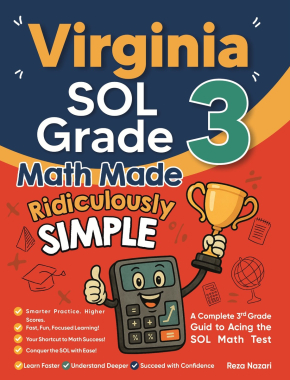
Explore Virginia SOL Grade 3 Math Made Ridiculously Simple. Open its product page to view the available sample and purchase details before deciding whether it fits your learner. This is an individual review book; the free worksheet links above remain available separately.

Related to This Article
More math articles
- 3rd Grade PACE Math Worksheets: FREE & Printable
- Nebraska NSCAS Grade 8 Math Free Worksheets: Printable Grade 8 Math Practice, No Login Needed
- Merit system
- How to Help Your 8th Grade Student Prepare for the North Dakota NDSA Math Test
- The Ultimate 7th Grade NYSTP Math Course (+FREE Worksheets)
- TABE Math Flashcards (Free Online: Formulas, Terms & Concepts)
- Digital SAT Math Practice Test PDF with Answers (2026)
- Top 10 Grade 3 Math Books: Inspiring Young Mathematicians to Explore
- The Best Grade 7 ELA Practice Tests for North Carolina Students
- The Best Grade 3 Math Book for California Students
What people say about "Virginia SOL Grade 3 Math Worksheets: 49 Free PDFs"?
No one replied yet.