How to Pass the Praxis Core Math Test (2026 Guide)

TL;DR: Aiming to pass the Praxis Core Math (5733)? A focused 4-to-8 week plan can get you there. Start with a diagnostic, then go hard on algebra and number/quantity (together, over 60 percent of the test), get comfortable with the on-screen calculator and what it can’t do, and close with timed full-length practice tests. Passing is 150 on the 100-to-200 scale. Consistent weekly work is what gets you across the line, not last-minute cramming.
Key takeaways:
- Praxis Core Math (5733): 56 selected-response questions in 85 minutes.
- ETS-recommended passing score: 150 on the 100-200 scale.
- Number/Quantity (36%) and Algebra (25%) carry 61% of the test together.
- On-screen four-function calculator available; no formula reference sheet.
- Required for entry into most teacher preparation programs.
If teaching is your calling, the Praxis Core math test is one of the early gates you have to clear. The whole subject test goes by the code 5733, and it is required by many teacher-prep programs and state licensing boards before you can step into a classroom of your own.
The reassuring news: Praxis Core math covers high-school-level content with a heavy lean on middle-school basics, and the questions are fair. You will not be ambushed by trick questions or weird topics. You just need to know the math, work cleanly under time, and use the right tools.
What Is on the Praxis Core Math Test (5733)?
The Praxis Core Mathematics test (5733) contains 56 questions in 90 minutes. That gives you about 96 seconds per question, which is generous compared to other teacher exams.
You will see a mix of: – Selected-response (single-answer multiple choice) – Multiple-select (choose more than one) – Numeric entry (type the answer)
Content is split into four reporting categories:
- Number and Quantity (~30%), operations with integers, fractions, decimals, percents; rates, ratios, proportions; order of magnitude; absolute value.
- Algebra and Functions (~30%), linear expressions, equations, inequalities, systems, functions, slope, graphs.
- Geometry (~20%), area, perimeter, volume, the Pythagorean theorem, congruence, basic transformations, parallel/perpendicular lines.
- Statistics and Probability (~20%), measures of center and spread, scatter plots, two-way tables, basic probability.
What Score Do You Need to Pass?
The national passing score for Praxis Core Math (5733) is 150 out of a 100 to 200 scale. Many states require this exact score; some set a slightly higher bar.

The good news: scaled scoring is forgiving. You typically need to answer roughly 60 to 65% of the questions correctly to hit 150. You can miss a third of the test and still pass.
States may also require Praxis Core Reading (5713) and Writing (5723). The three together form Praxis Core 5752. Your math score is independent, pass it once and you don’t have to retake it even if you fail the other two.
The Topics That Earn the Most Points
1. Linear equations, inequalities, and systems
A solid chunk of the test reduces to “solve for \(x\)” or “find where two lines meet.” Master: – Equations like \(3x + 5 = 2x – 7\) – Inequalities like \(-2x + 4 \le 10\) – Systems by substitution and elimination
2. Percents and proportions
Percent of, percent change, markup, discount, simple interest, and proportional reasoning. Pure points if you trained the formulas.
3. Slope, lines, and functions
Slope from two points, \(y = mx + b\), point-slope form, parallel and perpendicular lines, function notation \(f(x)\).
4. Geometry essentials
Area and perimeter of rectangles, triangles, circles, and trapezoids. Volume and surface area of prisms, cylinders, and cones. Pythagorean theorem and the distance formula. The Praxis provides reference formulas for some of these.
5. Statistics
Mean, median, mode, range, standard deviation (conceptual only. You do not have to compute it by hand), reading box plots and scatter plots.
Recommended Practice Resources
Calculator Policy
The Praxis Core Math test allows an on-screen four-function calculator built into the test interface. You may not bring your own calculator. Practice with the on-screen tool ahead of time, fumbling through it under timed conditions is a common, avoidable mistake.
A 6-Week Praxis Core Math Study Plan
Week 1, Diagnostic and arithmetic
- Take a full-length untimed practice test.
- Drill fraction, decimal, and percent arithmetic.
- Open an error log notebook.
Week 2, Percents, ratios, proportions
- Percent of, percent change, markup/discount.
- Ratios and rates in real-world settings.
- Simple interest.
Week 3, Algebra
- Linear equations and inequalities.
- Systems of equations.
- Exponents and basic radicals.
Week 4, Geometry
- Area, perimeter, volume.
- Pythagorean theorem and distance.
- Transformations and congruence.
Week 5, Functions and statistics
- Slope, \(y = mx + b\), point-slope.
- Function notation and evaluation.
- Mean, median, mode, range; scatter plots and box plots.
Week 6, Timed practice
- Two full-length timed practice tests on separate days.
- Review every miss and add to the error log.
- Focus last three days on your weakest topic only.
Test-Day Strategy

- Use the navigation bar. You can skip and return on the Praxis. Don’t waste 4 minutes on a question you can revisit later.
- Plug in numbers. If a problem gives you a generic variable and the answer choices are simple, pick a friendly number (like 2, 5, or 10), test it, and eliminate.
- Estimate before computing. A quick sanity check catches arithmetic mistakes you would otherwise miss.
- Use the on-screen calculator only when needed. Mental math is faster on simple operations.
- Bring ID and arrive early. Praxis test centers are strict on identification and time.
Common Mistakes
- Confusing rate and ratio. A rate compares two different units (miles per hour). A ratio compares the same units.
- Misreading inequalities. “At least 12” means \(\ge 12\), not \(> 12\).
- Forgetting to switch the inequality sign when multiplying or dividing by a negative.
- Mis-grouping in the calculator. Always use parentheses around numerators, denominators, and negatives.
- Skipping multi-select questions. They are scored as all-or-nothing. Read every choice; don’t quit at the first plausible one.
Free Resources
Effortless Math offers a complete free Praxis Core math system:
- Praxis Math Worksheets, topic-organized printable practice with answer keys.
- The Ultimate Praxis Math Course, a free, complete online course.
- Praxis Math eBooks, full prep books with practice tests.
Frequently Asked Questions
How many times can I take the Praxis Core Math test? You can retake the test after 28 days, with no annual cap. Most states allow unlimited attempts.
What is the difference between Praxis Core Math (5733) and the older 5732? 5733 replaced 5732 in 2019. The content is similar; the format and weighting are updated.
Do I have to pass all three Praxis Core sections at once? No. You can pass each section separately. If you pass math and fail reading, you only retake reading.
Is the Praxis Core math harder than the GED math? Slightly. Praxis assumes a stronger algebra and statistics foundation, but the topics overlap heavily.
Can I take the Praxis Core Math online from home? Yes, ETS offers an at-home version with online proctoring. You need a quiet room, a webcam, and a government-issued ID.
Are some questions experimental? Yes. Praxis includes unscored “pretest” questions mixed in. You will not know which they are, so treat every question seriously.
You Are Building the Future of Teaching
Every minute you spend on Praxis math is a minute that buys you a license, a classroom, and a lifetime of impact. The math is real, but it is learnable, and you have every right to be here. Open a worksheet today. Future-you, with your own class to teach, is going to be proud you started.
Keep Practicing With the Right Resources
Recommended EffortlessMath Books
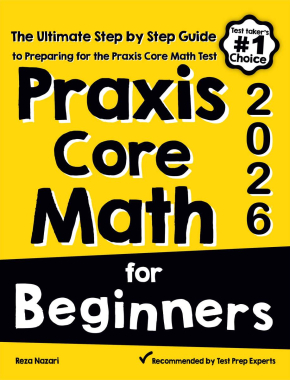
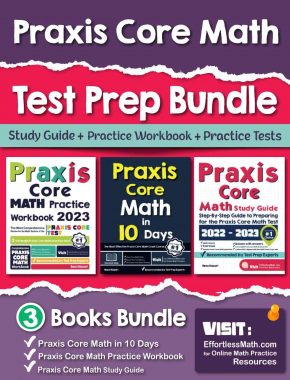
For a workbook that builds on this strategy guide, the Praxis Core Math for Beginners walks through every Praxis Core topic with worked examples. For complete credential-exam prep with multiple full-length practice tests, see the Praxis Core Math Test Prep Bundle.
Related EffortlessMath Lessons
If a topic on this page feels rusty, these short lessons go deeper:

Related to This Article
More math articles
- Federalist No. 70 and executive power
- How to Master Polynomial Functions: A Comprehensive Guide to Understanding and Solving Complex Zeros
- Free Grade 4 English Worksheets for Ohio Students
- How to Solve Math Word Problems: A 5-Step Framework
- How to Solve Equations with Multiple Angles
- Convert Rational Numbers to a Fraction
- Understanding Trigonometry: How to Calculate the Area of Triangles
- 6th Grade SBAC Math Practice Test Questions
- The Best Grade 7 ELA Practice Tests for Arizona Students
- Free Grade 2 English Worksheets for Mississippi Students













What people say about "How to Pass the Praxis Core Math Test"?
No one replied yet.