Tip, Tax & Discount Math: Mental Shortcuts That Save Money
You’ll calculate tips, taxes, and discounts thousands of times in your adult life. Most people pull out their phone. A few people just know. Once you learn the mental math shortcuts in this guide, you’ll join the second group, and you’ll never feel awkward at a restaurant or in line again.
The Foundation: 10% Is Your Best Friend
The single most powerful trick in percent math: 10% = move the decimal one place to the left.
- $80 \to \$8$
- $42.50 \to \$4.25$
- $137 \to \$13.70$
- $9.99 \to \$1.00$ (basically)
From 10%, you can calculate almost every common percent in seconds.
Tip Math (15%, 18%, 20%, 25%)
The Universal Method
- Find 10% of the bill.
- Adjust from there.
20% tip
The easiest tip to calculate. 20% = 10% × 2.
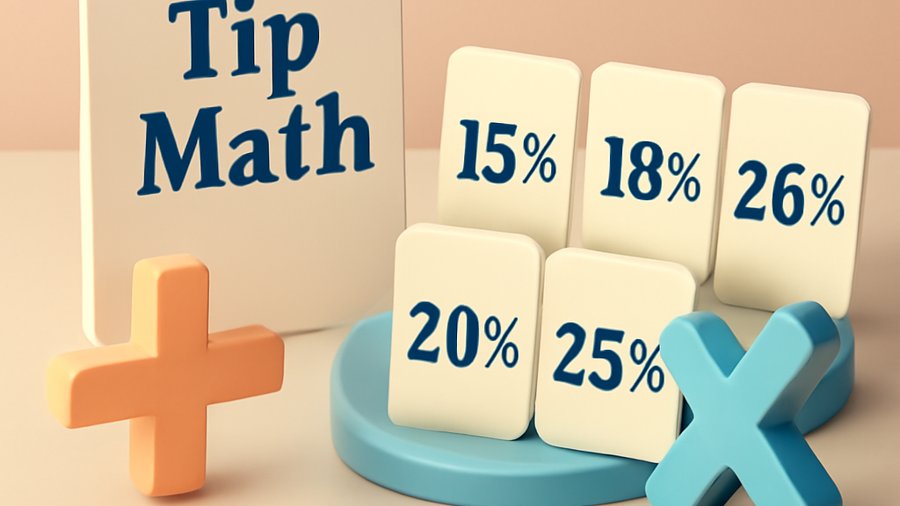
- Bill: $52 → 10% = $5.20 → 20% = $10.40.
- Bill: $87 → 10% = $8.70 → 20% = $17.40.
- Bill: $130 → 10% = $13 → 20% = $26.
15% tip
15% = 10% + 5% = 10% + (half of 10%).
- Bill: $40 → 10% = $4 → 5% = $2 → 15% = $6.
- Bill: $76 → 10% = $7.60 → 5% = $3.80 → 15% = $11.40.
18% tip
Two methods: Method A: 18% = 20% – 2%. – Bill: $50 → 20% = $10 → 2% (= 10% ÷ 5) = $1 → 18% = $9.
Method B: 18% ≈ 20% (just round up). – Most servers won’t notice the difference between $9 and $10. If you mentally tip 20% in tougher cases, you’re being slightly generous.
25% tip
25% = 20% + 5% OR 25% = bill ÷ 4.
- Bill: $40 → $40 ÷ 4 = $10.
- Bill: $84 → $84 ÷ 4 = $21.
Pro tip
Round the bill before tipping for ease. A $46.83 bill becomes $47, then 20% = $9.40. Close enough.
Sales Tax Math
The Universal Method
- Know your local tax rate (e.g., 8%).
- Find 10%.
- Adjust.
Common tax rates and shortcuts
5% tax: half of 10%. – $40 → 10% = $4 → 5% = $2.
6% tax: 5% + 1% (1% = 10% ÷ 10). – $50 → 10% = $5 → 5% = $2.50 → 1% = $0.50 → 6% = $3.
7% tax: 10% – 3%. – $80 → 10% = $8 → 3% = $2.40 → 7% = $5.60. – Or: 5% + 2% = $4 + $1.60 = $5.60.
8% tax: 10% – 2%. – $60 → 10% = $6 → 2% = $1.20 → 8% = $4.80.
8.875% (NYC): Round to 9%. Off by ~$1 per $100. Close enough.
10% tax (some areas): trivial, move the decimal.
The total price shortcut
If you want total with tax in one step: – 8% tax → multiply by 1.08. – 5% tax → multiply by 1.05.
For mental math, easier to find tax separately and add.
Discount Math
The Universal Method
- Find the discount percentage.
- Subtract from full price (or multiply remaining percentage).
Common discount shortcuts
10% off: subtract 10%. – $50 – $5 = $45.
15% off: subtract 10% + 5%. – $80 → save $8 + $4 = $12 → pay $68.
20% off: multiply by 0.80, or subtract 2 × 10%. – $60 → save $12 → pay $48.
25% off: multiply by 0.75, or subtract bill ÷ 4. – $80 → save $20 → pay $60.
30% off: subtract 3 × 10%. – $50 → save $15 → pay $35.
40% off: multiply by 0.60, or subtract 4 × 10%. – $90 → save $36 → pay $54.
50% off: halve it. – $48 → $24.
75% off: multiply by 0.25 (one-quarter). – $80 → pay $20.
The “complement” shortcut
For most discounts, calculate the percent you pay rather than the discount. – 30% off → you pay 70%. – 70% of $50 = 50 – 15 = $35. Same answer, sometimes easier.
Combining Tip + Tax
Some bills already include tax. Some don’t. Most tip etiquette says tip on the pre-tax subtotal, but many people tip on the total. It’s a small difference and your call.
Quick total estimator
For a restaurant bill of $X (pre-tax): – Total with 8% tax + 20% tip = $X × 1.28 – For mental math: 10% + 10% + 8% = 28%. – $50 → 28% × 50 = $14 → total ≈ $64.
This works any time tax + tip combine to a round percent.
Discount + Tax
When something is on sale and taxed: – Apply the discount first (most states). – Apply tax to the discounted price.
Example
- Item: $80, 25% off, 8% tax.
- Discounted price: $60.
- Tax on $60: 8% = $4.80.
- Total: $64.80.
Stacking Discounts (Don’t Get Tricked)
“30% off, then an extra 20% off” is not 50% off.
It’s 30% off, then 20% off the remaining 70%, so: – $100 → 30% off = $70 → 20% off = $56. – Total discount: 44%, not 50%.
Quick formula
Combined discount = \(1 – (1 – d_1)(1 – d_2)\). – 30% and 20%: \(1 – 0.70 \times 0.80 = 1 – 0.56 = 0.44 = 44\%\).
Real-Life Speed Drills
Try these in your head. Answers below.
- Bill $46. 20% tip. Tip = ?
- Item $80. 25% off. Sale price = ?
- Bill $74. 15% tip. Tip = ?
- Item $120. 30% off, then 10% off. Final price = ?
- Bill $35 + 8% tax. Total = ?
- Item $50. 40% off + 6% tax. Total = ?
Answers: 1. $9.20 2. $60 3. $11.10 ($7.40 + $3.70) 4. $75.60 ($84 → $75.60) 5. $37.80 6. $31.80 ($30 + $1.80)
If you got 4+ right without a calculator, you have functional adult percent fluency.
Why This Matters
Adults who can do mental math: – Avoid overpaying at restaurants and stores. – Spot pricing errors at the register. – Don’t get fleeced by misleading “sale” claims. – Look composed and confident in social situations. – Save real money over a lifetime.
This is one of the highest-ROI math skills you can have, and it takes a weekend to learn.
How to Practice in Real Life
- Estimate the tip mentally before the receipt comes. Compare to the suggested tip.
- Estimate tax on big purchases before the register total appears.
- Calculate the actual discount on a sale item before checking the sign.
Within a month, this becomes automatic.
Common Pitfalls
Forgetting the decimal
\(8.20 \times 10\) is not $82$. Move carefully.
Confusing 20% off and 20% tip
A 20% tip adds money. A 20% discount subtracts money. Sounds obvious, but anxious shoppers mix them up at the register.
Tipping on the total instead of pre-tax
Not a math error, a choice. But know what you’re doing.
Compound discount math
“40% off plus 25% off” = 55% off, not 65%. Stack discounts multiplicatively.
Free Resources
Effortless Math has percent and real-life math practice for every level:
- Math Blog, practical math guides.
- Math Topics Library, percents, ratios, real-world math.
- Percent Worksheets (resource currently unavailable), printable practice.
Frequently Asked Questions
How do you do tax, tip and discount math? Start with 10% by moving the decimal one place left, then build the percent you need. For a $60 meal, 10% is $6, so a 20% tip is $12 and a 15% tip is $9. For 8% sales tax on $60, take 10% minus 2%: $6 − $1.20 = $4.80. A 25% discount on $60 is a quarter of the price, $15 off.
How do you solve tax, tip and discount word problems? Find the percent amount first, then decide whether to add it or subtract it. Tips and tax are added; discounts are subtracted. For a $45 jacket at 20% off with 6% tax, the discount is $9, so the sale price is $36. The tax is 6% of $36, which is $2.16, for a total of $38.16. Always apply tax after the discount.
What are tax, tip, discount, markup and commission? All five are percent of a starting amount. Tax and tip are added to a price, a discount is taken off, a markup is what a store adds to its cost to set a selling price, and commission is the percent of a sale paid to a salesperson. A 5% commission on a $2,400 sale is $120, using 10% = $240 and then halving it.
Is there a tax, tip and discount worksheet with answers? Worksheets with answer keys are a good way to practice, especially for 7th grade percent units. You can also build your own: pick five receipt totals, find a 15%, 18% and 20% tip for each, then check with a calculator. Real menus and store sale tags make the practice feel useful, and checking answers right away helps the shortcuts stick.
Practice for One Week, Use It for Life
The mental math shortcuts above take 30 minutes to learn and a week to internalize. After that, you’ll never reach for your phone at a restaurant or sale again. Five hours of practice in exchange for fifty years of confident money math is one of the best deals you’ll ever get.

Related to This Article
More math articles
- Transport and Exchange: Oxygen, Nutrients and Kidneys
- FREE 6th Grade PSSA Math Practice Test
- Digital SAT Math Answer Entry: Preserve the Requested Value (2027 Prep)
- CPA ISC Access Controls: Preventive, Detective and Corrective (2027 Prep)
- Limits on Judicial Power: Checks, Cases and Examples
- FREE 6th Grade OST Math Practice Test
- Line Graphs
- Grade 2 Math Practice for North Carolina Second Graders
- Algebra 1 Topics: Everything You’ll Learn This Year
- How is the ATI TEAS 7 Test Scored?






What people say about "Tip, Tax, and Discount: Mental Math Shortcuts"?
No one replied yet.