YOUR PSAT/NMSQT STUDY COMPANION
Full-Length PSAT Math Practice Test-Answers and Explanations
27- Choice D is correct Percent of cities in the type of pollution A: \(\frac{8}{10}×100=80\%\) Percent of cities in the type of pollution C: \(\frac{7}{10}×100=70\%\) Percent of cities in the type of pollution E: \(\frac{5}{10}×100=50\%\)
27- Choice D is correct
Percent of cities in the type of pollution A: \(\frac{8}{10}×100=80\%\)
Percent of cities in the type of pollution C: \(\frac{7}{10}×100=70\%\)
Percent of cities in the type of pollution E: \(\frac{5}{10}×100=50\%\)
Quick answer: This page gives the answers and step-by-step explanations for questions 27 to 48 of our full-length PSAT Math practice test. Try each problem first, then check your work here. On the current digital PSAT/NMSQT, the Math section has 44 questions in 70 minutes, and you can use a calculator on every math question.
28- Choice D is correct
Let x be the number of cities that need to be added to the type of pollution E. Then:
\(\frac{x+5}{9}=0.8→x+5=9×0.8→x+5=7.2→x=2.2\)
29- Choice B is correct
Since \(f(x)\) is a linear function with a negative slope, then when \(x=-4,f(x)\) is maximum and when \(x=5,f(x)\) is minimum. Then the ratio of the minimum value to the maximum value of the function is: \(\frac{f(5)}{f(-4)}=\frac{-2(5)+2}{-2(-4)+2}=\frac{-8}{10}=\frac{-4}{5}\)
30- Choice B is correct
AB=15 And BC=36, AC=\(\sqrt{15^2+36^2} =\sqrt{225+1296}=\sqrt{1521}=39\)
Perimeter =\(15+36+39=90\), Area =\(\frac{36×15}{2}=270\)
In this case, the ratio of the perimeter of the triangle to its area is: \(\frac{90}{270}=\frac{1}{3}\)
If the sides AB and AC become one-third shorter, then: AB=5 And AC=13
BC=\(\sqrt{13^2-5^2}=\sqrt{169-25}=\sqrt{144}=12\), Perimeter =\(5+12+13=30\)
Area =\(\frac{12×5}{2}=30\), In this case, the ratio of the perimeter of the triangle to its area is: \(\frac{30}{30}=1\)
31- Choice B is correct
The ratio of boys to girls is 5:9. Therefore, there are 5 boys out of 14 students. To find the answer, first, divide the total number of students by 14, then multiply the result by 5.
\(84 ÷ 14 = 6 ⇒ 5 × 6 = 30\), There are 30 boys and \(54 (84 – 30)\) girls. So, 24 more boys should be enrolled to make the ratio 1:1

32- Choice A is correct
Ratio of women to men in city A: \(\frac{400}{455}=0.88\)
Ratio of women to men in city B: \(\frac{620}{868}=0.71\)
Ratio of women to men in city C: \(\frac{600}{700}=0.86\)
Ratio of women to men in city D: \(\frac{650}{800}=0.81\)
Choice A provides the maximum ratio of women to men in the four cities.
33- Choice A is correct
Percentage of men in city A = \(\frac{455}{855}×100=56.87\%\)
Percentage of women in city C = \(\frac{600}{1300}×100=46.15\%\)
Percentage of men in city A to percentage of women in city C = \\(frac{56.87}{46.15}=1.23\)
34- Choice A is correct
Let the number of women should be added to city D be \(x\), then:
\(\frac{650+x}{800}=1.4→650+x=800×1.4=1120→x=470\)
35- Choice C is correct
If \(f(x)=-2x+2(2x+3)+1\), then find \(f(-3x)\) by substituting \(-3x\) for every \(x\) in the function. This gives: \(f(-3x)=-2(-3x)+2(2(-3x)+3)+1=6x-12x+6+1\),
It simplifies to: \(f(-3x)=6x-12x+6+1=-6x+7\)
36- Choice C is correct
The amount of petrol consumed after \(x\) hours is: \(7.5×x=7.5x\)
Petrol remaining after x hours driving: \(60-7.5x\)
37- Choice A is correct
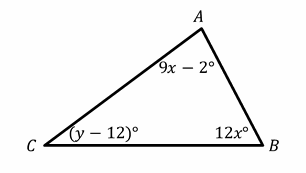
In the figure angle A is labeled \((9x-2)\) and it measures 43. Thus, \(9x-2=43\) and \(9x=45\) or \(x=5\). That means that angle B, which is labeled \((12x)\), must measure \(12×5=60\).
Since the three angles of a triangle must add up to 180, \(43+60+y-12=180\), then: \(y+91=180→y=180-91=89\)
38- Choice A is correct
??????? (????) \(= \frac{sum \space of \space terms}{number \space of \space terms}=\frac{8+12+15+15+8+14}{6}=12\)
39- Choice D is correct
The perimeter of the rectangle is: \(2x+2y=40→x+y=20→x=20-y\)
The area of the rectangle is: \(x×y=96→(20-y)(y)=96→y^2-20y+96=0\)
Solve the quadratic equation by factoring method.
\((y-8)(y-12)=0→y=8\) (Unacceptable, because y must be greater than 10) or \(y=12\)
If \(y=12 →x×y=96→x×12=96→x=8\)
40- Choice D is correct
The equation \(\frac{a-b}{2b}=\frac{5}{9}\) can be rewritten as \(\frac{a}{2b}-\frac{b}{2b}=\frac{5}{9}\), from which it follows that \(\frac{a}{2b}-\frac{1}{2}=\frac{5}{9}\), or \(\frac{a}{2b}=\frac{5}{9}+\frac{1}{2}=\frac{19}{18}.\)⇒\(\frac{a}{b}=\frac{19}{9}\)
41- Choice D is correct
\(Cosβ=\frac{Adjacent \space side}{hypotenuse}\), To find the hypotenuse, we need to use the Pythagorean theorem.
\(a^2+b^2=c^2→c=\sqrt{a^2+b^2}, cos (β)=\frac{a}{c}=\frac{a}{\sqrt{a^2+b^2}}, sec(β)=\frac{1}{cos (β)} =\frac{\sqrt{a^2+b^2 }}{a}\)
42- Choice B is correct
\(|\frac{2x}{3}-4x-6|<4.⇒-4<\frac{2x}{3}-4x-6<4\).Multiply both sides by 3. ⇒ \(-12<2x-12x-18<12\), and add 18 from all sides of the inequality. \(18-12<-10x-18+18<12+18⇒6<-10x<30\), Divide all sides by \(-10\). \(\frac{6}{-10}>x>-3\)
(Remember that when you divide all sides of an inequality by a negative number, the inequality sign will be swapped. < becomes >)
43- Choice D is correct
\(x\) is directly proportional to the square of \(y\). Then: \(x=cy^2
18=c(3)^2→18=9c→c=18/9=2\), The relationship between \(x\) and \(y\) is: \(x=2y^2
x=288, 288=2y^2→y^2=288/2=144→y=12\)
44- Choice B is correct
\(\begin{cases}2x+4y=6 \\x+3y=-20 \end{cases}\)
Multiply the second equation by \(-2\) then,
\(\begin{cases}2x+4y=6 \\-2x-6y=40 \end{cases}\)
Add two equations, \(-2y=46→y=-23\), plug in the value of y into the second equation, \(x+3y=-20→x+3(-23)=-20→x=49\)
Subtract 12 from both sides of the equation. Then: \(x+12=10→x=-2\)
45- The answer is 6
\(x+4y=\frac{-8y^2+12}{2x}\), Multiply both sides by \(2x\).
\(2x×(x+4y)=2x×((\frac{-8y^2+12}{2x})→2x^2+8xy=-8y^2+12
→2x^2+8xy+8y^2=12→2×(x^2+4xy+4y^2 )=12→x^2+4xy+4y^2=6
x^2+4xy+4y^2=(x+2y)^2, Then: →(x+2y)^2=6\)
46- The answer is 14.14
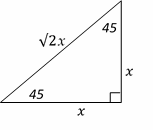
The relationship among all sides of special right triangle
\(45^\circ-45^\circ- 90^\circ\) is provided in this triangle: According to picture length of ladder is \(\sqrt{2} x⇒L=10\sqrt{2}=14.14\)
47- The answer is \(\frac{3}{2}\)
Let x be the length of an edge of cube, then the volume of a cube is: \(V=x^3\)
The surface area of cube is: \(SA=6x^2\), The volume of cube A is \(\frac{1}{4}\) of its surface area. Then:
\(x^3=\frac{6x^2)}{4}→x^3=\frac{3}{2}x^2\), divide both side of the equation by \(x^2\). Then: \(\frac{x^3}{x^2} =\frac{3x^2}{2x^2} →x=\frac{3}{2}\)
48- The answer is \(\frac{19}{12}\)
The intersection of two functions is the point with 3 for \(x\). Then:
\(f(3)=g(3) and g(3)=(3+2)=5\),
Then, (f(3)=5→a(3)^2+b(3)+c=5.⇒9a+3b+c=5) (i)
The value of x in the vertex of the parabola is: \(x=-\frac{b}{2a}→-3=-\frac{b}{2a}→b=6a\) (ii)
In the point \((-3, 11)\), the value of the \(f(x)\) is 11.
\(f(-3)=11→a(-3)^2+b(-3)+c=11→9a-3b+c=11\) (iii)
Using equations (i) and (iii): \(\begin{cases}9a+3b+c=5 \\ 9a-3b+c=11 \end{cases} \)
Equation 1 minus equation 2 is: (i)-(iii) →\(6b=-6→b=-1\) (iv)
Plug in the value of b in the second equation: \(b=6a →a=\frac{b}{6}=-\frac{1}{6}\)
Plug in the values of a and b in the first equation. Then:
\(9(-\frac{1}{6})+3(-1)+c=5⇒c=5+3+\frac{9}{6}=\frac{57}{6}=9 \frac{1}{2}\)
The product of a, b and c\(=(-\frac{1}{6})×(-1)×\frac{57}{6}=\frac{57}{36}=\frac{19}{12}\)
College Entrance Tests
The Best Books to Ace the PSAT Math Test
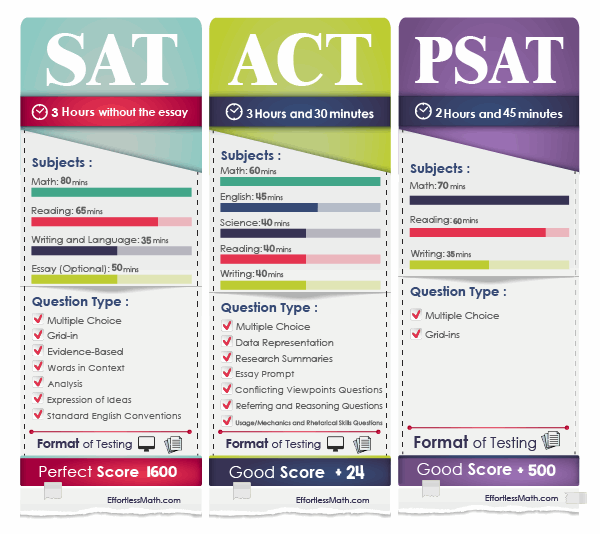
The Digital PSAT Math Section: Format and Timing
This practice set uses an older numbering, so here is how the current digital PSAT/NMSQT Math section is set up. For pacing, 44 questions in 70 minutes gives you about 95 seconds on each one. Keep that pace in mind when you take a full practice test.
| Item | Digital PSAT/NMSQT |
|---|---|
| Math questions | 44 |
| Time | 70 minutes |
| Structure | Two math modules |
| Calculator | Allowed on the whole Math section; a Desmos calculator is built into the testing app |
| Question types | Mostly multiple choice, plus some where you enter your own answer |
| Math score range | 160 to 760 |
| Total score range | 320 to 1520 |
How to Use an Answer Key to Raise Your Score
Checking answers is only half the work. The real gains come from understanding each miss.
- Mark every question first. Do not peek at answers until the whole set is done.
- Sort your misses. Was it a concept you did not know, a careless slip, or running out of time?
- Rework the problem. Close the explanation and solve it again from the start.
- Log the lesson. Write one line, such as “divide by the original amount for percent change.”
- Retest. A few days later, try similar problems and see whether the fix stuck.
Guesses you got right count too. If you were not sure, treat it like a miss and review it.
Frequently Asked Questions
How is the PSAT Math section scored?
Your number of correct answers is converted to a Math section score between 160 and 760. The Reading and Writing section uses the same scale, and the two add up to a total from 320 to 1520. There is no penalty for wrong answers, so answer every question, even if you have to guess.
What is the best way to practice for the PSAT?
Start with a full, timed practice test to see where you stand. Then study the topics you missed, one at a time, and redo those problems without help. Finish with another timed test closer to test day. Official College Board practice tests in the Bluebook app are the closest match to the real digital format.
Is a 980 a bad PSAT score?
Not necessarily. Whether a score is strong depends on your grade, your goals, and how much you have practiced. A 980 out of 1520 is a starting point you can raise with focused work. Compare it with the percentiles on your official score report, and use your missed questions to choose what to study next.
Can I use a calculator on these PSAT math questions, like on test day?
Yes, and you should. The digital PSAT/NMSQT allows a calculator on every Math question, and a Desmos graphing calculator is built into the testing app. An approved calculator of your own is fine too. Keep in mind that no calculator is allowed during the Reading and Writing section.
How is the PSAT math section set up?
There are 44 math questions on the digital PSAT/NMSQT, with 70 minutes to finish them. The questions come in two modules. Most are multiple choice, while some are open answer, where you work out the number and enter it. Use this practice test to try both formats.

Related to This Article
More math articles
- What does TSI Test Stand for?
- Advanced Vocabulary Words: Fantastic to Garrison
- How Many Questions Do You Need to Pass GED Math?
- 5th Grade GMAS Math Worksheets: FREE & Printable
- Free Grade 3 English Worksheets for Oregon Students
- GED Math Test-Taking Strategies
- The Best Grade 8 ELA Practice Tests for Delaware Students
- Civil War Turning Points: Major Campaigns and Their Consequences
- Free Smarter Balanced Grade 5 Math Worksheets — 49 Printable Single-Skill PDFs with Solutions
- How to Solve a Quadratic Equation by Completing the Square?





What people say about "PSAT Practice Test Answers: Math Explanations Step by Step"?
No one replied yet.