YOUR PSAT/NMSQT STUDY COMPANION
What Level of Math is Tested on the PSAT/NMSQT?
PSAT/NMSQT math is the same level as the SAT: algebra, advanced maths, problem solving and data analysis, and a small geometry and trigonometry section. It runs 44 questions in 70 minutes across two adaptive modules. Below: the share each area takes and what the calculator policy allows.
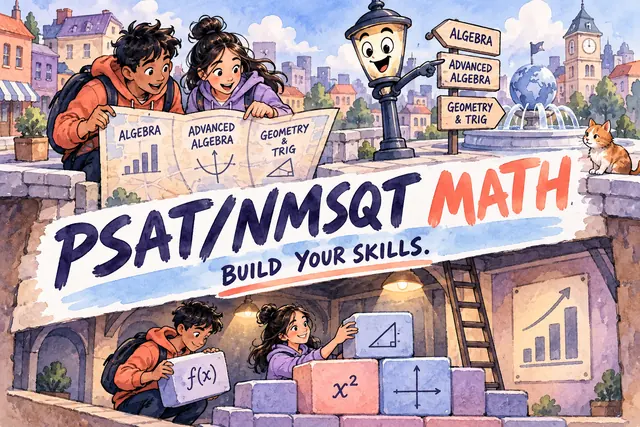
PSAT/NMSQT math is the same level as the SAT: algebra, advanced maths, problem solving and data analysis, and a small geometry and trigonometry section. It runs 44 questions in 70 minutes across two adaptive modules. Below: the share each area takes and what the calculator policy allows.
Quick answer: PSAT/NMSQT math is mostly Algebra 1 and Algebra 2 level, with some geometry and basic trigonometry. The highest topics are quadratic, exponential, polynomial, rational and radical equations, plus right triangle trigonometry. There is no calculus. The section has 44 questions in 70 minutes, and a calculator is allowed throughout.
What level of math is tested on the PSAT/NMSQT? But first off, what is the PSAT/NMSQT?
The PSAT/NMSQT is a nationwide and standardized test. It is designed for high school juniors to aid in college entrance exams and determine their eligibility for national merit scholarships.
You have 70 minutes to complete the math section, split into two 35-minute modules. It has 44 questions: most are multiple choice, and the rest ask you to type in your own answer.
You may use an acceptable calculator on the entire math section, and a graphing calculator is built into the Bluebook testing app. If you bring your own, choose one you already know well, not a brand-new calculator just for the test.
If you score in the top 3-4%, you are named a Commended Scholar. If you score in the top 1%, you become a Semifinalist. You can then apply to become a Finalist and possibly gain scholarships.
Even if you don’t ultimately get a National Merit scholarship, it will still look excellent on your college applications.
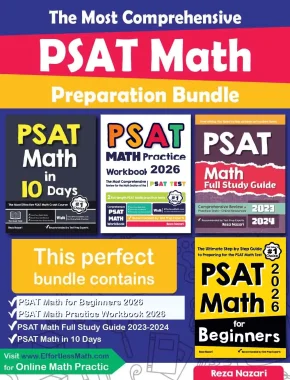
The Absolute Best Book to Ace the PSAT Math Test
ctions using various techniques.
To show complete knowledge of the topics, you will have to solve problems that vary in form and appearance. Some may be straightforward and just checking your understanding.
In contrast, others may challenge how you can use your knowledge, such as interpreting the connection between algebraic and graphical representations or solving as a process of reasoning.
To attain high marks, you will need to show both a skill in solving problems and a deeper understanding of the concepts of linear equations and functions.
Problem-Solving and Data Analysis (about 20% of the math section)
This section tests your skill in creating a representation of a problem, considering the units involved, showing the meaning of quantities, and using different properties of objects and operations.
Problems in this category will require a significant understanding of ratios, rates, and proportional relationships, and challenge your knowledge and ability to apply unit rates.
Identifying quantitative measures of the center is required. You will also need to understand overall patterns, including striking deviations, and spread in multiple data sets. Finally, you will need to recognize the effects of outliers on the measures of the center of data sets.
Best PSAT Math Prep Resource
Advanced Math (about 32.5% of the math section)
Passport to Advanced Math questions include topics that are important to understand before studying advanced math.
Most important is your understanding of the structure of expressions and your ability to analyze and modify them; this includes reasoning with more complex equations and interpreting and building functions.
Some specific areas to review include the area and perimeter of a polygon; the area and circumference of a circle; volume; Pythagorean theorem; isosceles, equilateral, and right triangles; parallel and perpendicular lines; coordinate geometry; slope; transformations
Geometry and Trigonometry (about 12.5% of the math section)
Additional topics will include geometric and trigonometric concepts, including data interpretation, statistics, mean, median, mode, and probability.
Final Thoughts
You will likely take the PSAT/NMSQT in October of 11th grade. However, you may ask to take it earlier for practice. You don’t get the full benefits from the test until you are a junior, such as scholarships.
While you should have learned everything during your classes, you should set aside time in the months preceding the test to study and prepare for the actual exam.
College Entrance Tests

PSAT Math FREE Resources:
- The Ultimate PSAT Math Course
- PSAT Math Formulas
- PSAT Math Worksheets
- Full-Length PSAT Math Practice Test
- FREE PSAT Math Practice Test
- Top 10 Free Websites for PSAT / NMSQT Math Preparation
The Best Books to Ace the PSAT Math Test
The four PSAT math domains and their weights
The digital PSAT/NMSQT and PSAT 10 test the same four domains. College Board gives these approximate shares:
| Domain | Approx. share | Main topics | Course level |
|---|---|---|---|
| Algebra | 35% | Linear equations, linear functions, systems of two linear equations, linear inequalities | Algebra 1 |
| Advanced Math | 32.5% | Equivalent expressions, quadratics, exponential, polynomial, rational and radical equations, nonlinear systems | Algebra 1 and 2 |
| Problem-Solving and Data Analysis | 20% | Ratios, rates, percentages, data distributions, scatterplots, probability, margin of error | Pre-algebra to Algebra 2, statistics |
| Geometry and Trigonometry | 12.5% | Area and volume, lines, angles and triangles, right triangle trigonometry | Geometry |
Algebra and Advanced Math together make up about two thirds of the section.
What is the highest level of math on the PSAT?
The hardest content sits in Advanced Math. You may need to rewrite a quadratic in vertex form, solve a system with a line and a parabola, interpret an exponential growth model or work with rational and radical equations. In geometry, the top topic is right triangle trigonometry: sine, cosine and tangent in a right triangle.
Compared with the PSAT 8/9, the PSAT/NMSQT adds right triangle trigonometry and inference from sample statistics with margin of error. Calculus is not tested.
The test is also adaptive. If you do well on the first module, the second module brings harder questions, so a strong grasp of Algebra 2 topics matters most for top scores.
Frequently Asked Questions
What level of math is on the PSAT?
PSAT/NMSQT math is mostly Algebra 1 and Algebra 2 level, with some geometry and basic right triangle trigonometry. The hardest questions involve quadratic, exponential, polynomial, rational and radical equations. There is no calculus. A student who has finished Algebra 1 and geometry and is partway through Algebra 2 has seen most of the content.
What areas of math are tested on the PSAT?
The math section covers four domains: Algebra, Advanced Math, Problem-Solving and Data Analysis, and Geometry and Trigonometry. Algebra and Advanced Math make up the largest share, so linear equations, systems, functions and quadratics deserve the most practice. Data questions cover percentages, ratios, rates, probability and reading tables and graphs.
Is the PSAT/NMSQT the same as the PSAT 10?
They have the same content, format and scoring. The difference is timing and eligibility: the PSAT/NMSQT is given in the fall to 10th and 11th graders and is the test used to enter the National Merit Scholarship Program, while the PSAT 10 is given in the spring to sophomores and does not count toward National Merit.
Is the PSAT/NMSQT the same as the SAT?
No, but they are closely related. Both test the same math domains with similar question types and adaptive modules. The PSAT/NMSQT is a bit shorter and is scored from 320 to 1520, while the SAT is scored from 400 to 1600. Because of that, PSAT math tops out at 760 and is pitched slightly below SAT level.
Can you take the PSAT/NMSQT in 9th grade?
Many schools let 9th graders take it, and it is useful practice for the math level you will see later. However, a 9th-grade score does not qualify you for National Merit recognition. For most students, only the score from junior year counts, so treat earlier attempts as a chance to find weak spots in algebra and data analysis.
How long is the PSAT/NMSQT test?
The digital PSAT/NMSQT takes about 2 hours and 14 minutes of testing time, plus a short break. Reading and Writing lasts 64 minutes, and the math section lasts 70 minutes, split into two 35-minute modules with 22 questions each. You can use an acceptable calculator for all 44 math questions.

Related to This Article
More math articles
- How to Use Box Multiplication Method
- The Best Grade 4 ELA Practice Tests for Mississippi Students
- Guess My Number Game — Higher or Lower Number Guessing
- Best Calculator For 8th Grade Students
- How to Help Your 4th Grade Student Prepare for the Florida FAST Math Test
- FREE 4th Grade PARCC Math Practice Test
- Limits on judicial power
- Slope Calculator (Free Step-by-Step Tool)
- How to Find Interval Notation
- Identify 3–Dimensional Figures







What people say about "What Level of Math Is on the PSAT? Topics by Domain"?
No one replied yet.