YOUR PSAT/NMSQT STUDY COMPANION
Free PSAT Math Practice: 20 Questions with Answers
Use these 20 free PSAT-style math practice questions with answers and worked explanations to find skills that need review. This is an unofficial, nonadaptive practice set, not a full-length digital PSAT/NMSQT simulation or a scaled-score predictor.
Use these 20 free PSAT-style math practice questions with answers and worked explanations to find skills that need review. This is an unofficial, nonadaptive practice set, not a full-length digital PSAT/NMSQT simulation or a scaled-score predictor.
How to use this short practice set
Work through the questions on paper before opening the answer section. Record any question you guessed or could not finish. Then compare your method with the explanation and redo missed questions without looking at the solution. Use your result to choose review topics; a score out of 20 does not convert directly into an official PSAT score.
For a full digital rehearsal, use College Board’s official practice tests in Bluebook. The PSAT/NMSQT Math section has 44 questions in two 35-minute modules. Its second module adapts to your first-module performance. This fixed set does not reproduce that structure. See College Board’s current Math section guide for the official format.
20 PSAT-style math practice questions
Answer the questions one at a time. Press Submit to see right away whether you were correct, along with a worked explanation. Your score appears after question 20, with a list of the questions to review.
Let the number of women should be added to the town be \(x\), then:
\(\frac{(528+x)}{550} = 1.2 → 528 + x = 550 × 1.2 = 660 → x = 132\)
The perimeter of the rectangle is:
\(2x + 2y = 30 → x + y =15→ x = 15 – y\)
The area of the rectangle is:
\(x × y = 50 → (15 – y)(y) = 50→ y^2 – 15y + 50 = 0\)
Solve the quadratic equation by factoring method.
\((y – 5)(y – 10) = 0→y = 5\)
(Unacceptable, because y must be greater than 5) or \(y = 10\)
If \(\space y = 10 →x × y = 50→x × 10 = 50→x = 5\)
sin\(β = \frac{opposite \space side}{hypotenuse}\)
To find the hypotenuse, we need to use the Pythagorean theorem.
\(a^2+b^2=c^2→c=\sqrt{(a^2+b^2 )}\)
sin\((β) =\ \frac{b}{c}= \frac{b}{\sqrt{(a^2+b^2 )}}\)
Combine like terms inside the absolute value:
\(\left|\frac{x}{2}-2x+10\right|=\left|-\frac{3x}{2}+10\right|\).
An absolute value less than 5 gives
\(-5<-\frac{3x}{2}+10<5\).
Subtract 10:
\(-15<-\frac{3x}{2}<-5\).
Multiply by \(-\frac{2}{3}\), reversing both inequality signs:
\(10>x>\frac{10}{3}\).
In increasing order, \(\frac{10}{3}<x<10\).
The intersection of two functions is the point with 2 for \(x\). Then:
\(f(2)=g(2) \space and \space g(2)=(2×(2))-3=4-3=1\)
\(Then, f(2)=1→a(2)^2+b(2)+c=1→4a+2b+c=1 (i)\)
The value of x in the vertex of the parabola is:
\(x=- \frac{b}{2a}→-2=- \frac{b}{2a}→b=4a \space (ii)\)
In the point (-2, 5), the value of the \(f(x)\) is 5.
\(f(-2)=5→a(-2)^2+b(-2)+c=5→4a-2b+c=5 (iii)\)
Using the first two equations:
\(4a+2b+c=1\)
\(4a-2b+c=5\)
Equation 1 minus equation 2 is:
\((i)-(iii) →4b=-4→b=-1 \space \space (iv)\)
Plug in the value of b in the second equation:
\(b=4a →a =\frac{b}{4}= – \frac{1}{4}\)
Plug in the values of a and b in the first equation. Then:
\(4 (-\frac{1}{4}) +2(-1)+c=1→-1-2+c=1→c=1+3→c=4\)
the product of a, b and c= \((-\frac{1}{4}) ×(-1)×4=1\)
Let \(L\) be the ladder’s length. The 30-foot ground distance is adjacent to the 60-degree angle, and the ladder is the hypotenuse.
\(\cos60^\circ=\frac{30}{L}=\frac12\), so \(L=60\) feet.
Let \(x\) be the length of an edge of a cube, then the volume of a cube is: \(V=x^3 \)
The surface area of a cube is:
\(SA=6x^2\)
The volume of cube A is \(1/2\) of its surface area. Then:
\(x^3 = \frac{6x^2}{2}→x^3=3x^2\)
divide both sides of the equation by \(x^2\). Then:
\(\frac{x^3}{x^2} = \frac{3x^2}{x^2} →x=3\)
Multiply both sides by \(x\).
\(x×(3x+6y)=x× (\frac{-3y^2+15}{x})→3x^2+6xy=-3y^2+15 \)
\(→3x^2+6xy+3y^2=15→3×(x^2+2xy+y^2 )=15→x^2+2xy+y^2= \frac{15}{3}\)
\(x^2+2xy+y^2=(x+y)^2, Then:\)
\(→(x+y)^2=5\)
Then; \(5x + 3 = 5 (4.5) + 3 = 22.5 + 3 = 25.5\)
Number of biology books: \(35\)
Total number of books; \(35+95+80=210\)
the ratio of the number of biology books to the total number of books is:
\(\frac{35}{210}= \frac{1}{6}\)
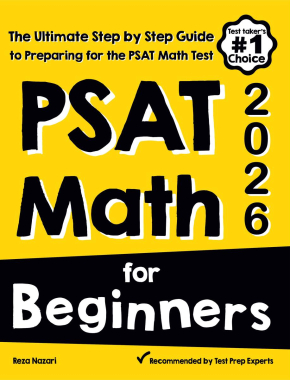
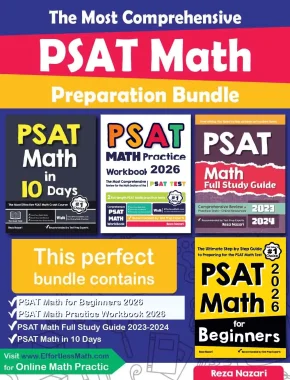
Need more practice? PSAT Math for Beginners 2027 covers PSAT math step by step, with practice problems and answers. Look inside · $17.99
\(α=180^\circ-112^\circ=68^\circ\)
\( β=180^\circ-135^\circ=45^\circ\)
\( x+α+β=180^\circ→x=180^\circ-68^\circ-45^\circ=67^\circ\)
A. \(f(x)=x^2-5 \space if \ x=1→f(1)=(1)^2-5=1-5=-4≠5 \)
B. \(f(x)=x^2-1 \space if \ x=1→f(1)=(1)^2-1=1-1=0≠5 \)
C. \(f(x)=\sqrt{(x+2)} \space if \ x=1→f(1)=\sqrt{(1+2)}=\sqrt 3≠5\)
D. \(f(x)=\sqrt{x}+4 \space if \ x=1→f(1)=\sqrt 1+4=5\)
\(xp+2yq=26→xp=26-2yq \space (1)\)
\(xp+yq=17 \space (2)\)
\((1) \space in \space (2) →26-2yq+yq=17→26-yq=17→yq=26-17=9\)
Let \(x\) be all expenses, then
\(\frac{22}{100}x =$660 →x= \frac{100×$660}{22}=$3000\)
He spent for his rent: \(\frac{27}{100}×$3000 = $810\)
And
\(n=-9a=-9×12=-108\)
\(\frac{1}{8}= 0.125→C=5\)
\(\frac{1}{20}=0.05→D=5→C×D=5×5=25\)
Let P be the circumference of circle A, then;
\(2πr_{A}=18π→r_{A}=9\)
\(r_{A} = 3 r_{B}→r_{B}= \frac{9}{3} = 3\)
→ Area of circle B is;
\(πr^2_{B}=9π\)
\(f(x)=x^2+2x-5\)
\(f(3t^2 )=(3t^2 )^2+2(3t^2 )-5=9t^4+6t^2-5\)
\(y\) is the intersection of the three circles. Therefore, it must be odd (from circle A), negative (from circle B), and multiple of 5 (from circle C).
From the options, only\( -5\) is odd, negative, and multiple of 5.
let \(x\) be the total number of marbles in the box, then the number of red marbles is: \(x – 132\)
\(p = \frac{1}{4}= \frac{x – 132}{x}\)
Use cross multiplication to solve for \(x\).
\( x=4(x-132)→x=4x-528→3x=528→x=176 \)
Quiz complete
Answers and worked explanations
Each worked explanation opens as soon as you submit that question, so you can compare your method with the solution while it is fresh. Press Try again on the last screen to work through the set a second time.
Optional PSAT workbook
Turn missed questions into a review plan
Group your mistakes by skill: equations and inequalities, functions, ratios and percentages, or geometry. Review one topic, attempt a few matching problems, then retry the original question. Use the PSAT Math hub for worksheets and lessons, or browse the PSAT practice collection for more practice choices.
If you prefer a workbook, inspect the sample on the PSAT Math in 10 Days product page to judge the level and format before purchasing. The free questions and explanations on this page remain available without a purchase.
Related EffortlessMath Lessons
If a topic on this practice test feels rusty, these short lessons go deeper:

Related to This Article
More math articles
- Top 10 6th Grade SBAC Math Practice Questions
- Top 10 8th Grade STAAR Math Practice Questions
- Variance Calculator
- Electron Transport and Chemiosmosis: How ATP Forms
- AI Detection Guide to Identify AI Writing vs Human Authors
- Bar Graph Maker: Make a Bar Chart Online from Your Data
- Earth’s Layers and Plate Tectonics
- South Dakota Smarter Balanced Grade 7 Math Worksheets: 95 Free Printable PDFs
- Best Calculators for Business: Graphing vs Financial Options
- 10 Most Common HSPT Math Questions




What people say about "Free PSAT Math Practice: 20 Questions with Answers"?
No one replied yet.