How to Graph Translations on the Coordinate Plane?
A translation slides a figure across the coordinate plane without rotating or resizing it. Every point moves the same distance in the same direction, so you add the same amount to each x-coordinate and each y-coordinate.
Translations on the Coordinate Plane, Example 1:
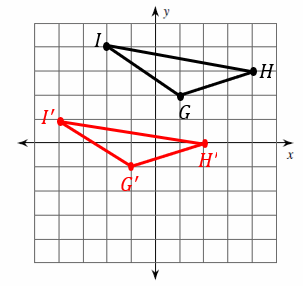
Translations on the Coordinate Plane, Example 2:
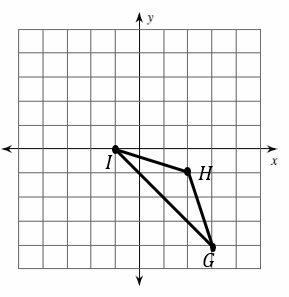
Translation: (4) units left and (3) units up.
Solution:
First, write the original coordinates of the points:
(I=(3, 0)) (G=(2, -4)) (H=(5, -2))
Use this coordinate notation for translating each point: ((x, y)→(x+a, y+b))
(4) units left →(a=-4)
(3) units up →(b=3)
Then: (I^prime=(-1, 3)) (G^prime=(-2, -1)) (H^prime=(1, 1))
Now, find new points on the coordinate plane and graph the new triangle by (I^prime, G^prime, H^prime) coordinates.
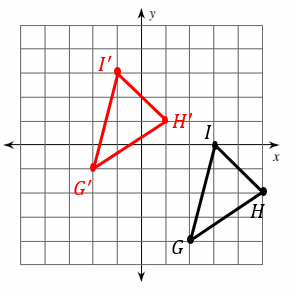
Exercises for Translations on the Coordinate Plane
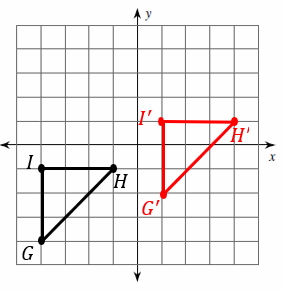
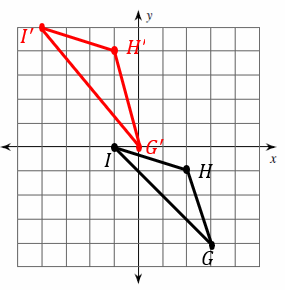
Graph the image of the figure using the transformation given.
1.Translation: (5) units right and (2) unit up.
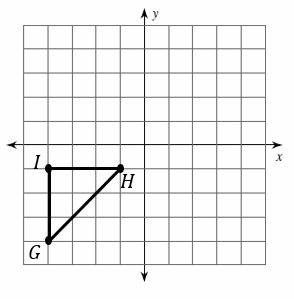
2.Translation: (3) units left and (5) unit up.


Original price was: $109.99.$54.99Current price is: $54.99.
Original price was: $109.99.$54.99Current price is: $54.99.

Related to This Article
More math articles
- Women’s Rights and Seneca Falls: Coverture, Suffrage and Reform
- Work, Pay, and Occupational Segregation
- Free Grade 7 English Worksheets for Georgia Students
- Watergate: Executive Power, Evidence and Reform
- 10 Most Common GED Math Questions [Updated for 2026]
- Homeostasis, Enzymes, and Nutrition
- 3rd Grade SBAC Math Practice Test Questions
- Major Body Systems and Organs
- Budget Laptops for Online Teachers: Compare 6 Options
- How to Graph Quadratic Functions?


What people say about "How to Graph Translations on the Coordinate Plane"?
No one replied yet.